
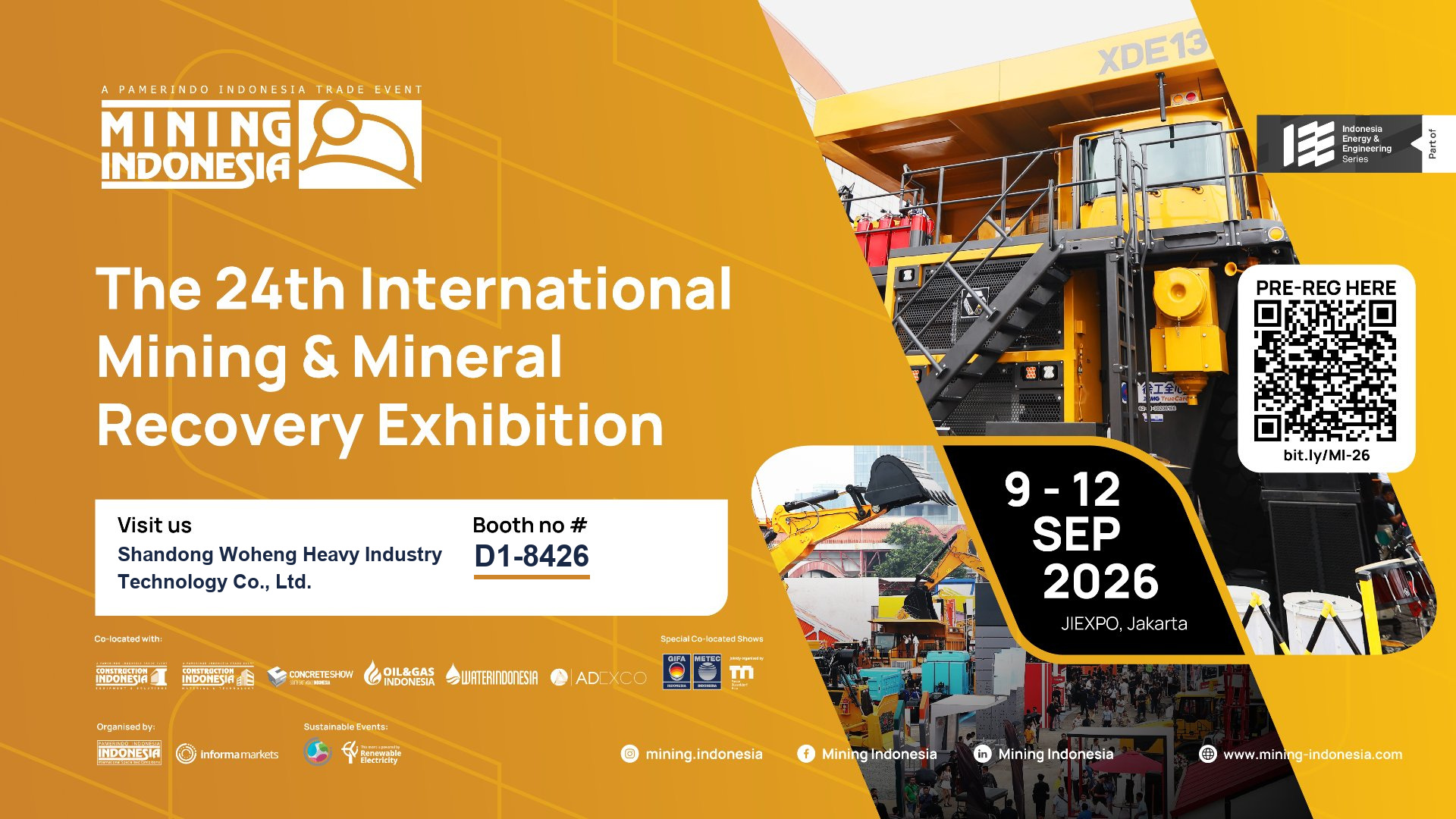
What we put in front of visitors was deliberately narrow: not a catalogue of machines, but one question — what happens to the slag left behind when coal is gasified, and how does a plant turn that stream into saleable product instead of a landfill line item? Shandong Woheng Heavy Industry Technology Co., Ltd. has spent a decade answering that question in China's coal chemical bases. Jakarta was the first time we answered it in Southeast Asia.
1. Why does a slag processing company exhibit at a mining show?
Because Indonesia's mining story has moved downstream, and downstream produces slag. Coal gasification slag processing is a problem that arrives about three years after a gasifier starts up — long after the EPC contract is signed and long after anyone budgeted for it.
The flagship case is Tanjung Enim in South Sumatra, where the national downstreaming project is designed to convert roughly 7 million tonnes of coal a year into 1.4 million tonnes of DME, a product worth about 4.3 times the same coal sold raw. Ground was broken on the Phase II project on 29 April 2026, with final investment decision targeted for 2027 and first commercial operation around 2030. The driver is structural: Indonesia's LPG demand is projected at close to 10 million tonnes in 2026 against domestic output of only 1.3–1.4 million tonnes.
Entrained-flow gasifiers do not burn that coal to nothing. Depending on ash content, a plant of that scale will generate on the order of 0.7–1.0 million tonnes of slag a year, split between coarse slag from the gasifier bottom and fine slag carried out with the syngas. Indonesian coals are low-rank and often higher in ash and moisture than the Chinese coals our equipment was first designed around, which makes the fine-slag stream harder to dewater and the carbon loss larger.
That is exactly the gap Woheng builds equipment for: coarse/fine slag separation, washing, dewatering and residual-carbon recovery, delivered as a plant rather than as individual machines.
2. What did visitors actually ask at booth D1-8426?
Four questions came up again and again — moisture, carbon, water, and who runs the plant afterwards. They are also the four numbers that decide whether a slag line pays for itself.
Gasification slag dewatering starts as a measurement problem
Most buyers arrive asking for "a filter press that gets cake to 30%". The honest answer is that mechanical dewatering has a physical floor set by bound water, and you cannot buy your way past it. The test takes a day: pull a vacuum filter cake and measure its moisture (M1), then centrifuge the same sample at 3,000 g for ten minutes and measure again (M2). M2 is the water no vacuum, belt or centrifuge will remove; M1 minus M2 is the free water your equipment can actually fight.
On Chinese gasification fine slag, M2 measures 43–45%. A membrane filter press there reaches 44.70% — not a tuning failure, but the material telling you where the wall is. Coarse slag behaves differently and drops below 30% without heroics.
|
Stream |
Moisture after typical dewatering |
What it decides |
|
Coarse slag (gasifier bottom) |
10–18% |
Directly saleable as aggregate or sand substitute |
|
Fine slag — vacuum belt |
~69% |
Trucking cost dominates; product has no market |
|
Fine slag — centrifuge |
~51% |
Still wet enough to cake or freeze in the silo |
|
Fine slag — membrane filter press |
~44.7% |
Bound-water floor; needs thermal or blending route |
Carbon pays for the water
Residual carbon in gasification slag runs 15–30% by mass, and it is the only part of the stream that generates revenue rather than cost. Our flotation and gravity circuit lifts it to a 60–65% carbon concentrate that returns to the boiler or the briquette line. On a plant handling a million tonnes of slag a year, recovered carbon frequently covers the operating cost of the whole washing section — which is why we open with carbon, not moisture.
Water closed-loop design, reagent consumption and spare-part logistics were the practical questions from operators rather than owners. Indonesian sites sit further from a service base than Chinese ones, so overseas layouts keep wear parts standardised and pump skids modular. ✅ Bottom line: measure bound water before specifying equipment — no dewatering machine beats it, so the process route has to be chosen around it.
3. Who did we meet in Jakarta?
Three groups, and each left with a different next step.
- New Indonesian customers — mining and coal-processing companies that signed with our team during the show for slag washing and dewatering scope, with sample testing as the first deliverable.
- Potential and new prospects — nickel and coal operators, IPP owners and EPC contractors who arrived at D1-8426 with a tonnage and a problem. Several asked for layout drawings and budget pricing on the spot; those requests are now in the engineering queue.
- Existing and prospective clients — long-standing partners from Indonesia and neighbouring markets invited for face-to-face technical reviews, plus first-time buyers who wanted equipment references before a site visit.
The quieter work mattered too: Woheng branding ran across signage, catalogues and screens in front of Southeast Asia's mining decision-makers for four days, in a hall that drew 28,762 trade attendees from 39 countries at the previous edition.
4. What happens after the show?
Follow-up is running on three tracks: sample testing, site visits and local service. Every serious enquiry from D1-8426 was logged with a tonnage, a slag type and a target moisture, and each now has an owner and a date.
- Sample testing — Indonesian coarse and fine slag samples are shipping to our laboratory for M1/M2 bound-water testing, carbon content and particle-size analysis. The report returns a recommended route and a cost per tonne, not a quotation.
- Site visits — engineering visits to South Sumatra and Kalimantan are being scheduled for the first half of 2027, timed to projects moving from FID into construction.
- Local support — we are evaluating a regional service and spare-parts arrangement so commissioning does not depend on a flight from Shandong.
We will return to Mining Indonesia in 2027 with the same message the booth carried at D1-8426: slag is not a waste problem, it is an unprocessed product.
FAQ
Q: What is coal gasification slag and why does it need processing? A: It is the mineral residue left after coal is gasified to syngas — coarse slag from the gasifier bottom, fine slag carried out with the gas. It typically holds 15–30% residual carbon and arrives at 50–70% moisture, so it cannot be sold or safely stacked without washing, dewatering and carbon recovery.
Q: Can you test our slag before we commit to a line? A: Yes. Send 20–50 kg of each stream and Woheng returns a bound-water (M1/M2) result, carbon content, size distribution and a recommended process route with projected cost per tonne — before any equipment is specified.
Q: Do you support projects outside China, including Indonesia? A: Yes. Shandong Woheng Heavy Industry Technology Co., Ltd. delivers complete slag washing plants — design, manufacture, installation supervision and commissioning — for Southeast Asian projects, with remote diagnostics and scheduled site support after handover.
Send us your slag sample
If your project will produce gasification slag within three years, the cheapest decision available now is a measurement. Send 20–50 kg of coarse and fine slag to Woheng and we will return a bound-water and carbon report, a recommended flowsheet and an operating cost estimate per tonne, free of charge for qualified projects. Mention booth D1-8426 in your enquiry to reach the engineers who staffed the Jakarta stand.