No — not automatically. GB T 2423 vs IEC 60068 report equivalence for export is a technical yes and a commercial "only when you can prove it."
China's GB/T 2423 series was drafted as identical or modified adoptions of the IEC 60068 family. Conditions, severities and durations are transcribed, not reinvented. What gets a report rejected at a border inspection is rarely the method — it is an accreditation scope that omits humidity, a uniformity map past its twelve-month date, or a signed certificate with no raw-data trail behind it.
Since 2005, Jiuhuan Fuqi has built environmental chambers for export-facing laboratories. Hangzhou Jiuhuan Fuqi Industrial Co., Ltd. ships both catalog and OEM configurations to labs in ten-plus countries. Below: the full equivalence map, the five records an auditor actually checks, and how a China factory closes the gaps before a shipment is held.
1. Is GB/T 2423 technically identical to IEC 60068 — and where do reports actually fail?
They map one-to-one on paper; a wrong method-to-mechanism match causes most rejections. The Chinese standards are transcriptions of their IEC counterparts, so the number on the cover is rarely the problem. The problem is a lab running a cyclic condensation profile, labelling it "damp heat," and submitting it against a steady-state requirement — or quoting a chamber spec measured at 25 °C / 50 % RH as proof of a 40 °C / 93 % RH run.
|
Chinese method |
IEC equivalent |
Exposure condition |
Dominant failure mechanism |
|
GB/T 2423.1-2008 (Test A) |
IEC 60068-2-1 |
-40 / -65 °C, cold soak |
Low-temperature embrittlement, seal shrinkage |
|
GB/T 2423.2-2008 (Test B) |
IEC 60068-2-2 |
+150 / +200 °C, dry heat |
Thermal ageing, lubricant breakdown |
|
GB/T 2423.3-2016 (Test Cab) |
IEC 60068-2-78:2012 |
40 °C / 93 % RH, steady, 10 / 21 / 56 days |
Moisture absorption and diffusion, no condensation |
|
GB/T 2423.4-2008 (Test Db) |
IEC 60068-2-30:2005 |
12 h + 12 h cycles, 25 ⇄ 40 °C, forced condensation |
Surface condensation, coating delamination |
|
GB/T 2423.22 (Test N) |
IEC 60068-2-14 |
Na two-zone / Nb single-zone ramp |
Thermal shock fatigue, solder joint cracking |
|
GB/T 2423.34 |
IEC 60068-2-38 |
Composite temperature-humidity cycling |
Combined thermal and hygroscopic fatigue |
|
GB/T 5170.5-2016 |
No test-method twin — apparatus verification only |
Chamber inspection and calibration rules |
Proves the equipment, not the specimen |
That is the practical answer to GB T 2423 vs IEC 60068 report equivalence for export: the conditions match, but the report must name both editions and the apparatus basis. Cab holds one condition for weeks so moisture diffuses into the bulk material. Db deliberately drives the specimen through the dew point twice a day so water condenses on surfaces. A conformal coating can survive 56 days of Cab and fail within six Db cycles — which is why the method choice decides your chamber configuration, not just your paperwork.
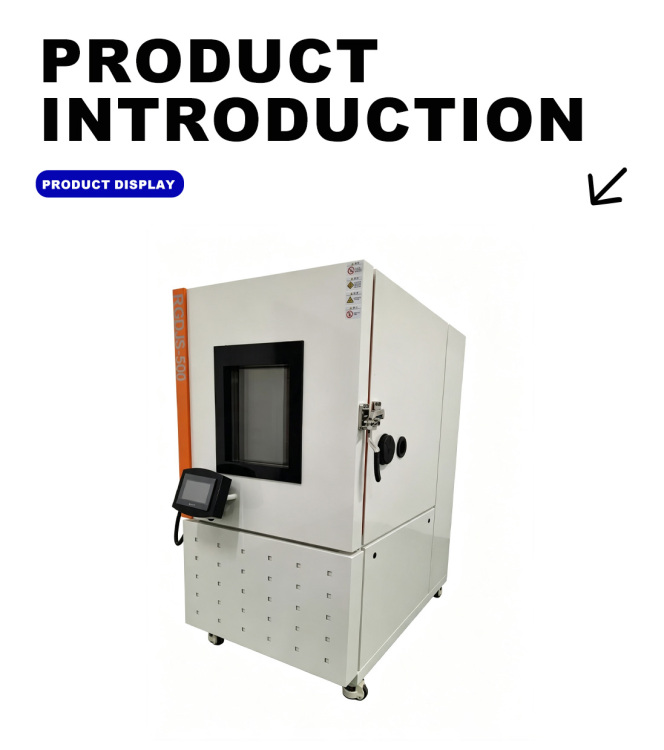
Steady-state exposure demands humidity uniformity within a few percent across the whole working volume for hundreds of hours. A Constant Temperature and Humidity Test Chamber rated at 85–98 % RH with ≤2 °C temperature uniformity and ≤3–4 % RH humidity uniformity is the usual baseline; Jiuhuan Fuqi builds these in seven working volumes from 400 × 450 × 550 mm up to 1000 × 1500 × 1000 mm. Ask a supplier for the uniformity figure at 40 °C / 93 % RH specifically — a sheet quoting performance at 25 °C / 50 % RH proves nothing about a Cab run.
One more trap: GB/T 5170.5-2016 is an equipment verification standard, not a test method. Overseas reviewers often have no equivalent in their own system and treat it as an unexplained extra. Attaching it as the inspection basis alongside the test method usually removes the question. For large assemblies or coupled climate-plus-mechanical programmes, a Multi-function Climatic Environment Test Room adds CO₂ / SO₂ / NOₓ dosing, rainfall, UV and a two-trolley 2-ton loading frame — and every added subsystem adds its own calibration record to the file.
✅ Bottom line: The standards are equivalent; a wrong method-to-mechanism match and an unverified chamber are what sink an otherwise valid report.
2. What does an overseas auditor check before accepting a Chinese test report?
Five records — and none of them is the standard number. When a quality manager asks whether a report will survive an overseas audit, these are the documents they are actually graded against:
|
Rejection reason |
What the auditor expects |
How to close it |
|
Calibration not traceable |
ISO/IEC 17025 certificate with ILAC MRA mark, ≤12 months old |
Scope must list both temperature and humidity channels |
|
No spatial uniformity evidence |
Nine- or fifteen-point mapping per IEC 60068-3-5 |
Record sensor positions, empty and loaded states, mapping date |
|
Summary page only |
Continuous raw log with timestamps and sampling interval |
Export the controller archive, including alarms and door-open events |
|
Unexplained drift |
Drift budget or recalibration record |
Uncalibrated for 12 months can reach ±1.5 °C at 150 °C and ±3 % RH at 85 % RH |
|
Method statement ambiguous |
Both editions named, plus apparatus verification basis |
State GB/T 2423.3-2016 ≡ IEC 60068-2-78:2012 and cite GB/T 5170.5-2016 |
Start with environmental chamber calibration ISO 17025 NIST traceable documentation — the certificate must cover the humidity channel, not just temperature. The documents needed for damp heat report overseas audit then extend to a recent uniformity map, a continuous raw-data trail, a drift record and a method statement naming both editions. Jiuhuan Fuqi ships a calibration and mapping dossier with each unit, and our engineering team extends it to custom ODM projects where a customer's own quality system dictates the record format.
Two field details cause a surprising share of failures. Humidification water should be deionized below 5 µS/cm; tap water scales the steam generator and drifts the wet-bulb reading mid-run. Specimens need at least 50 mm clearance from the air outlet, because a sensor in the direct airflow reports conditions the sample never saw. Replace the wick around every 500 running hours on wet-bulb systems.
Scope changes the paperwork load again. Coastal and offshore qualifications are stricter: an Artificial Marine Environment Test Room combines 3–5 % salt mist at 5–10 µm droplet size with humidity and temperature cycling, so the audit file must also demonstrate traceability for brine concentration and the 150–250 L/h flow rate. A practical rule from our export projects: build the evidence pack before the test starts. Retrofitting a nine-point map onto a completed 1,000-hour run is not possible.
✅ Bottom line: Acceptance hinges on traceable calibration, a recent uniformity map and continuous raw data — not on rewriting a GB/T report as an IEC report.
FAQ
Q: Is GB T 2423 vs IEC 60068 report equivalence for export accepted by EU and Southeast Asian auditors? A: Usually yes, because the Chinese editions are identical adoptions and CNAS is an ILAC MRA signatory. Check the accreditation scope rather than the logo: it must list the specific damp heat method and the measured ranges. A lab accredited only for dry heat cannot issue a defensible 40 °C / 93 % RH certificate.
Q: What does environmental chamber calibration ISO 17025 NIST traceable actually require from a supplier? A: A certificate from an accredited body, issued within twelve months, whose scope explicitly covers both temperature and humidity over your test range. As a China manufacturer quoting direct, Jiuhuan Fuqi includes this dossier as standard and can align formats to your quality system — no trading intermediary involved.
Q: Which of the documents needed for damp heat report overseas audit are most often missing? A: The continuous raw log and the spatial uniformity map. A signed certificate alone is not enough; auditors want timestamped data, sensor positions, empty and loaded states, and a drift or recalibration record. Wholesale documentation packages for distributors are available on request.
Get a free audit-readiness evidence checklist
Send Jiuhuan Fuqi your target standard, chamber volume and destination market. Our engineers return a one-page checklist of the calibration, mapping and raw-data records an auditor will ask for, plus a custom OEM configuration if your programme needs coupled stresses or non-standard working dimensions. Hangzhou Jiuhuan Fuqi Industrial Co., Ltd. — environmental test equipment since 2005, Hangzhou headquarters and Shanghai production base, exported to 10+ countries.
Phone: +86 181 4348 1978
Email: [email protected]
Website: www.jiuhuan-chamber.com