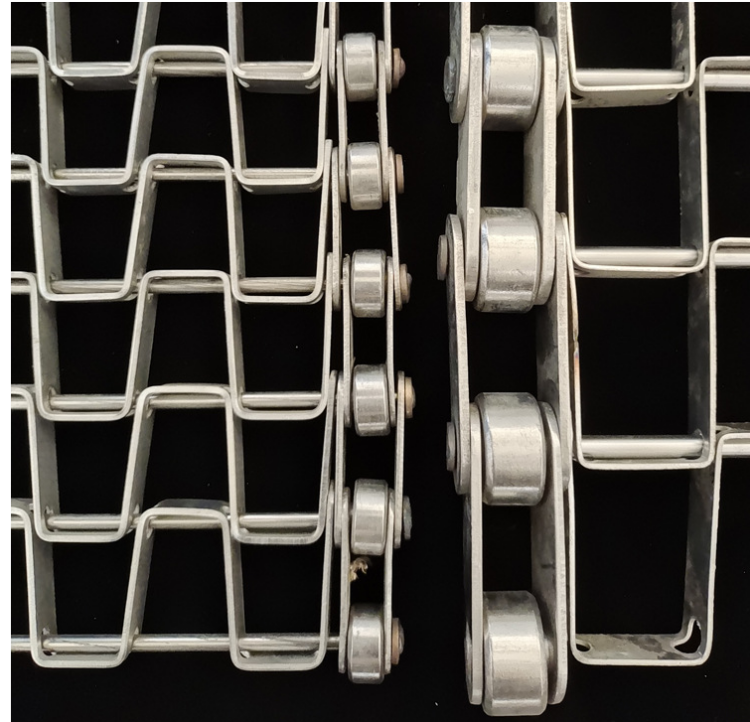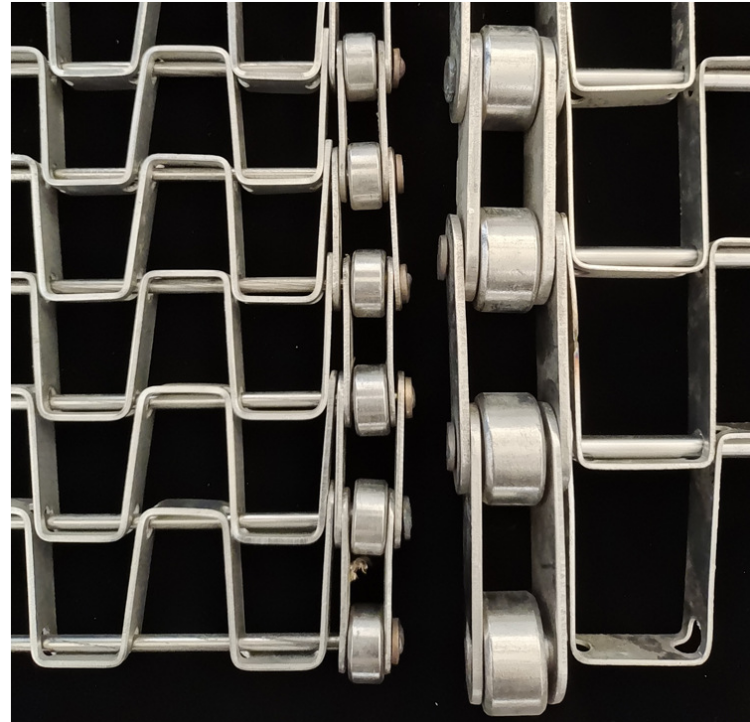
A round wire belt relies on point contact. When the metal gets hot and softens, those tiny contact points can leave permanent marks on the product, especially with glass, metal parts, or delicate ceramics. Worse, round wires have a smaller surface area for heat transfer. They create localized hot spots where the product touches the wire, while the gaps remain cooler.
A Flat Wire Belt solves this by offering surface contact instead of point contact. The flat top surface provides a stable, continuous platform. This even distribution prevents the product from sagging or warping under high heat. The flat profile also offers superior thermal conductivity, pulling heat evenly across the bottom of the product to eliminate temperature gradients.
You see this principle in different mesh designs. A Honeycomb Belt uses a similar flat, interlocking structure to provide excellent support for heavy loads and maximize airflow, though its complex pattern can sometimes trap smaller particles. Meanwhile, a Flat Flex Belt is highly flexible and great for spiral freezers or washdown, but its linked spiral design still relies on round rod contact.
For extreme temperature applications where flatness and surface quality are non-negotiable—like sintering or glass annealing—the flat wire design is the clear winner. When sourcing, don't just ask for a high-temperature alloy. Check the belt profile. The geometry of the contact surface determines the quality of your final product.