

1. What Does an Axial Gradient Actually Do During Cure?
It runs two cure reactions at once. Epoxy kinetics follow Arrhenius behavior — every 10°C drop roughly halves the reaction rate — so the cold end of the tank gels later, converts less, and ends up a softer laminate than the hot end.
Put numbers on it. Typical winding epoxies carry an activation energy of 60-80 kJ/mol, which makes the rate penalty brutal: a 3°C cold spot runs roughly 20% slower than setpoint, a 6°C cold spot about 35% slower. On a fixed schedule — say 120 minutes at 130°C, the standard Type III/IV vessel cycle — a hot end reaching 96% degree of cure typically lands near 90% at a 6°C cold end, depending on the resin. Conversion gaps of that size are the core of why temperature gradient ruins composite pressure vessel cure:
|
Axial gradient |
Reaction rate penalty |
Conversion gap |
Tg gap along vessel |
Field consequence |
|
±1.5°C |
~10% |
<2% |
2-3°C |
inside process margin |
|
±3°C |
~20% |
3-5% |
5-8°C |
service margin eroded |
|
±6°C |
~35% |
8-12% |
10-15°C |
burst scatter, delamination risk |
Three failure paths follow, and none of them show up on a visual check:
- Tg shortfall. Glass transition temperature scales with degree of cure, so the cold dome can sit 10-15°C below the datasheet value — exactly the margin the vessel needs at 70 MPa service temperature.
- Residual stress. The two ends gel at different times, then cool through the same shrinkage range with different moduli. The mismatch locks hoop residual stress into the barrel and spring-in into the domes; work from the University of Bristol and QinetiQ has long identified residual stress as the main driver of delamination in thick laminates.
- Scatter, not shift. Parts from the same oven batch burst ±8-10% apart instead of ±3-4%, and the qualification report quietly documents an unreliable process.
Axial direction deserves the emphasis. Radial gradients on a rotating mandrel can be averaged out by turning the part, but an axial gradient moves with the part — every cross-section stays at its own temperature for the whole soak. That is why temperature gradient ruins composite pressure vessel cure in a way rotation, vacuum or better resin cannot repair: the damage is positional, and it survives into the finished vessel.
✅ Bottom line: Every degree of axial gradient converts directly into Tg and residual-stress spread along the vessel; ±1.5°C keeps that spread inside process noise.
2. How Do You Hold ±1.5°C Along a 4-6 Meter Tank?
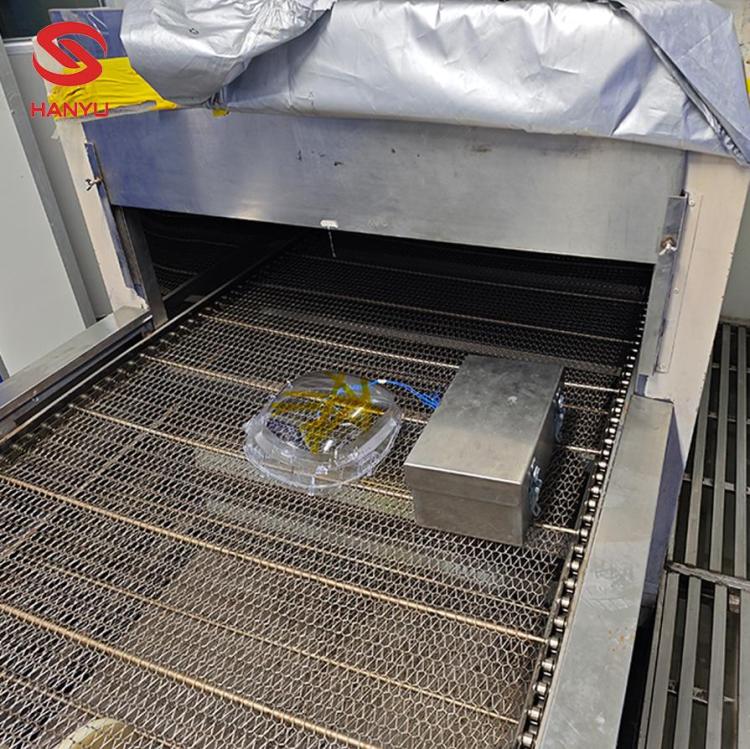
One independent zone per roughly two meters, each with its own heating circuit, circulation fan and damper, trimmed against part thermocouples — a single plenum with three sensors cannot hold the number.
The zone architecture behind a multi zone hot air circulation oven composite curing accuracy claim matters more than the claim itself — it is what turns written axial temperature uniformity requirements filament wound tank curing oven specs into measured reality. In a one-plenum chamber, air takes the path of least resistance: the door-end band loses heat to the frame, the discharge band runs hot, and the middle coasts. Independent zones let the controller pay each deficit separately:
|
Tank length |
Independent zones |
Airflow design |
Achievable loaded uniformity |
|
≤2 m |
1, with door-end compensation |
axial duct |
±3°C |
|
2-4 m |
2-3 |
axial, isolated plenums |
±2°C |
|
4-6 m |
3-4 |
axial + radial trim, per-zone fans |
±1.5°C |
|
>6 m |
4-6 |
axial + radial, survey ports per zone |
±1.5°C, surveyed |
Three details decide whether the table holds in production:
- Control accuracy below uniformity. If the controller itself wanders ±2°C, a ±1.5°C zone spec is fiction. PID with fuzzy-logic trim holding ±1°C at the sensor is the realistic pairing — the uniformity budget has to absorb sensor drift, load mass changes and door openings and still close.
- Rotation handles the circumference, zones handle the axis. Turning the mandrel averages the radial spread, as covered in our rotating-mandrel curing guide; the axial spread is the one only zoning can fix.
- Loaded, surveyed, logged. Uniformity quoted empty flatters the design. Insist on a temperature uniformity survey run with a loaded mandrel, part thermocouples logging through the full cycle, and the report handed over as an acceptance document. Every multi zone hot air circulation oven composite curing accuracy figure should arrive as loaded, surveyed and logged — or it is a chamber-air number wearing a part-quality costume.
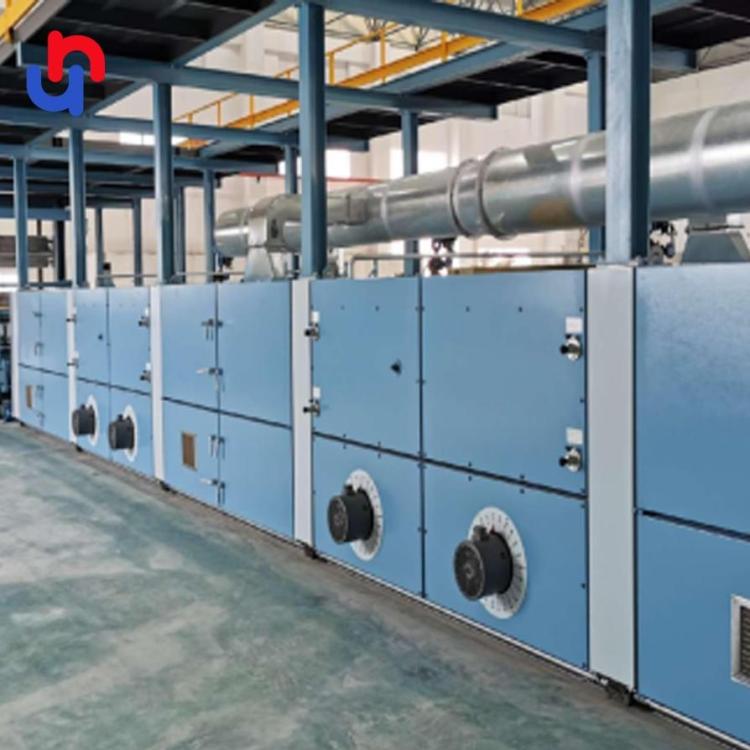
Suppliers who skip the survey usually cannot produce it. When a China manufacturer quotes a wound-tank oven, ask for the loaded survey report, the controller and blower brands by name, and the zone count for your specific tank length. HanYu builds 3-4 zone chambers for 4-6 m tanks with independent axial and radial circulation, ±1.5°C loaded uniformity and ±1°C PID plus fuzzy-logic control accuracy, and runs the loaded survey before shipment as standard.
✅ Bottom line: One zone per two meters with sub-degree control accuracy is what makes ±1.5°C real; the proof is a loaded survey report, not a datasheet.
FAQ
Q: Is ±3°C good enough for wound pressure vessels? A: For aerospace-benchmarked work, ±3°C surveyed is the floor — AMS2750-class practice tolerates ±3°C (±5°F) and expects it verified under load. Structural wound tanks can live there if the cure schedule was qualified at that band. For Type IV hydrogen vessels the band tightens to ±1.5°C because the plastic liner deforms before the resin gels, which is why the axial temperature uniformity requirements filament wound tank curing oven specs for hydrogen service are written one grade tighter than aerospace oven standards.
Q: How is axial uniformity verified before we accept the oven? A: A three-step survey: empty-chamber grid per zone to baseline the design, a loaded run with the production mandrel in place, and part thermocouples logged through a complete cure cycle. The acceptance package should include the zone-by-zone spread, not just a single chamber average — HanYu ships that report as standard. Our earlier Type IV temperature requirements guide lists the survey terms to write into the RFQ.
Q: Can you build a zoned oven to our tank dimensions and resin schedule? A: HanYu builds to drawing: zone count and layout are set from tank length and the cure schedule, with chamber dimensions, heating rates and vacuum port arrangement customizable per project. Suzhou Hanyu Automation Equipment Co., Ltd. quotes chamber, controls, installation supervision and spares as one package from the Suzhou factory, with OEM or ODM branding available for line integrators, and ships with the loaded uniformity survey as an acceptance document.
CTA: Send Your Tank Length and Cure Schedule
Email tank length, outer diameter, wall thickness and resin system, and the HanYu engineering team will return a zone layout, a loaded-uniformity commitment and an indicative factory price within two working days. Enquiries answered in 2 hours, 48-hour on-site attendance domestically, spares for life.
|
|
|
|
Published: November 2026 |
By HanYu Engineering Team |