
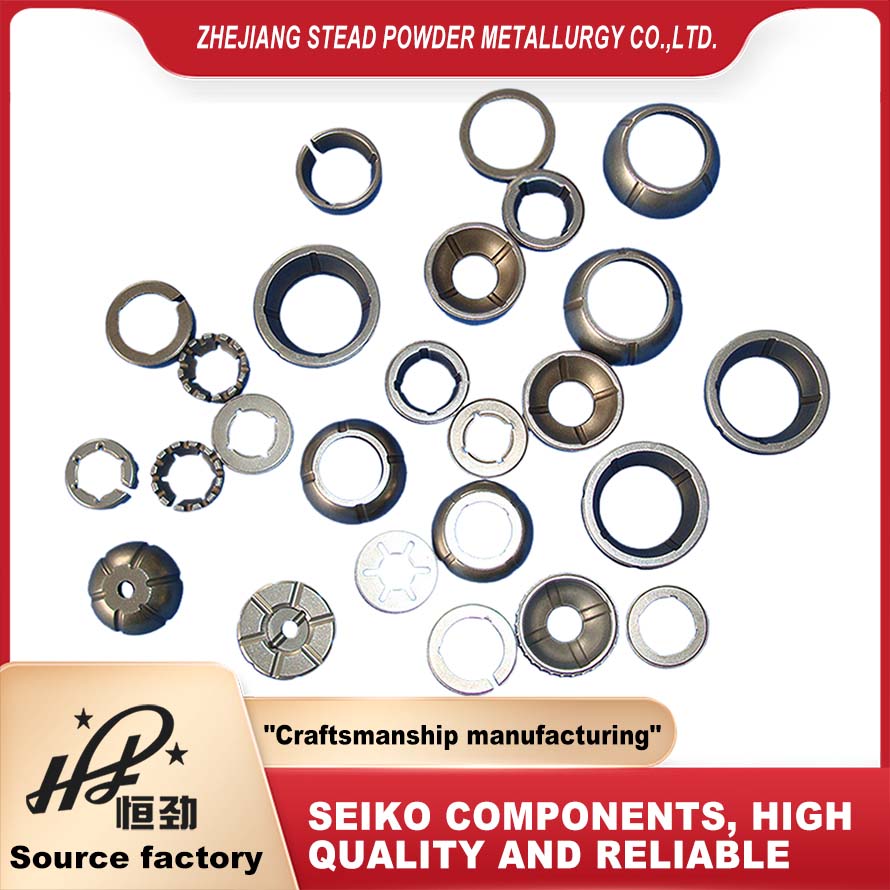
That distinction matters commercially. Replacing rods without fixing the cause produces a repeat claim six months later, and in damper or cylinder warranty analysis the same six mechanisms account for most field failures. This breakdown covers the six, the rod specification that prevents them, and how to buy the surrounding Durable Piston Rod Accessories as one qualified set rather than four unmatched lots.
sitaide, the export brand of Zhejiang Stead Powder Metallurgy Co., Ltd., supplies guide rings, pistons, valve seats and ball seats into damper and cylinder production, so the numbers below reflect what actually shows up on incoming inspection.
1. Why Does a Piston Rod Score at the Guide Instead of the Seal?
Because the guide is where the side load lands. Axial force passes through the piston; radial force from strut angle, mounting compliance and hydraulic side load passes through the guide ring and into the rod. That is the contact pair that generates the debris, the heat and the wear track.
The six mechanisms, in order of frequency
- Wiper failure first, scoring second. A hardened or torn wiper lets road grit past the seal. Those particles embed in the guide ring and machine the rod on every stroke. Spiral scoring is the signature.
- Rod too rough. Above Ra 0.8 µm the asperities act as a lap and polish the ring's bore away, which then increases clearance, which then tilts the rod.
- Rod too smooth. Below Ra 0.1 µm there is no film to carry oil, so the ring runs boundary-lubricated and glazes. Counter-intuitively, a mirror finish shortens guide life.
- Insufficient case depth. Under 1.2 mm of case, a side impact brinells the rod surface. The raised lip then scores the ring bore and the seal lip.
- Chrome spalling at the guide edge. Poor adhesion or an unbroken edge radius lets the plating lift exactly where contact pressure peaks.
- Misalignment. A bent rod, a collapsed top mount, or a housing whose guide bore is not concentric with the seal bore within 0.02 mm TIR. The ring then carries load on one arc instead of the full circumference.
The rod specification that prevents most of it
|
Parameter |
Target |
What fails if you miss it |
|
Surface hardness |
≥ 50 HRC, case 1.2–2.5 mm |
Brinelling, then ring scoring |
|
Surface finish |
Ra 0.2–0.8 µm |
Below 0.1 µm glazing; above 0.8 µm ring wear |
|
Hard chrome |
20–30 µm, edge radius broken |
Spalling at the guide edge |
|
Straightness |
≤ 0.15 mm per 300 mm |
One-sided loading, oval ring wear |
|
Roundness / ovality |
≤ 0.01 mm |
Local clearance collapse and hot spots |
|
Guide bore concentricity |
≤ 0.02 mm TIR to seal bore |
Extrusion gap opens on one side |
✅ Bottom line: fix the wiper and the rod finish before replacing the guide — the scoring is a symptom, and a new rod in a dirty gland scores identically.
2. Which Piston Rod Accessories Should You Buy as One Set?
Buy the guide, the seals and the powder-metal valving as a matched stack, because the tolerances interact. Guide clearance, seal groove depth and rod diameter form a single stack-up; sourcing them from three suppliers means three tolerance philosophies fighting each other in one bore.
For a damper or cylinder rebuild, the functional set is:
- Guide ring — sets radial position and side-load capacity.
- Rod seal — the pressure barrier, sized to the actual guide clearance.
- Wiper / dust seal — the part that decides whether items 1 and 2 survive.
- Buffer seal — absorbs pressure spikes before they reach the rod seal.
- Powder-metal internals — rebound valve support, compression valve seat, piston; these set damping consistency and are usually bought from the same sintering supplier as the guide.
The commercial logic is simple. When one factory produces the guide ring and the valve seat, the groove dimensions and material certificates come from one process sheet, and a dimensional drift shows up in one conversation instead of three. That is the practical meaning of Best Piston Rod Parts — not a marketing claim, but a stack that has been measured together.
What to check on a supplier before you consolidate
- Material traceability. Ask for the certificate behind the compound, not just the part number. Phenolic fabric and PA66-GF30 behave very differently at −30 °C.
- Tolerance capability. ±0.02–0.04 mm on ID/OD is the working benchmark for machined rings; a supplier who quotes ±0.1 mm is quoting a different product.
- Sampling discipline. First-article report, dimensional layout, and a documented change notification process — the difference between an OEM supply program and spot buying.
- One-stop scope. Guides, pistons, seats and supports from one source removes the mismatch risk that generates most rebuild comebacks.
For buyers running aftermarket kits, the same logic applies at a smaller scale: a wholesale pack of guides and seals matched to one rod diameter sells better than loose bins, because the installer cannot mix sizes. Custom ID, OD and thickness are the standard request for ODM suspension programs, and a factory with in-house compaction can turn a drawing into samples without a third-party tooling round.
Zhejiang Stead Powder Metallurgy Co., Ltd. operates a 25,500 m² plant in Sanmen County, Zhejiang, producing roughly 5,000 customer programs across shock absorber and engine components, and quotes custom guide rings and rod accessories from drawings at MOQ 1 for validation builds.
✅ Bottom line: consolidate the guide, seal and powder-metal internals with one supplier so the tolerance stack is measured as a set, not assembled from three guesses.
FAQ
Q: How much rod wear is acceptable before replacement? A: Measure the guide contact band, not the whole rod. A wear step over 0.01 mm deep, or ovality over 0.01 mm, justifies replacement — beyond that the ring cannot maintain clearance and the seal will extrude. Light polishing marks with no measurable step are cosmetic.
Q: Can I upgrade to a better guide ring without changing the rod? A: Sometimes. If the rod is within Ra 0.2–0.8 µm and holds hardness, moving from PA66-GF30 to phenolic fabric raises bearing capacity from roughly 40 to 50 N/mm² at 20 °C. If the rod is already scored, no compound survives — the groove acts as a cutting edge.
Q: Do you supply accessories in kit form for aftermarket programs? A: Yes. sitaide builds matched kits around a single rod diameter — guide ring, rod seal, wiper and buffer — and can add powder-metal valving for a complete rebuild set. Bulk and wholesale volumes ship with lot traceability, and custom packaging is available for distributor brands. Every kit is assembled from Best Piston Rod Parts lots measured against the same drawing.
CTA
Photograph the scoring pattern and the wiper, note rod diameter and duty cycle, and the sitaide engineering team will identify the likely mechanism, recommend a compound, and quote guide rings and matched accessories factory-direct. Samples from one piece; production with full dimensional and material documentation.
Whether you need OEM development, ODM kits or wholesale supply of Durable Piston Rod Accessories, sitaide handles the guide ring and the powder-metal internals under one roof — one drawing review, one tolerance stack, one shipment. Start at sitaide.com.