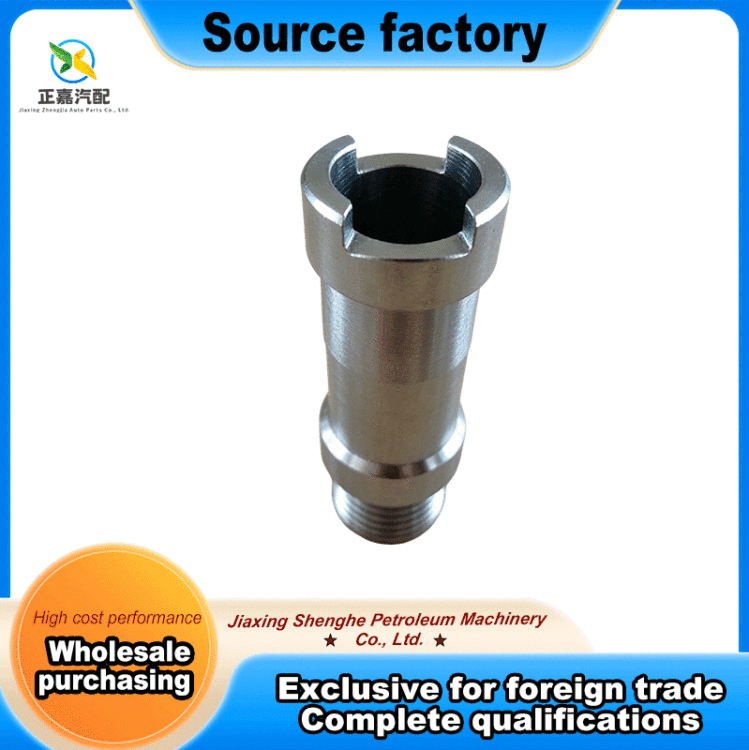
Roughly three out of four early shaft failures are not strength problems — they are fit, finish, or corrosion problems that a drawing could have prevented. A shaft that snaps at a keyway, a spline that wears 0.3 mm in eighteen months, a chrome rod that pits and tears its seal: none of these are solved by specifying a stronger steel. They are solved by controlling misalignment, micro-slip, coating integrity, and stress concentration.
This breakdown covers the five failure modes we see most often on shaft transmission parts in agricultural, hydraulic, and motor drive assemblies, and the specification changes that convert a short-life part into one of the Durable Transmission Solutions your customers stop complaining about.
1. What are the five real causes of early transmission component failure?
Misalignment, fretting at fits, corrosion-driven seizure, coating breakdown, and stress concentration account for the large majority of premature failures. Ranked by frequency in field returns:
|
Failure mode |
What you see |
Root cause |
Specification fix |
|
Fretting corrosion at bearing seat |
Rust-colored debris, shaft spins in inner ring |
Micro-slip of 10–30 µm under reversing load, insufficient interference |
Increase interference to 0.0005–0.001 × Ø, add retaining compound, Ra ≤ 0.8 µm seat |
|
Bending fatigue at keyway or shoulder |
Crack initiating at keyway end or fillet |
Stress concentration factor 2–3 at a sharp corner |
Fillet radius ≥ 0.15 × Ø at shoulder, radiused keyway end, shot peening |
|
Seal leakage from chrome rod |
Scoring, chrome spalling, seal lip wear |
Plating too thin at edge, unground finish, side-load deflection |
Chrome 25–40 µm, ground to Ra 0.2–0.4 µm, straightness 0.05 mm/m |
|
Thread seizure on tie rods |
Threads galled, nut will not release |
Corrosion in the thread root, no anti-seize allowance |
Trivalent zinc 8–12 µm plus passivation, or black oxide plus oil, thread class 6g |
|
Spline wear and backlash |
Audible clatter, angular play |
Inadequate lubrication, hardness mismatch, misalignment |
Case hardness 58–62 HRC on 20CrMnTi, backlash per DIN 5480, crown the tooth ends |
Fretting is the failure nobody specifies against
A bearing seat with 0.005 mm interference on a Ø30 shaft looks fine on paper and slips in service. Under reversing load, the shaft micro-slips inside the ring by 10–30 µm per cycle. The oxide debris that forms is harder than the parent steel and acts as an abrasive. Within a season the fit opens, the shaft spins, and the journal is destroyed.
The fix costs almost nothing at the drawing stage: interference at 0.0005–0.001 × diameter, a ground seat at Ra ≤ 0.8 µm, and a retaining compound on assemblies that see shock load. ZHENGJIA writes those three values onto the drawing for exactly this reason — it is far cheaper than a field campaign.
Corrosion is a thread-root problem, not a surface problem
Agricultural tie rods do not fail because the visible barrel rusts. They fail because water sits in the thread root, the nut seizes, and the operator cannot adjust steering geometry. Trivalent zinc at 8–12 µm with a proper passivation holds 96–200 hours of salt spray; black oxide at 1–3 µm holds almost none outdoors and belongs only on oiled, enclosed assemblies.
Stress concentration lives at the transition
A Ø40 shaft stepping to Ø30 has a theoretical stress concentration near 2.0 with a sharp internal corner. At 2,000 rpm under reversing bending, that corner is where the crack starts, not the middle of the span. A 6 mm fillet, a radiused keyway end, and a 0.2 mm shot peen on the transition typically buys two to three times the fatigue life at a few percent of part cost.
✅ Bottom line: Attack fretting at the fit, corrosion at the thread root, and stress concentration at the shoulder — three drawing changes that prevent most early failures.
2. How do you specify and verify quality transmission components that actually last?
Specify the failure mode you are designing against, then verify it with a measurement — not a certificate. Durability comes from matching four design levers to the dominant load case, then proving the result at incoming inspection.
The four design levers, in order of return on effort
- Geometry before metallurgy. Increase the fillet, remove the sharp keyway end, add a relief groove. Geometry changes cost nothing per part; material upgrades cost 15–30%.
- Surface integrity before bulk hardness. A ground Ra 0.4 µm seat with 0.2 mm of compressive stress from peening outlasts a harder but turned surface in nearly every fatigue application.
- Coating system before base material. For corrosive duty, 30 µm of hard chrome on 4140 at 30 HRC beats 420 stainless at 45 HRC on both life and cost, provided the chrome is ground after plating. ZHENGJIA builds hydraulic rods exactly this way — 4140 core, 28–32 HRC, 25–40 µm chrome, ground to Ra 0.2–0.4 µm.
- Alignment budget across the assembly. A coupling rated for 0.5° angular misalignment will not survive 1.2° caused by housing bore tolerances stacking up. Fix the stack, not the coupling.
Verify with these five measurements
- Total runout on V-blocks: 0.01 mm for motor shafts, 0.03 mm for general drive shafts. Check after heat treatment, not before.
- Hardness map: three points along the length and one at the case depth, per lot. A single Rockwell reading at the end face proves nothing about the journal.
- Coating thickness by gauge: chrome 25–40 µm at the sealing band, zinc 8–12 µm at the thread root, both checked at the thinnest geometric point.
- Salt spray to the relevant standard: 96 hours minimum for outdoor agricultural parts, 200+ for washdown duty.
- Magnetic particle or dye penetrant after hardening: catches quench cracks before they become field failures. Ask whether this is in the routing or only on request.
ZHENGJIA runs this sequence on every Quality Transmission Components order from its Jiaxing plant — material certification, heat treatment batch records, dimensional report, and coating verification tied to the shipment. The plant has produced Shaft Transmission Parts for hydraulic, agricultural, and motor applications since 2002, working from customer drawings or reverse-engineered samples under OEM and ODM arrangements.
What this means for your sourcing decision
A supplier that only quotes a price and a lead time is selling a compliant part. A manufacturing partner asks which failure mode hurts you, then proposes a geometry or coating change that removes it — and one that can explain exactly why your last part failed is the one most likely to deliver Quality Transmission Components on the next order. That is what separates Custom engineering from catalogue supply. When you evaluate a China factory for drive components, ask for one worked example: a part that failed in the field, the root cause found, and the change made. You will learn more from that answer than from any capability brochure.
✅ Bottom line: Match geometry, surface integrity, and coating to the dominant failure mode, then verify runout, hardness, and coating thickness per lot — that is the whole method.
FAQ
Q: How long should a shaft in a transmission assembly last? A: Design life is normally set by the machine's overhaul interval — 5,000–10,000 hours for agricultural equipment, 20,000+ hours for industrial motor shafts. If a part fails at 20–30% of that figure, the cause is almost always fit, misalignment, or corrosion rather than insufficient strength.
Q: Is induction hardening or carburizing better for spline shafts? A: Carburizing (20CrMnTi, 58–62 HRC case at 0.6–1.0 mm) suits splines under shock load and high contact pressure. Induction hardening (4140, 50–55 HRC at 0.8–2.0 mm) suits long shafts where distortion must stay low and only the journal or spline needs hardness. Choose by distortion tolerance and load type, not by hardness number alone.
Q: How do you detect fretting before it becomes a failure? A: Look for reddish-brown oxide powder around the bearing seat or spline, measure the fit with a micrometer against the original nominal, and check for a polished ring on the journal. A fit that has opened by more than 0.01 mm is already slipping and should be redesigned with more interference.
CTA
Send a failed shaft or a drawing with its service conditions — load, speed, environment, expected life — and we will treat it as a Durable Transmission Solutions project rather than a re-order. Jiaxing Zhengjia Auto Parts Co., Ltd. returns a failure assessment plus a revised specification covering material, heat treatment, coating, and critical geometry, with wholesale pricing for prototype through production volumes.