
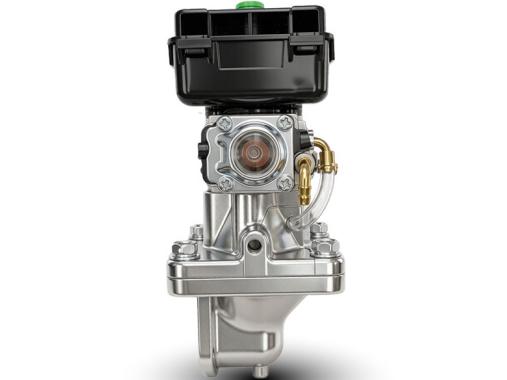

A Short History: How Plastic Took Over the Fuel System
The history of plastic carburetor adoption in small engines follows the regulatory timeline. Through the 1980s, nearly every small-engine carburetor body was die-cast zinc or aluminum. In the 1990s, marine engine makers led the switch — Johnson and Evinrude outboards moved carburetor covers, bowls, and eventually full bodies to nylon composites, because saltwater was destroying metal housings within a few seasons.
The decisive decade was the 2000s. California's tightening small-engine emission standards forced engine makers to redesign carburetors with more complex internal fuel passages — geometry that die casting plus machining struggled to produce economically. Injection molding solved it: a single molded component could carry fuel channels, pulse passages, and mounting bosses that previously required three cast parts and secondary machining. One well-documented conversion project by a US molding firm replaced an aluminum carburetor with a single thermoplastic part built to roughly 500 controlled dimensions, scaled to 10 million units a year for a major engine brand.
✅ Bottom line: plastic carburetors were not a downgrade that snuck through quality control. They were the enabling technology for the emissions-compliant, lightweight engines we sell today.
Reason 1: Emissions Rules Demanded Geometry Metal Couldn't Deliver
Modern emission compliance requires precise fuel metering at part throttle — which means longer, narrower, more intricate internal passages. Die casting needs draft angles and generous cross-sections; then each passage must be drilled and deburred. Injection molding forms those same passages in one shot, with consistent wall thickness and no burrs to shed into the fuel system.
✅ Bottom line: when a buyer asks why the new carburetor looks different from the old metal one, the honest answer is: it has to, to meet the emissions rules the engine was certified under.
Reason 2: Weight, Cost, and the Arithmetic of Handheld Tools
The classic plastic carburetor advantages weight cost injection molding case stacks up quickly:
- Weight: glass-filled nylon runs up to 70% lighter than aluminum for equivalent structures. On a 5 kg brush cutter, saving 150 grams at the far end of the shaft measurably reduces operator fatigue over a working day.
- Cost: a molded body consolidates machining, deburring, and plating steps into one cycle. Per-part cost advantage typically lands between 15% and 25% at volume — the difference between winning and losing a retail price point.
- Design consolidation: one molded part replaces several. Fewer parts means fewer leak paths, fewer assembly steps, and fewer SKUs in your spares bin.
✅ Bottom line: for distributors, the cost advantage is not just margin — it is shelf-price competitiveness in the under-$10 wholesale band where volume lives.
Reason 3: Ethanol Fuel Chemistry Favors Polymers
Here is the reason almost nobody puts in a product page: modern pump fuel is harder on metal than on properly formulated polymers. Ethanol blends like E10 absorb water and phase-separate, and the resulting water-alcohol layer corrodes zinc alloys and bare aluminum. Aromatic octane additives in straight gasoline attack certain metals more aggressively than ethanol itself. Quality polymer bodies — nylon 6/6, glass-filled PA66, PBT — are formulated to shrug off E10 contact without swelling or gumming.
Metal still wins where it matters: jets, needles, and metering levers remain brass and steel in virtually every design, because precision metering parts need metal's dimensional stability.
✅ Bottom line: the smart procurement question is not "plastic or metal" but "which parts are plastic, and which parts stayed metal." A well-designed plastic carburetor keeps the metering hardware metallic and the housing polymeric — the construction philosophy fdjinxing applies across its polymer-body lines.
Reason 4: Manufacturing Consistency at Volume
A die-cast body varies with casting temperature, alloy batch variation, and machining setup. The final answer to why do manufacturers use plastic carburetors instead of metal is repeatability at volume. An injection-molded body, once the tool is proven, repeats shot after shot — cavity pressure sensors can hold critical dimensions across millions of cycles. That repeatability is the least discussed of the plastic carburetor advantages weight cost injection molding delivers, and for an OEM committing to annual volumes in the millions, it converts directly into fewer warranty claims per thousand units.
What This Means for Your 2026 Assortment
The market data backs the trend: plastic-composite carburetors accounted for roughly 26.5% of diaphragm carburetor revenue in 2025, concentrated in residential and entry-commercial equipment. But professional-grade platforms still specify aluminum for a reason — thread durability, impact tolerance, and heat dissipation under sustained full throttle. That is why the platform mix, not the material, should drive your order: a pro Chainsaw Carburetor program still belongs in aluminum, a residential mower line belongs in polymer, and a lightweight Hedge Trimmer Carburetor or agricultural Drone Carburetor application sits right at the crossover point where polymer's weight advantage starts to decide the purchase.
Fuding Jinxing General Engine Carburetor Co., Ltd. runs both die-cast aluminum and engineering-polymer body production, so distributors can position material by platform and market instead of betting the whole range on one camp. Send fdjinxing your engine platforms and target markets, and receive a material-by-platform recommendation with wholesale quotation within one business day.
FAQ
Q1: Do plastic carburetors fail faster than metal ones?
A quality glass-filled nylon body delivers 600-800 operating hours in typical service — enough for several residential seasons or a full commercial season on light equipment. Failure before that point is usually a material or molding defect, not an inherent property of polymer; judge the factory, not the material family.
Q2: Why do manufacturers use plastic carburetors instead of metal if pro users prefer metal?
Because the majority market — residential and light-commercial equipment — rewards weight, cost, and emissions compliance more than it rewards extreme-duty durability. Pro platforms still get aluminum; the material split follows the customer split.
Q3: Is the shift to plastic reversible?
No. The history of plastic carburetor adoption in small engines shows a one-way ratchet: emissions geometry, fuel chemistry, and cost structure all favor polymers, and tooling investment has followed. The realistic future is more hybrid designs — metal metering hardware inside polymer housings — rather than a return to all-metal bodies. For buyers planning a range, fdjinxing recommends deciding material per platform with a fitment review rather than defaulting to one camp.
Sourcing for both material camps?
Contact fdjinxing for sample kits of polymer and aluminum carburetors for your key platforms — with fitment charts, material data sheets, and factory-direct wholesale pricing returned within one business day.
Email:[email protected]
Mobile: +86 13777534699
Website:www.jinxingcarb.com