
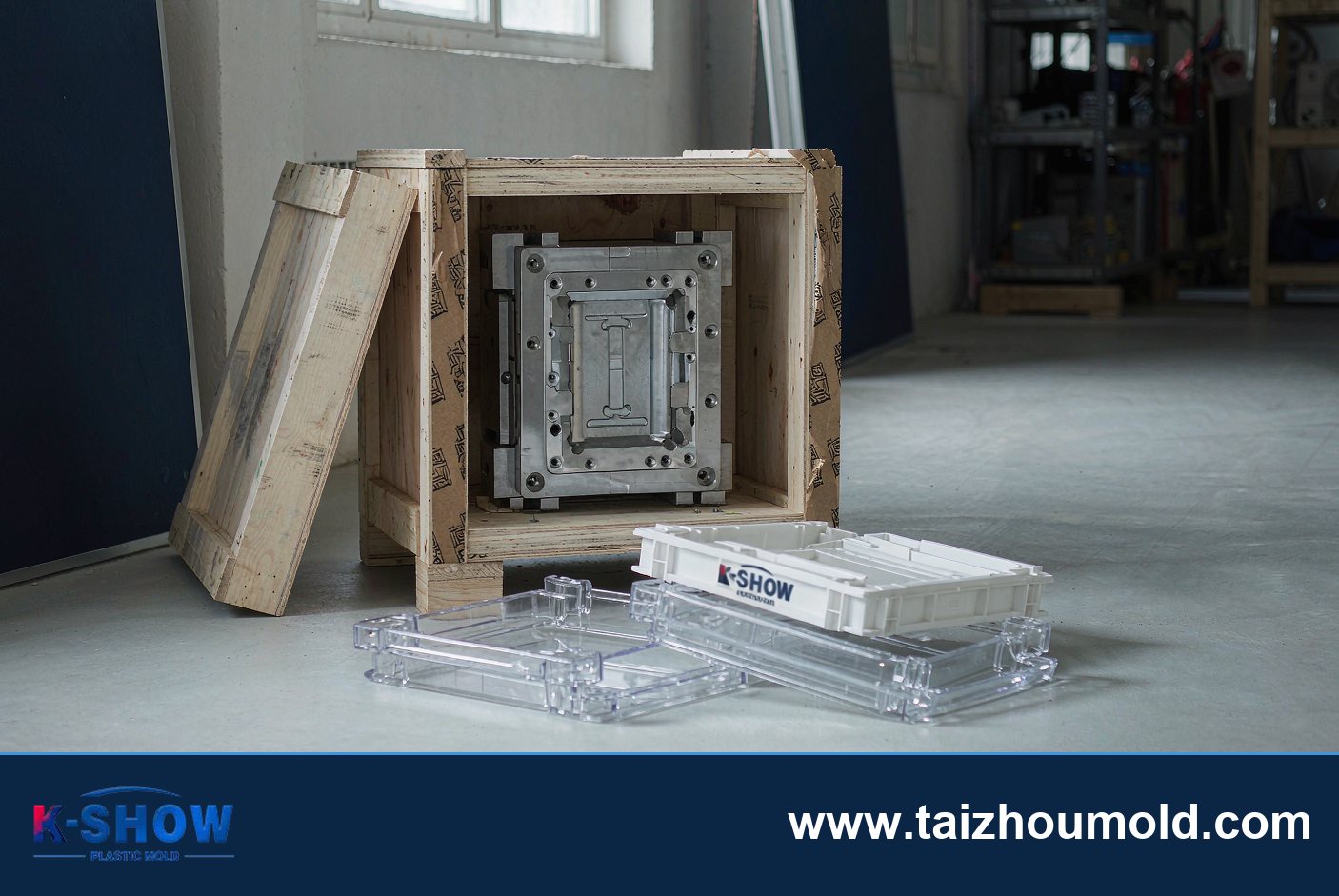
Walk through any appliance showroom and the shelves look like the cheapest thing in the cabinet. In tooling terms they are the opposite: a shelf is a long, thin, ribbed structural part with a visible cosmetic face, a food-contact surface and a fit interface that has to slide into a liner made on a different continent. Buyers who treat it as a commodity usually discover this at the first pilot run, when the shelf either rattles in its rails or will not enter them at all.
KSHOW has built injection mold tooling in Huangyan for 24 years, with 30,000+ molds delivered to 100+ countries under ISO 9001 and IATF 16949, and a fair share of that work is exactly this kind of unglamorous part: shelves, bins, crisper drawers, liners.
If you are re-sourcing a shelf or bin family, the useful first step is a liner drawing plus the load and temperature the shelf must survive: [email protected], WhatsApp +86-18957424655. KSHOW will tell you which of the six tools in a typical family can share a mold base — and which cannot.
Clear polystyrene is unforgiving
The clear shelf is where a toolmaker's reputation is made or lost. General-purpose polystyrene transmits close to 90% of visible light, polishes to a mirror, and shows every flow mark, every weld line and every trace of residual stress as a bright band under supermarket lighting.
Three rules decide the outcome:
· Dry the resin and keep it dry. GPPS takes up only around 0.02% water as supplied, but a granule that has sat in a humid hopper can carry ten times that — and above roughly 0.1% the moisture turns to silver streaks on a clear face. Dry at 70–80 °C for 2–3 hours and keep the hopper dry.
· Gate where the flow can finish. A gate placed for mold convenience rather than flow balance lets the last melt arrive too late to pack, and leaves a hesitation mark that polishing cannot remove.
· Do not over-pack. Higher packing pressure improves flatness and worsens stress; a stressed clear shelf crazes in service when a customer wipes it with a solvent cleaner.
|
Material |
Light transmission |
Mold shrinkage |
Typical role |
Main risk |
|
GPPS |
88–90% |
0.4–0.6% |
Clear shelf, crisper front |
Crazing under solvent attack |
|
HIPS |
Opaque |
0.4–0.7% |
White shelf, liner trim |
Yellowing over time |
|
PP |
Translucent to opaque |
1.2–1.8% |
Door bins, ribbed shelves |
Creep under sustained load |
|
PC |
88–90% |
0.5–0.7% |
High-temperature premium shelf |
Cost and stress birefringence |
KSHOW cuts clear-shelf cavities from ESR-grade mirror steel and finishes to a high polish, but the material choice in that table belongs to the appliance maker. The toolmaker's job is to make the chosen material behave — which is why the material grade has to be fixed before the cavity is polished, not after the first sample.
Where the tolerance actually lives
A shelf drawing usually carries one flatness callout and a general tolerance, and neither describes what the assembly line actually checks. The dimensions that stop a line are usually the ones the drawing never showed.
Short answer: rail spacing, front trim flatness, support pad height, bin hook geometry, molded scale marks and drawer run-out — six dimensions the assembly line checks, not the general tolerance on the drawing. Taken one by one:
· Rail spacing, typically 26 mm ±0.3 — 0.1 mm tighter and the shelf will not slide, 0.1 mm looser and it rattles.
· Front trim flatness, because it is the only line the customer sees when the door opens.
· Support pad height, which decides whether the shelf sits level or rocks on four points.
· Bin hook geometry, where a 0.2 mm error turns into a bin that drops when loaded.
· Molded scale marks and dividers, which must stay legible after the polish.
· Drawer run-out, since a crisper that binds at 80% extension reads as a quality defect, not a tolerance issue.
KSHOW agrees the datum scheme with the appliance maker before T0 for exactly this reason: if the shelf is measured against the rail centreline in the tool room and against the outer edge on the assembly line, both parties will be right and the part will still fail.
KSHOW case: six tools for one refrigerator platform
A Middle Eastern appliance brand was launching a 480-litre platform with four shelves and two door bins, and wanted one toolmaker for the whole set so that the parts would fit a liner that was already in production.
KSHOW cut six tools on three mold-base heights, so that one part family ran on two press sizes instead of six. The recorded project data:
|
Tool |
Part |
Material |
Cavities |
Key result |
|
S1 |
Clear shelf 480 × 320 mm |
GPPS |
1 |
Flatness 0.45 mm vs 0.8 mm allowed |
|
S2 |
Clear shelf 380 × 300 mm |
GPPS |
1 |
Rail spacing 26.12 mm vs 26 ±0.3 |
|
S3 |
White shelf, ribbed |
PP |
1 |
Deflection 2.1 mm at 15 kg, 24 h, 40 °C |
|
S4 |
Half-depth shelf |
HIPS |
1 |
Warp 0.6 mm, no rework after T1 |
|
B1 |
Standard door bin |
PP |
2 |
Hook pull-out 120 N vs 90 N minimum |
|
B2 |
Deep door bin |
PP |
2 |
1.2 m drop test, filled, no crack |
KSHOW has since repeated the same mold-base logic on other appliance families: fix the base by part family first, then schedule by press.