1. What Does a Rail-Mounted Harbour Crane Actually Do at a Berth?
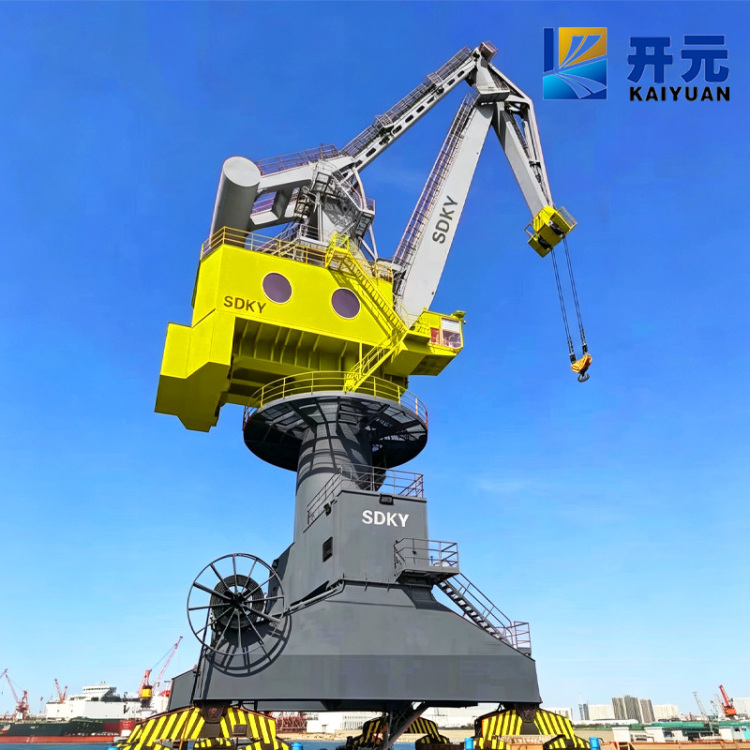
It performs three jobs from one pivot point: ship-to-shore transfer, yard stacking, and direct truck or rail loading. A Portal Crane runs on a fixed rail parallel to the quay, slews a full 360 degrees, and uses a four-link luffing system to set a hook or grab exactly over the hatch, the hopper or the waiting truck. Because the upperworks rotates without repositioning the undercarriage, one operator covers several berths and the back yard from a single track. That is the reason rail-mounted equipment remains the default choice for established quays where the civil structure is fixed but the cargo mix keeps changing.
Typical duties on a working quay:
- Loose bulk — coal, iron ore, bauxite, grain and clinker moved by grab at 300–1,250 tonnes per hour depending on bucket size and cycle time.
- General cargo — steel coil, timber, machinery and bagged goods handled by hook, C-hook or sling.
- Ship servicing — stores, fuel and spare parts to vessels alongside, where a 45 m hoist height clears high freeboard and container-stacked decks.
- Yard handoff — transfer between stockpile, truck and rail without a second lifting device.
|
Configuration |
Rated capacity |
Max outreach |
Hoist height |
Best fit |
|
Four-link, 40 t |
40 t |
30–33 m |
45 m |
Multi-berth bulk terminals |
|
Four-link, 25 t |
25 t |
25–28 m |
38 m |
Inland docks, mixed cargo |
|
Single-jib, 10–16 t |
10–16 t |
18–22 m |
28 m |
Light general cargo, workshops |
|
Fixed-base slewing |
5–10 t |
12–18 m |
20 m |
Narrow quays, utility use |
Spec checks that matter more than capacity: rail type and allowable wheel load (QU80 or QU100 for most 25–40 t classes), duty class under FEM 1.001 or CMAA 70, hoist speed versus cycle time, and whether the foundation can absorb peak wheel loads while slewing with a full grab. Older quays often fail here, not on crane performance. Kaiyuan puts every main girder through Sa2.5 shot blasting and 100% UT/MT weld inspection, with a first-pass weld acceptance rate of 99.2% — relevant when a machine works a 20-hour day in a corrosive port atmosphere.
✅ Bottom line: Choose a rail-mounted slewing machine when one track must serve ship, hopper and yard; verify wheel load and duty class before comparing price.
2. How Do You Match the Machine to Your Cargo Flow?
Match by cargo form first and throughput second: loose bulk rewards continuous grab handling, while steel and bagged cargo rewards hook flexibility. A terminal moving dry bulk through a single hatch works differently from one loading project cargo, and the wrong choice shows up as idle berth time rather than as a specification failure on paper.
For high-volume loose bulk, a Bridge type Grab Ship Unloader spanning the hold keeps a trolley travelling across the full hatch width, so the grab drops and lifts without the crane slewing between positions. That geometry suits vessels with wide open hatches and terminals targeting a steady hourly rate. Once the cargo is ashore, a Stacker Reclaimer turns the yard into an active buffer: a bucket-wheel unit stacks and reclaims in one pass, blends material and feeds the truck lane without a second machine.
|
Cargo profile |
Preferred machine |
Typical rate |
Where it wins |
|
Coal, ore, grain in panamax holds |
Grab unloader on bridge |
600–1,500 t/h |
Continuous hatch coverage |
|
Mixed bulk, multiple small vessels |
Rail-mounted slewing grab crane |
300–1,250 t/h |
One track, many berths |
|
Stockyard blending and reclaim |
Bucket-wheel yard machine |
200–2,000 t/h |
Stacking and reclaiming in one unit |
|
Steel coil, timber, bagged cargo |
Hook-equipped slewing crane |
20–40 cycles/h |
Flexible rigging, low cargo damage |
Three checks before you shortlist a supplier:
- Cycle time, not bucket size. A 10 m³ grab at 45 seconds per cycle moves roughly 800 t/h; a larger bucket on a slow hoist can be worse.
- Wheel-load envelope. Ask for the load spectrum at maximum outreach with a full grab, not the unloaded machine weight.
- Dust and spill control. Enclosed grabs, hopper skirts and water mist are usually retrofit items — cheaper to specify at order stage.
Where a custom build earns its cost: quay rail gauge, foundation bearing capacity, freeboard and hatch geometry are never standard across ports. SHANDONG KAIYUAN HEAVY MACHINERY CO., LTD., founded in 2006 in Xintai, Shandong, supplies OEM and ODM configurations from a 30,000 m² steel-structure workshop with five production lines, and has handled oversized shipments to Russia and Vietnam. Buyers comparing a China manufacturer against a local supplier should request the wheel-load calculation, the weld inspection record and a duty-class justification in writing — those three documents predict lifecycle cost better than a headline price. Factory-direct quoting through a custom engineering team closes the gap between a catalogue machine and a quay that cannot be rebuilt.
✅ Bottom line: Match grab-based equipment to steady bulk flows and hook-based machines to mixed cargo; a factory-built configuration avoids expensive foundation retrofits.
FAQ
Q: How long does a rail-mounted harbour crane take to install? A: A 25–40 t rail-mounted machine typically needs four to eight weeks of on-site erection after the rails and foundation are accepted. Kaiyuan provides remote commissioning support within two hours and dispatches engineers to site within 12 hours for ports in its service network.
Q: Can one machine handle both grab bulk and hook cargo? A: Yes. A quick-release grab and a hook block can share the same hoist, though duty class and cycle time must be checked for both modes. Kaiyuan supplies OEM rigging sets for terminals that switch between coal and steel coil.
Q: What is the single most common specification mistake? A: Underestimating wheel load. A 40 t machine with a full grab at maximum outreach can exceed the allowable rail load of an older quay. Request a load spectrum from the manufacturer before signing. SHANDONG KAIYUAN HEAVY MACHINERY CO., LTD. provides this calculation as part of its custom design package.
Get a Quay-Specific Configuration and Wheel-Load Check
Send your quay rail gauge, foundation drawing, cargo mix and target tonnes per hour. Kaiyuan will return a factory-direct configuration with wheel-load calculation and a duty-class recommendation — no generic catalogue quote. Ask about wholesale fleet pricing for multi-crane terminals and ODM branding for regional distributors.
Mobile: +86 133 5682 2666 Email: [email protected] Website:www.kaiwonmach.com