
In lamination, adhesive is the most visible variable material cost. Run the same substrate and the same adhesive on two different lines and the amount applied per square metre is often not the same. The difference rarely comes from the adhesive itself. It comes from how closely the coating unit holds the coat weight to its set value through a whole reel. For a packaging printing plant running continuously, that difference accumulates by the metre and ends up in the consumables account of every batch.
What the adhesive saving figure actually means
The published specification for Senruiyuan's water-based dry roll-to-roll laminating machine quotes an adhesive saving of around 30 percent for the servo-driven gluing section. That is a published reference figure, not a promise for a particular production line. What a plant actually saves depends on the substrate structure, the target coat weight, the running speed, and how much extra adhesive was being applied in the first place as a safety margin. The full list of published figures is on our water-based dry laminating machine specification.
Lower adhesive use does not come from buying a cheaper adhesive. It comes from removing the extra that was applied to be safe. When coat weight is controllable and the roller surface is uniform, the set value can sit close to the lower end the process genuinely needs, instead of the upper end with a margin left on top. That is the underlying reason the same consumable behaves differently on different machines.
If the process route itself is still open, the comparison of water-based, thermal and solvent-free lamination is the better starting point: coat weight only makes sense once the route and the substrate are fixed.
Three mechanical conditions behind coating uniformity
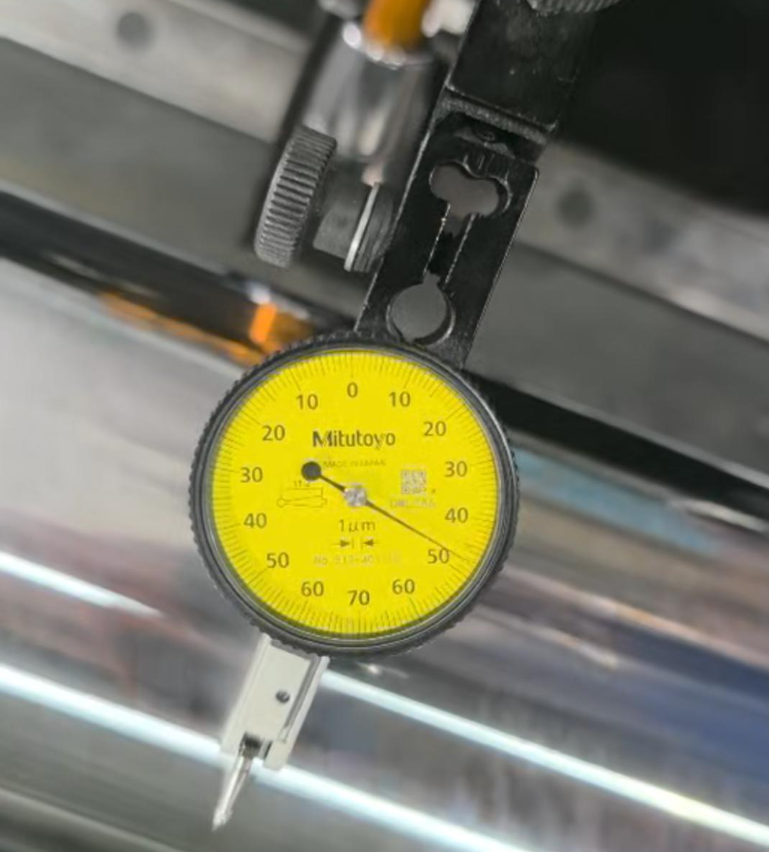
- Roller runout and concentricity. Radial runout of the coating roller and the metering roller at speed turns directly into a periodic variation in coat weight. The smaller the runout, the closer the applied amount stays from the start of a reel to the end.
- Roller surface finish and the gap between rollers. Surface accuracy, roller diameter pairing and the gap setting decide whether the adhesive film keeps the same thickness across the full web width. Deviation at the two edges is the easiest to miss.
- How the glue supply follows line speed. Servo-driven gluing lets the supply track line speed, so a reel change or a speed ramp is less likely to produce a short burst of over- or under-coating. The faster the control response, the less film is wasted in those transition sections.
The published specification also gives points that can be checked one by one when specifying a line: servo-driven gluing, a 420 mm mirror roller paired with a 300 mm pressure roller, a motion controller with a response in the 50 microsecond range, and shaftless unwind and rewind. Treat these as catalogue items to verify against the actual quotation, not as performance claims for a customer's line.
How to measure it yourself at acceptance
Rather than relying on the coat weight printed in a brochure, measure it on your own substrate during the material trial:
- Fix one target coat weight in grams per square metre, then take a sample at low speed, at normal running speed and at high speed.
- Weigh a known area, or read the glue application log, to work out the actual amount applied per square metre, and compare the three readings.
- Check appearance and peel strength at the left, centre and right of the web width, and see whether the edges match the middle.
- Record the metres of film lost during a reel change and during acceleration or deceleration.
- Write every reading into the acceptance sheet, with the substrate, the speed and the date, as a baseline to come back to.
| What to record | How to measure it | What it tells you later |
|---|---|---|
| Coat weight at three speeds | Weigh a known area or read the application log at low, normal and high speed | Whether the coating unit holds its set value as speed changes |
| Cross-web uniformity | Appearance and peel strength checks at left, centre and right | Whether the web edges behave like the middle |
| Transition waste | Metres of film lost at a reel change or a speed ramp | How closely the glue supply follows the line |
| Baseline record | Substrate, set coat weight, speed and date in the acceptance sheet | A reference for detecting drift months afterwards |
A filled-in acceptance sheet says more six months later than a claim that the glue control is stable. Keep the same measurement points and the same substrate reference from one check to the next, or the numbers cannot be compared.
Put adhesive use next to the other running costs
Adhesive is only one variable cost. Energy use and payback have to be worked out from real operating hours with an energy cost and payback worksheet, and a headline speed is not a production figure, as the nameplate speed versus real output calculation shows. Uneven coating usually turns up first as bubbles, wrinkles and delamination, so a lamination defect troubleshooting guide is worth keeping beside the cost sheet. Put all of these in one table before comparing machines: that is what shows the cost of the equipment over its working life, rather than the price of one consumable.
Job mix matters too. Plants running short runs with frequent changeovers reset the process far more often, so the transition sections in the table above deserve more attention than they would on a long single job.
Start with trial data, not with a claim
If you are evaluating water-based dry roll-to-roll laminating equipment, send us your substrate structure, web width and current running speed. We will put together the coat weight points worth checking on your line, so the material trial can be measured against them. Whether a machine is the right one is a question your own readings answer, not a sentence in a brochure.
Frequently asked questions
Is the 30 percent adhesive saving guaranteed for our line?
No. It is a published reference figure for the servo-driven gluing section, not a commitment. The result on a real line depends on the substrate, the target coat weight, the speed and how much was being over-applied before. Measure it at acceptance on your own material.
What is the simplest way to check coat weight?
Weigh a known area of coated film before and after drying, or read the glue application log, and express it in grams per square metre. Repeat at three speeds and at the left, centre and right of the web. Always note the substrate and the speed with the reading.
Why can the edges of the web differ from the middle?
Roller runout, roller surface accuracy and the gap setting all affect film thickness across the width. A cross-web peel strength check at three points, done at normal running speed, is the quickest way to see whether there is a pattern.
Can we run a trial with our own substrate?
Yes. A material trial at our Foshan factory can be arranged with your own film and adhesive. Tell us the substrate structure, web width and target output in advance so the line is set up for a meaningful run.
About Senruiyuan
Senruiyuan is based in Foshan, Guangdong, and builds roll-to-roll laminating, printing and post-press equipment for water-based dry and pre-coated film process routes. If you would like a coat weight calculation sheet for your own line, send your substrate structure, web width and current running speed. Use the enquiry form on this site, or the contact details below.
Contact Senruiyuan
Foshan Senruiyuan Machinery Technology Co., Ltd.
Email: [email protected] | WhatsApp: +86 17328088404
No. 8, Jinxian, Jinli Community, Lishui Town, Nanhai District, Foshan, Guangdong, China