
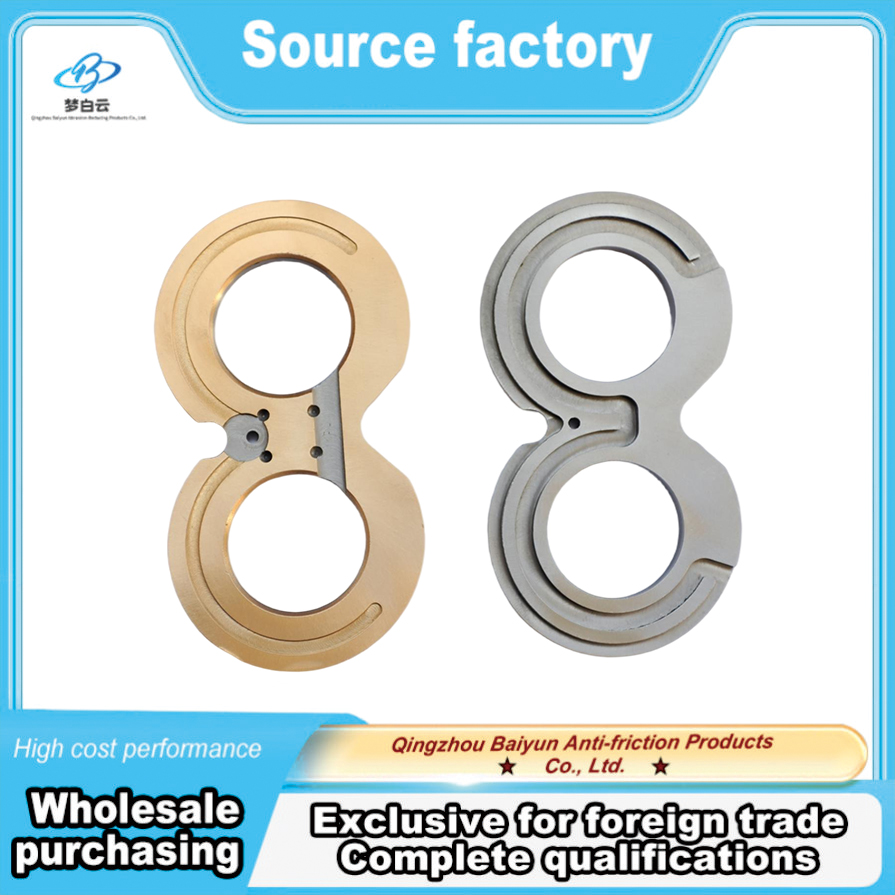
A $170 AP2D12 valve plate is either a sensible repair or the start of a second rebuild — the price says almost nothing, while the bronze grade, bond test and rotation suffix say everything.This guide to uchida ap2d12 valve plate aftermarket replacement quality compares what actually ships at $50, $100 and $170, names the warning signs in online listings, and explains why a plate that looked perfect on day one can be finished at 500 hours. Baiyun sinters steel-bronze friction plates with 0.003 mm batch flatness and a bond shear strength of at least 180 MPa, and machines AP2D-series plates to the exact suffix on your pump.
|
|
|
|
Published: November 2026 |
By Baiyun Engineering Team |
1. What Does a $170 Valve Plate Buy — and Which Listing Details Should Stop You?
Marketplace prices for an AP2D12 plate run from roughly $52 to $100 before freight; around $170 is the landed retail figure for a single plate or an entry-level kit — and none of those numbers tells you what alloy or bond you are getting. The same pump code is listed across Bobcat 331, Case CX17–CX27, Kobelco SK20/SK25/SK27, Hitachi EX20U/ZX20U, New Holland EH27 and Yanmar compact machines, so a generic "fits AP2D" plate has a very large potential audience and a very small guarantee.
The three price tiers, decoded
- $52–62 per piece (marketplace, 1 / 6 / 20-piece tiers)** — usually a machined part listed simply as "brass," with generic ISO wording and no alloy designation. Freight to the United States can be around $45, more than the part itself.
- $68–100 (regional parts seller or rotary-group listing)** — a 74.0 mm plate sold by diameter, or a complete group at about $100. Better than nothing, still no bond or flatness data.
- Around $170 (retail, landed) — often a single plate or an entry kit with a three-month warranty that explicitly excludes labour, towing and rental. That exclusion is where the real cost of a cheap part lives.
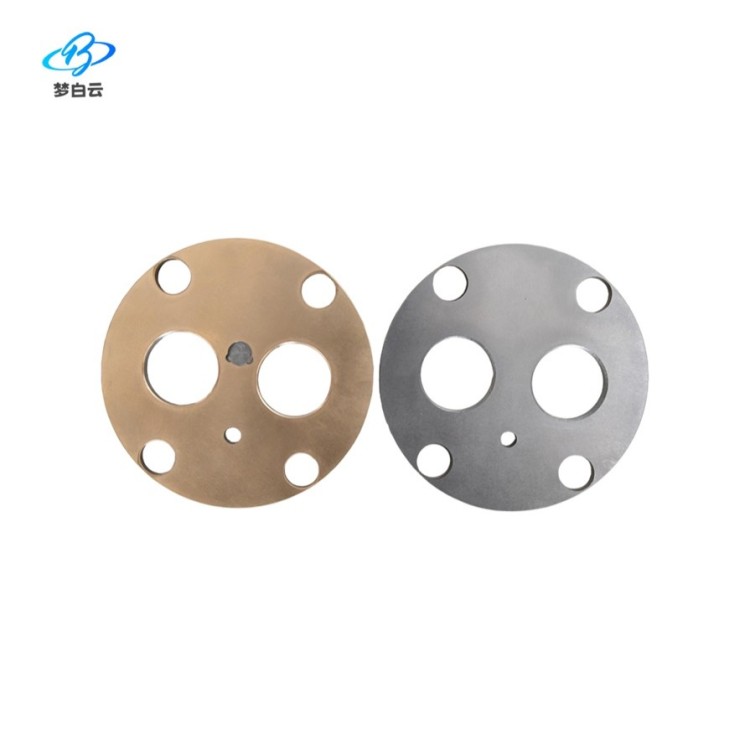
A professional uchida ap2d12 valve plate aftermarket replacement quality check starts before price: confirm the full pump code including its suffix (for example AP2D25LV1RS7), because suffixes encode rotation, control and porting variants that do not interchange within one frame size. Some AP2D12 kit sheets list a single "Valve Plate R" — the R is not marketing.
Five red flags when buying cheap hydraulic parts online
- The alloy is called "brass" rather than a bearing bronze such as CuPb10Sn10 at HB 60–90. Brass has different embeddability and seizure behaviour against a steel cylinder block.
- No batch inspection data — no CMM flatness and parallelism report, no bond shear result, no roughness reading. A generic ISO certificate is not a test of your plate.
- One part number spanning AP2D12 through AP2D42. Those frames cover 12–42 cc/rev; a single "fits all" casting is not machined to model.
- Warranty that covers the part and nothing else. A three-month part-only warranty on a component that needs a pump teardown to replace transfers the entire risk to the buyer.
- Freight larger than the part, no named manufacturer. A marketplace storefront is not a factory; ask who sintered the bronze layer before you ask for a discount.
✅ Bottom line: Treat $170 as a mid-market price, not a quality signal — demand the alloy, suffix match and batch test data before the part is worth installing.
2. Why Does a New Valve Plate Fail After 500 Hours?
A plate that survives 500 hours and then loses pressure was almost never "a bad batch" on its own — the usual causes are a wrong rotation suffix, a bond that could not take the load, or a contamination problem nobody fixed when the pump was open. That is the honest answer to new valve plate failed after 500 hours why: the plate is where the failure becomes visible, not always where it starts.
The five causes worth checking in that order
|
Symptom after 500 hours |
Most likely cause |
Evidence on the bench |
Corrective action |
|
Bronze lifts or peels at the port bridge |
Bond strength below specification |
Dark patch under the copper, then a flap |
Require ≥180 MPa shear data; replace the plate |
|
Pressure fades when oil is hot |
Wrong R / L plate or port timing |
Grooves mirrored against the old plate |
Match the full pump suffix, not just AP2D12 |
|
Scoring across the whole face |
Contamination left in the system |
Copper and silicon in oil analysis |
Flush, change filters and breather, re-check oil |
|
Narrow crescent wear on one side |
Worn or tilted cylinder block |
Block face run-out beyond about 0.02 mm |
Machine or replace the block with the plate |
|
Pitting at the inlet side of the bridge |
Cavitation from a restricted suction line |
Frosted, eroded inlet port |
Clean strainer, fix suction before the next plate |
Contamination is the big one: industry estimates put particle-related causes behind roughly 75–82% of hydraulic failures, and about 78% of failures show measurable warning signs two to six weeks before they happen. A case-drain trend and an oil sample cost far less than a second teardown. The short answer behind new valve plate failed after 500 hours why is that the plate is where the problem surfaces, not necessarily where it began — Baiyun rejects returned plates that show contamination scoring rather than a bond defect, because a replacement would fail the same way.
What a buyer should insist on before the second order
- Bronze layer integrity — a sintered CuPb10Sn10 layer, not a thin coating, with a visible bond line treated as a reject.
- Flatness at or below 0.003 mm on the batch certificate, with parallelism reported alongside it.
- Suffix confirmation in writing — R or L, control code, and the pump serial if the nameplate is legible.
- A matched block check — the old block face measured, not assumed good because it "looked fine."
- A root-cause note — whether the previous oil, filter and breather were changed at the same time.
Baiyun supplies custom AP2D plates against drawings or samples and returns the batch flatness and bond data with the quote, so a China manufacturer can be judged on measurements rather than storefront ratings. A wholesale buyer rebuilding several compact machines should standardise on one verified plate per suffix; mixing sources across a fleet is how the 500-hour failure repeats in three different machines.
✅ Bottom line: After an early failure, measure the bond, the suffix and the block face before blaming the plate — a second plate without a root-cause check is a second 500-hour clock.
FAQ
Q: Is a $170 uchida ap2d12 valve plate aftermarket replacement quality actually acceptable?** A: It can be. Price around $170 is normal for a single retail plate or entry kit, but quality depends on the alloy, the sintered bond and the flatness report. Ask for those three items and the full pump suffix; a seller who cannot supply them is selling appearance, not OEM-level performance.
Q: What are the most important red flags when buying cheap hydraulic parts online? A: A "brass" plate with no alloy grade, no batch inspection data, one number claimed to fit AP2D12 through AP2D42, and a part-only warranty that excludes labour. Any one of those is a reason to pause; two together usually mean the part was priced for a single repair, not a working life.
Q: A new valve plate failed after 500 hours — why did it happen? A: Most often the bronze bond was too weak, the wrong rotation plate was fitted, dirt remained in the system, or the cylinder block face was already out of tolerance. A factory replacement should arrive with flatness and shear data; check those plus the old block before installing it.
CTA: Match the Suffix Before You Pay for Another Plate
Send the complete pump code with suffix, a nameplate photo, and three measurements of the failed plate. Our engineering team returns the matched specification, the batch flatness and bond report, and the current price — usually within 24 hours, with no obligation.
Baiyun has produced steel-bronze friction components in Qingzhou, Shandong since 1999: 16,000 m² of plant, 2 million bimetal plates a year, ISO 9001, and ODM support for AP2D12, AP2D28 and the older Uchida frames. If you are comparing a marketplace plate with a factory-direct one, request the test data first.
|
|
|
|
Contact: [email protected] |
Qingzhou Baiyun Anti Friction Products Co., Ltd., Qingzhou, Shandong, China |