
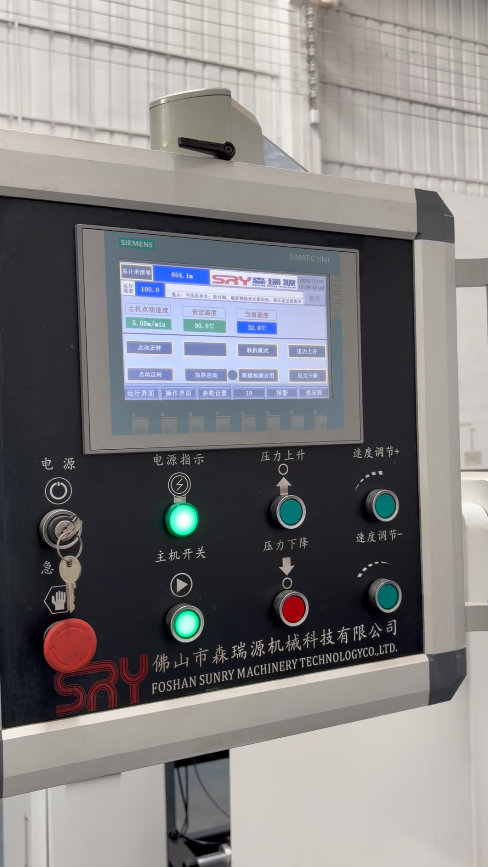
Treating lamination temperature as a single set value is the most common misjudgement during a material trial and in daily production. A water-based dry roll-to-roll laminating line has at least two control points doing different jobs: the drying section removes water from the adhesive layer, and the laminating roller activates the adhesive at the moment of bonding. Watch only the roller reading and an incompletely dried layer will still show up later as bubbles and delamination, however accurate that reading is. For batch orders, the question is rarely what number to set. It is whether that number held steady through the whole batch.
Two control points, two different jobs
- The drying section. After the water-based adhesive is applied, water has to be carried away so the adhesive film reaches a state that can be bonded. Residual moisture sealed into the interface at the nip becomes the starting point for bubbles and delamination later on.
- The laminating roller. The surface temperature decides whether the adhesive activates fully at the nip, which directly affects initial tack and final peel strength.
The two stages are in series, not two dials that can compensate for each other. No roller setting can make up for a layer that was not dried; over-drying pushes the adhesive out of its process window in the opposite direction. When a fault appears, confirm the condition of the substrate at the drying section exit before touching the roller setting. That order saves far more time than trimming one number repeatedly.
A starting range is not a specification
Shop floors often keep a remembered starting range for a standard job. Treat it only as a place to begin: it is not a machine specification, and it is not a value that transfers to another plant. The right setting moves with the adhesive type and solids content, the heat tolerance of the film, the paper grammage, the coat weight and the line speed. BOPP and PET film do not behave the same way. The reference is the adhesive supplier's data sheet, and the value has to be confirmed on your own substrate during a material trial.
When a temperature goes into the process card, four things go with it: the adhesive batch, the substrate structure, the line speed, and which zone and which measuring point the reading came from. Without those four, a number from one order cannot be compared with a number from the next. The water-based dry laminating machine specification lists the heating method and the roller configuration as catalogue items; it does not give a temperature value for a particular plant's job, and those items should be checked against the actual quotation.
How low and high temperatures leave different marks
- Insufficient drying. Moisture stays in the adhesive layer, so the interface is prone to bubbles and delamination after bonding, often more visible once the reel has been stored for a while.
- Roller too cool. The adhesive does not activate fully, initial tack is weak and peel strength falls. Heavy solid ink coverage and large ink areas expose it first.
- Either point too hot. The film can shrink, curl or change gloss, and the paper may become brittle. Thin films with low heat tolerance are the most sensitive.
These symptoms look very much like the defects caused by low nip pressure or uneven coating, so do not raise the temperature the moment a bubble appears. Write down the substrate condition at the drying exit, the measured roller surface temperature, the line speed and the pressure reading together, then decide which variable to move. The lamination defect troubleshooting guide sets out that order of checks.
Holding the band is harder than setting the value
A batch that looks good at the start and poor at the end usually did not have its set value changed. The temperature drifted. An operator watching a dial cannot cover a whole reel, so what matters is the stability of the temperature control and a record that can be read back. During the material trial, work through the following table point by point:
| Temperature point | What it does | What to record at acceptance |
|---|---|---|
| Drying section zones | Carry water out of the adhesive layer | Set value and actual value per zone, and substrate condition at the exit |
| Laminating roller surface | Activate the adhesive at the nip | Left, centre and right surface readings and the fluctuation band |
| Reel change and speed transitions | Temperature follows line speed | Recovery time and metres of film lost during the transition |
| Whole-batch record | Compare the start and the end of a batch | Substrate, speed, coat weight, adhesive batch, time and readings |
If the left, centre and right of the roller surface keep showing a temperature difference in the same direction, check heating uniformity and the roller surface condition before discussing the set value. A recorded fluctuation band tells you more at acceptance than a single number written on a sheet. Plants running short runs with frequent changeovers reset the process far more often, so the transition rows deserve extra attention, and the nameplate speed versus real output calculation explains why line speed keeps changing in the first place.
Keep all three readings on one process card
Coat weight, nip pressure and the two temperatures are one problem, not four. A drift in any of them shows up first as defects and wasted film. The value of a line is not how high one parameter is rated, but whether it holds all three steady through a full reel and a full shift. Drying energy also belongs in the same calculation, since the energy cost and payback worksheet turns a catalogue claim into measured operating hours.
If you are evaluating water-based dry roll-to-roll laminating equipment, send us your substrate structure, web width and current line speed. We will put together the temperature points worth checking on your line, so the material trial can be measured against them. Together with the coat weight readings and the pressure readings, this table makes up one complete baseline process card. If the process route itself is still open, the comparison of water-based, thermal and solvent-free lamination is the better starting point.
Frequently asked questions
Is there a standard temperature we can set for every job?
No. A remembered starting range is not a machine specification and does not transfer between plants. Adhesive type and solids content, film heat tolerance, paper grammage, coat weight and line speed all change the right setting. Use the adhesive supplier's data sheet as the reference and confirm the value on your own substrate at a material trial.
Why do bubbles appear even when the laminating roller reading looks right?
The drying section and the roller work in series. If water is still in the adhesive layer when it reaches the nip, it is sealed into the interface and shows up as bubbles or delamination later. Check the substrate condition at the drying exit first, then the roller surface, together with line speed and pressure.
How do we check temperature stability across a full batch?
Log the set and actual value per drying zone, take roller surface readings at the left, centre and right, and record the recovery time and wasted metres through a reel change and a speed ramp. Compare the start of the batch with the end using the same substrate reference. A fluctuation band over time is far more useful than one reading.
Can we run a trial with our own film and adhesive?
Yes. A material trial at our Foshan factory can be arranged with your own substrate. Tell us the substrate structure, web width and target output in advance so the line is set up for a meaningful run, and so the readings can be written into a baseline process card.
About Senruiyuan
Senruiyuan is based in Foshan, Guangdong, and builds roll-to-roll laminating, printing and post-press equipment for water-based dry and pre-coated film process routes. If you would like a temperature recording sheet for your own line, send your substrate structure, web width and current line speed. Use the enquiry form on this site, or the contact details below.
Contact Senruiyuan
Foshan Senruiyuan Machinery Technology Co., Ltd.
Email: [email protected] | WhatsApp: +86 17328088404
No. 8, Jinxian, Jinli Community, Lishui Town, Nanhai District, Foshan, Guangdong, China