1. What is a triple-belt system and how does it differ from a separate thickener plus press?
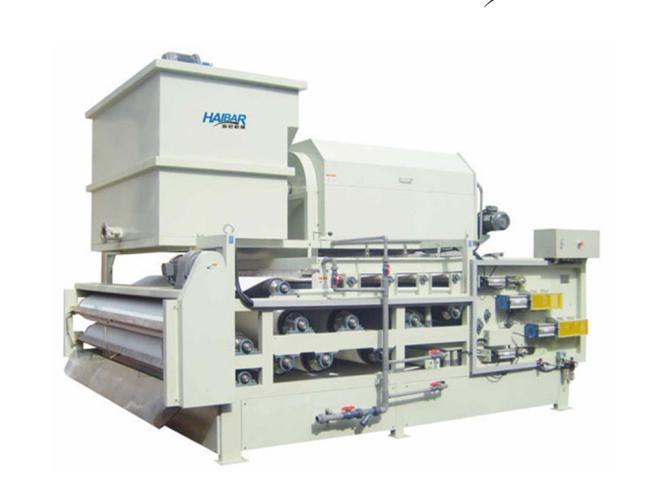
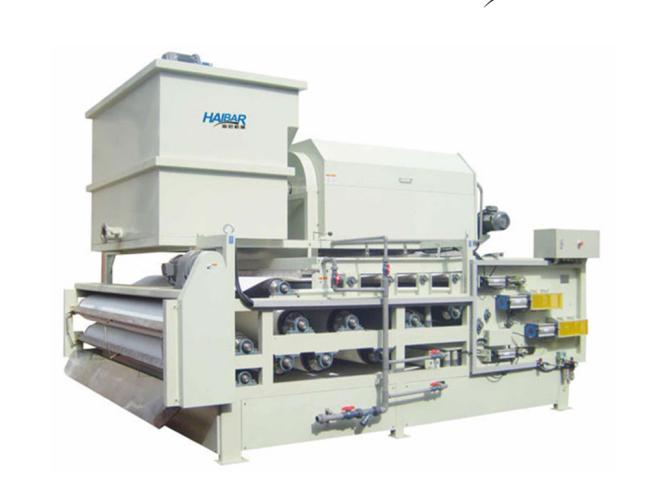
A triple-belt system is one integrated machine that thickens and dewaters sludge in three consecutive belt zones, replacing a standalone thickener followed by a separate belt press. The first belt runs a gravity drainage deck that lifts feed from roughly 1–2% to 4–6% dry solids. The second belt applies wedge and low-pressure squeezing to pre-dewater the slurry. The third belt then drives the cake through a tightening roller stack for high-pressure shear, reaching 18–25% dry solids in a single pass.
A conventional line splits those jobs: a rotary-drum or belt thickener feeds a buffer hopper, then a pump moves the thickened sludge across the plant to a separate belt press. Each hand-off needs its own drive, frame, walkway, controls and operator attention. Haibar's HTB3 triple-belt series folds all three zones onto one skid with one motor train, so a single triple belt sludge thickening and dewatering system manufacturer is responsible for the whole duty from feed to cake discharge.
The design family is broader than one model. A drum belt sludge thickening and dewatering integrated machine uses a rotating drum for the first thickening stage instead of a flat gravity deck, which suits fibrous or fast-draining sludges that blind a flat belt. Both approaches share the same goal — fewer machines, one responsibility — but pick the front end based on sludge drainability rather than price alone.
✅ Bottom line: A triple-belt unit collapses thickener-plus-press into one skid with one drive train, so you trade two machines and a transfer step for a single integrated responsibility.
2. What are the real savings and trade-offs of integrating thickening and dewatering into one unit?
Integrating the two stages saves 40–50% of floor space and one full material-transfer step, but it locks you into a single machine's duty range and creates one point of failure. The table below stacks the integrated approach against a separate thickener and press on the numbers that actually hit your budget.
|
Factor |
Triple-belt integrated |
Separate thickener + press |
|
Footprint |
1 unit, ~40–50% less floor area |
2 machines + pump + buffer hopper |
|
Capital cost |
Lower (one frame, one drive) |
Higher (two frames, two drives) |
|
Sludge transfers |
None (in-line) |
1–2 (odour, leak risk) |
|
Labor / control |
One operator, one HMI |
Two zones to tune separately |
|
Redundancy |
Single point of failure |
Either stage can back up the other |
|
Duty flexibility |
Fixed within one machine range |
Easy to upsize one stage only |
The disposal argument is where the drum belt sludge thickening and dewatering integrated machine and triple-belt share the same payoff. A high dryness belt filter press for lower disposal cost is not a slogan — every point of cake solids above the landfill or incineration threshold removes payable water weight. Moving from 18% to 24% dry solids on 5,000 t/yr of cake cuts roughly 300 t of trucked water, and at a typical haul-and-tip fee of €25–45/t that is a recurring €7,500–13,500/yr saving before counting smaller polymer and energy use.
The trade-off is rigidity. If your flow swings far above the unit's rated throughput, a separate line lets you add a second press while keeping the thickener; an integrated unit forces a whole-machine upgrade. For steady municipal, food or industrial flows inside one duty band, Haibar offers the unit as a custom build and integration wins on cost and simplicity. For highly variable or fast-growing sites, two separate stages keep your options open.
✅ Bottom line: Integrate when your flow is steady and sits inside one duty band; keep stages separate when throughput swings widely or you expect to upsize one stage only.
FAQ
Q: Can a triple-belt system handle variable feed solids, or does integration reduce flexibility? A: A triple belt sludge thickening and dewatering system manufacturer sizes the unit to a feed range, typically 0.5–4% inlet solids, and the three zones self-balance within that band. Outside the band you lose efficiency, so treat integration as a steady-flow solution rather than a swing-duty one. Haibar offers pilot testing on your actual sludge before final sizing.
Q: How does a drum-belt integrated machine differ from a triple-belt unit for my plant? A: A drum belt sludge thickening and dewatering integrated machine thickens on a rotating drum, which resists blinding on fibrous or fast-draining sludge, while a triple-belt uses a flat gravity deck better suited to fine, slow-draining biological sludges. Both are available as OEM/ODM builds, and the choice is driven by drainability and foulant load, not by price.
Q: Does integrating thickening actually raise cake dryness enough to cut disposal cost? A: Yes — integration does not lower dryness versus a separate line; it reaches the same 18–25% range while saving space and transfers. A high dryness belt filter press for lower disposal cost still depends on correct polymer and belt tension, so the saving comes from removed handling steps plus every dry-solids point above the disposal threshold. Work with a single supplier who tunes polymer and belt tension to your sludge to lock in that saving.
Get a Spec-Matched Integrated Unit
Send Haibar your feed solids, peak flow and cake target, and our China factory will return a sized proposal — HTB3 triple-belt or drum-belt integrated — with reference plants near you. Shanghai Haibar Mechanical Engineering Co., Ltd. operates an 11,000 m² plant and exports to 30+ countries; contact us for a free pilot assessment and a configured quote.