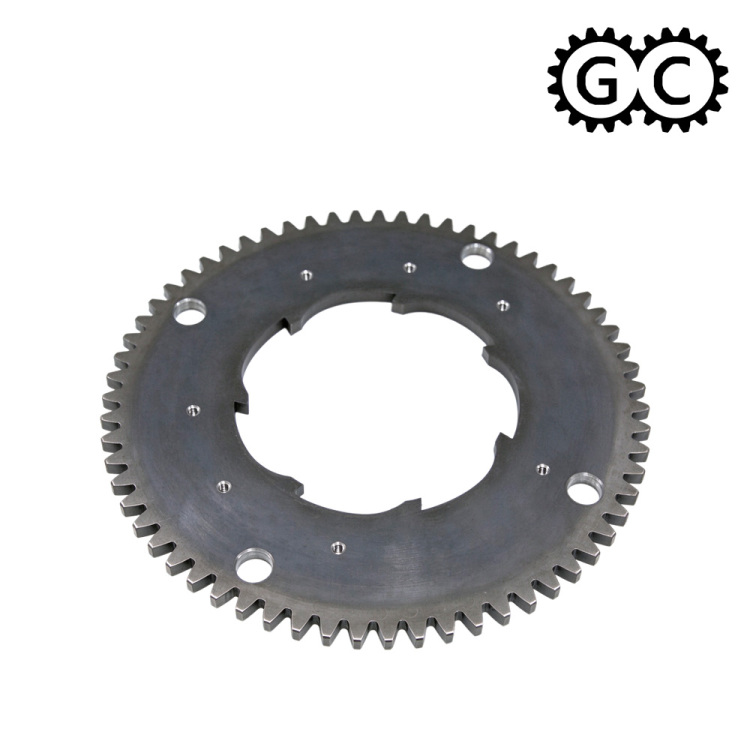
1. When Should You Specify a Helical Profile Over a Straight-Cut One?
Specify helical when the drive runs above roughly 1,000 rpm, carries moderate to heavy load, or must meet a strict noise limit. The teeth are cut at a helix angle — typically 8°–25° — so they engage progressively rather than full-face all at once. More teeth share the load at any instant, raising the contact ratio and spreading stress across the flank. The result is smoother transmission, lower vibration and roughly 8–15 dB less noise than an equivalent straight-cut set at the same speed. For designers comparing the two tooth forms, this engagement geometry is the deciding factor, not the tooth count.
|
Parameter |
Straight-cut (Spur) |
Helical |
|
Tooth engagement |
Full-face, abrupt |
Gradual, progressive |
|
Contact ratio |
1.1–1.4 |
1.4–2.1 |
|
Noise at 1,500 rpm |
~78–85 dB |
~68–75 dB |
|
Axial thrust |
None |
Yes, scales with helix angle |
|
Mesh efficiency |
98–99% |
96–98% |
|
Typical accuracy |
ISO grade 6 |
ISO grade 7–8 |
|
Relative unit cost |
Baseline |
+15–40% |
The unavoidable trade-off is axial thrust. The helix angle pushes the wheel along its axis, so angular-contact or tapered-roller bearings and a stiffer housing become mandatory. In a compact reducer that can add 10–20% to bearing and housing cost, which is why the choice must be settled at layout stage, not after the casing is frozen. Whichever form you select, it must be keyed onto a transmission shaft whose runout and keyway tolerance match the bore — an out-of-spec shaft erases the advantage of a precisely ground tooth set. gaocheng holds straight-cut profiles at ISO grade 6 and helical at grade 7–8, with an in-house heat-treatment line keeping case depth consistent from prototype through production batch.
- Module range M0.5–M8, outside diameter up to 600 mm
- Carburizing or induction hardening to HRC 58–62, with contact-pattern inspection on matched sets
- Custom helix angle and hand selected to cancel thrust in opposed arrangements
✅ Bottom line: Choose helical for high-speed, heavy-load or noise-sensitive drives with thrust-capable bearings; choose straight-cut for simple, low-speed, cost-driven layouts.
2. How Do Noise, Load and Cost Compare in Practice?
A helical set carries roughly 15–30% more load at the same module and face width, but costs 15–40% more and adds thrust bearings to the bill of materials. In gaocheng's comparison drawn from recent custom OEM orders, the acoustic gap is 8–15 dB in favor of helical at 1,500 rpm, and it narrows as speed falls. Below about 500 rpm the two are acoustically close, and the cheaper straight-cut form usually wins on value. Efficiency is the quiet differentiator: straight-cut holds 98–99% per mesh, while helical drops to 96–98% because flank sliding generates heat the lubricant must carry away.
|
If your priority is… |
Pick |
Why |
|
Lowest unit cost |
Straight-cut |
Simpler cutting, no thrust bearings |
|
Noise below 75 dB |
Helical |
Progressive engagement |
|
No axial bearings allowed |
Straight-cut |
Zero axial thrust |
|
High torque density |
Helical |
Higher contact ratio |
|
Retrofit into unknown housing |
Straight-cut |
Drop-in, lower tolerance stack-up |
|
Low-backlash positioning |
Ground helical |
Smoother backlash variation |
One consideration before you engineer a reducer around the problem: if the job is moving bulk material rather than transmitting between parallel shafts — a conveyor line, for instance — a sprocket with roller chain is often the lower-cost, easier-to-service answer. It is worth ruling out early. For genuine toothed drives, ratio, module and face width can be specified to fit the centre distance you already have, which is where a supplier with in-house cutting and heat treatment saves time and rework. gaocheng supplies both forms as custom OEM components with full inspection records and drawing-based customization.
✅ Bottom line: Helical buys roughly 20% more load and much lower noise for about 30% higher system cost; below 500 rpm, straight-cut is usually the better value.
FAQ
Q: Can straight-cut and helical sets be swapped in an existing reducer? A: Not directly. Helical generates axial thrust and usually needs different bearings and shaft shoulders. A straight-cut set can often replace a helical one in the same housing when ratio and centre distance match, but the reverse rarely works without modification.
Q: Do you provide custom OEM/ODM manufacturing for equipment builders? A: Yes. gaocheng has built transmission components since 2006, runs more than 120 machining and testing machines plus an in-house heat-treatment workshop, and supplies OEM and ODM customers across 30+ countries. Send a drawing or sample and our engineers return a quote with material, accuracy grade and heat-treatment recommendation.
Q: What accuracy grade should a B2B buyer specify? A: For general machinery, ISO 6 on straight-cut and ISO 7–8 on helical is sufficient. Specify grade 5 or tighter only for high-speed or low-backlash positioning drives, because each grade step adds grinding cost without benefit in a normal conveyor or agricultural reducer.
Get a Quote Built Around Your Actual Duty Cycle
Tell us your speed, torque, centre distance and noise limit — gaocheng's engineering team will recommend straight-cut or helical, confirm the matching shaft and bearing arrangement, and return a factory-direct quote within 48 hours. Whether you need a single prototype, a wholesale batch of custom toothed components, or a complete OEM/ODM transmission package, we manufacture to drawing with in-house heat treatment and full inspection records. Request your free application review today.
Email: [email protected]
Mobile: +86 13813669756
Website:www.gaochenggear.com