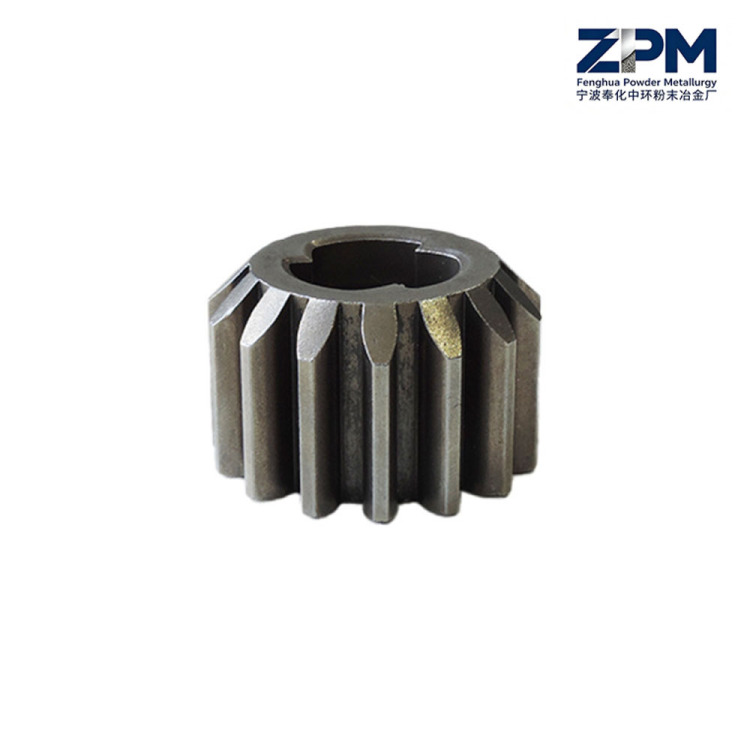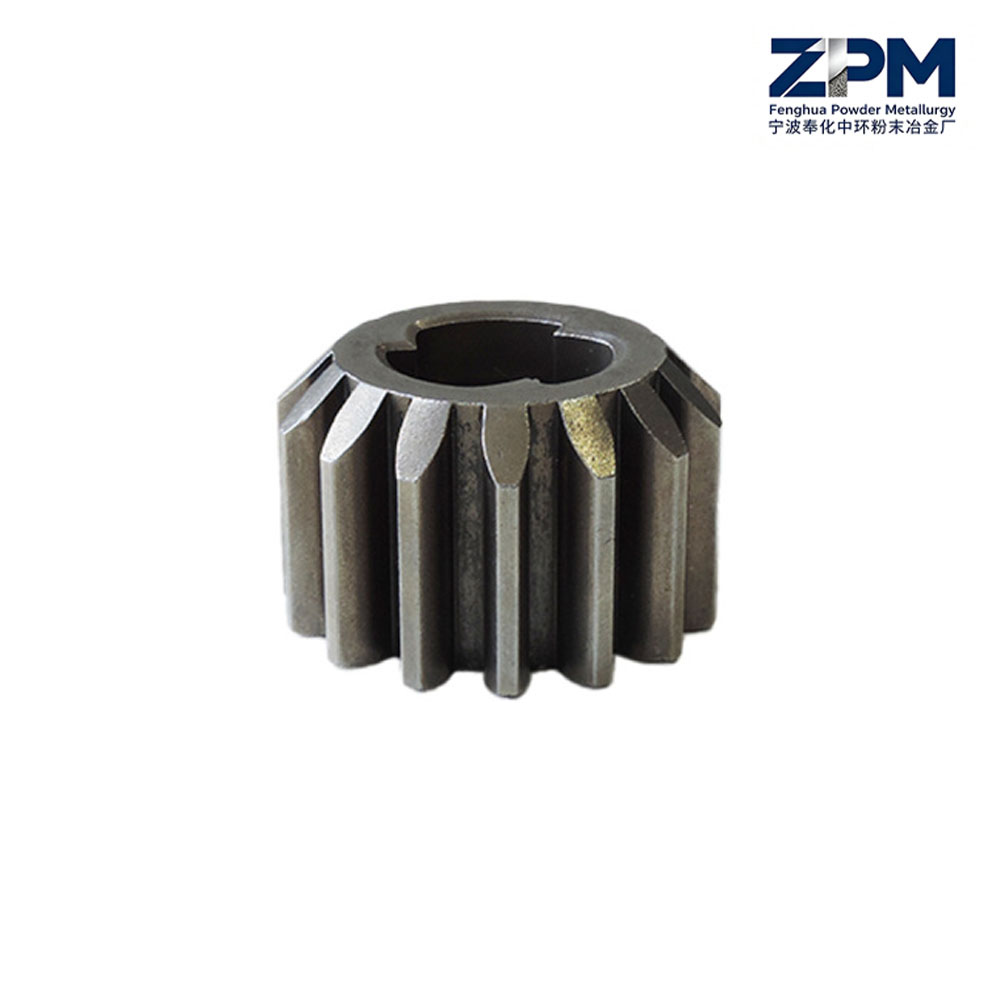
The answer to motorcycle gear PM or machined which process is better is volume-driven: below roughly 5,000 pieces a year, machining wins; above it, powder metallurgy wins on part cost and consistency. There is no universal winner — the right call depends on annual volume, tooth precision, and how much heat treatment the gear needs. This guide gives the break-even math OEMs actually use when they qualify a transmission gear.
A machined gear starts from bar or forged blank and cuts the tooth; a sintered gear compacts powder in a die and sinters it near net shape. Both reach the same mesh, but their cost curves cross at very different volumes. Zhonghuan presses Iron-based, stainless steel, and silicon carbide powder metallurgy parts on one campus, which is why a buyer can qualify a sintered gear and a matching stainless spacer in a single audit.
1. Where does the break-even point sit between sintered and machined gears?
A motorcycle transmission gear sintered versus machined cost comparison crosses over at about 5,000–10,000 pieces a year, once the shared tooling cost of $2k–$50k is amortized across the run. Below that band, the tooling amortization swamps the per-part saving and machining is cheaper; above it, PM pulls ahead fast.
The math is simple. A sintered gear costs more up front — die, sinter fixture, and first-article validation — but the per-part cost falls because there is almost no cutting. A machined gear costs little to set up but pays for every tooth, every pass, every grind. The crossover moves with part complexity:
- Simple spur gear, module 2: crossover near 5,000 pieces a year
- Helical or profiled shift gear: crossover near 8,000–10,000 pieces a year
- Gear with a hub, spline, or cam feature molded in: PM wins even sooner
A motorcycle transmission gear sintered versus machined cost study should also count scrap and rework. PM scrap is powder, recyclable at low loss; a machined gear throws away 50–70% of the blank as chips. At volume that chip pile is real money, and it is why high-run transmission gears almost always go sintered.
Two hidden costs flip the decision. First, design changes: a die is cut for one geometry, so a gear that changes every model year carries a fresh tooling bill each time. Second, tight tolerances: if the bore or a face needs grinding anyway, PM loses part of its cost edge because you are back to a finishing operation. Machining absorbs late changes cheaply; PM rewards a design that is frozen. For a stable platform that trade favors PM, and for a fast-iterating one it does not.
✅ Bottom line: Treat 5,000–10,000 pieces a year as the crossover; above it PM beats machining on total cost once tooling is amortized.
2. Which process fits high-volume motorcycle gear production?
Which process for motorcycle gear high volume production is answered by PM for runs above the break-even, because only compaction repeats the tooth form within ±0.05 mm shot to shot without per-part cutting. At a hundred thousand pieces a year, machining variability and labor cost make the math worse, not better.
Volume is where PM's die-defined repeatability pays. Every compacted gear leaves the same die, so tooth thickness, profile, and bore stay inside tolerance without an operator judging each part. Machining can match that, but only with more cells, more tool changes, and tighter supervision. The decision rule OEMs use:
- Low volume, prototype, or a part that changes yearly: machine it
- High volume, stable design, many features molded in: sinter it
- A gear needing HRC 60+ through-hardened with no distortion budget: machine or forge it
A buyer running which process for motorcycle gear high volume production should also weigh lead time. PM tooling takes 4–8 weeks but then floods the line; machining scales only by adding cells. For a model that sells steadily, PM is the safer capacity bet.
✅ Bottom line: Above the break-even, PM is the only process that repeats the tooth form within ±0.05 mm at scale without per-part cutting.
FAQ
Q: Is motorcycle gear PM or machined which process is better for a low-volume custom bike? A: For low-volume or custom runs under ~5,000 pieces a year, machining is usually cheaper once tooling is counted. Zhonghuan recommends PM only when the annual volume clears the break-even and the design is stable.
Q: Can sintered gears match the precision of machined ones? A: Yes for most transmission meshes. PM holds AGMA class 8–9 at volume, and a light shave closes the gap to class 10 if a specific mesh needs it. The die, not an operator, defines the form.
Q: What is the tooling cost range for a sintered gear? A: Tooling typically runs $2,000–$50,000 depending on part complexity and press size, with a 4–8 week lead time. That cost is the reason PM only wins above the volume break-even.
Run your break-even with us
Send Zhonghuan your gear drawing, annual volume, and target AGMA class and we will model the motorcycle gear PM or machined which process is better call for your exact part, with tooling cost and per-part price at three volume points, and confirm which process for motorcycle gear high volume production suits your run. As Ningbo Fenghua Zhonghuan Powder Metallurgy Plant, a China OEM/ODM factory, we supply both sintered and machined prototypes so you can validate mesh and cost before committing to tooling.
Published: November 2026 | By Zhonghuan Engineering Team
Email: [email protected]
Mobile: +86 18268606088
Website:www.zhpmtech.com