
The 40–70% is a material saving against solid-wall duct, and it is real — but it is not an installed saving, and it does not transfer to single wall. Per metre at DN160, single wall runs about 39% cheaper than double wall, which sounds like found money until the route crosses a road: the concrete encasement that single wall then needs adds roughly 40 times the duct saving per metre. Double wall keeps the saving only because it can be buried without that concrete.
Most cost comparisons stop at the price per metre, which is why the argument never settles. A duct is 3–8% of a buried route's cost; trench, bedding, backfill, reinstatement and the load path above the pipe are the rest. Getting the wall right is a decision about that other 92%, not about the invoice line.
1. Where Does the 40–70% Actually Come From?
It comes from mass per metre, and the band is wide because three products are being compared as two. At DN160 the numbers separate cleanly:
- Solid-wall MPP, 8.0 mm: 4.0 kg/m
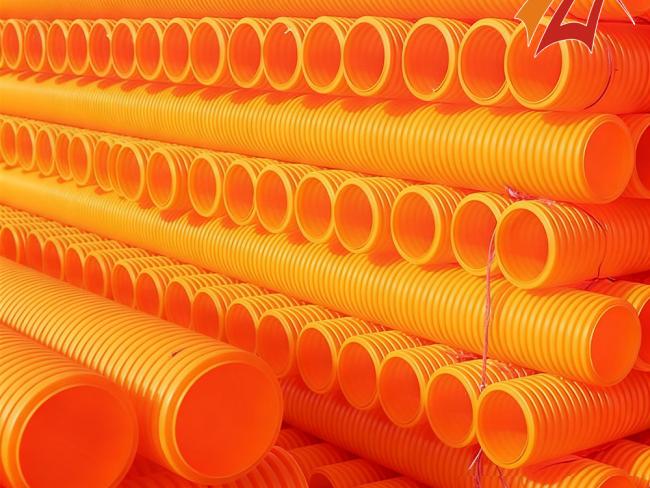
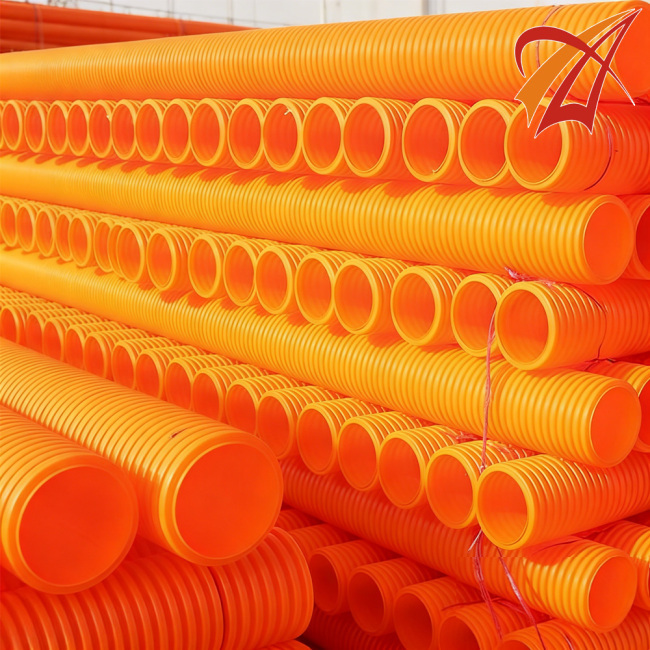
- Double-wall corrugated, 2.8 mm outer plus 1.1 mm inner: 1.6 kg/m — 60% lighter than solid wall
- Single-wall corrugated, 2.0–2.5 mm ribbed: 0.9–1.1 kg/m — a further 35–40% lighter than double wall
So the "40–70%" figure is the double-wall range against solid wall. Single wall sits outside that band entirely and buys its extra saving by giving up something the other two have: a continuous structural ring.
|
DN160, per metre |
Single wall |
Double wall |
Solid wall |
|
Mass |
0.9–1.1 kg/m |
1.6 kg/m |
4.0 kg/m |
|
Material cost, FOB China |
~$0.95 |
~$1.55 |
~$3.60 |
|
Ring stiffness range |
SN4–SN8 |
SN8–SN16 |
SN8–SN24 |
|
Bore surface |
Spiral rib |
Smooth liner |
Smooth |
|
Joints per 100 m |
1 (100 m coil) |
17 (6 m lengths) |
8 (12 m lengths) |
|
Direct burial under traffic |
No |
Yes |
Yes |
The single-wall figure of 0.9–1.1 kg/m is the honest one, and so is the joint count. Coiled single wall arrives in 100 m lengths, so it needs one joint where double wall needs seventeen — a genuine advantage on long, straight, lightly loaded runs, and the reason it dominates telecom and verge work.
What it cannot do is carry load. An SN8 single-wall profile tested to GB/T 9647 or ISO 9969 passes the stiffness test in the lab and still ovalises under a 1.2 m cover with traffic above, because the ribbed wall has almost no ability to redistribute a concentrated wheel load. That is not a quality complaint; it is what the geometry is for. A double-wall MPP Corrugated Pipe (product range) from AnjiXinghua carries the same load with a smooth liner for the cable and an outer rib that spreads it.
✅ Bottom line: The 40–70% is real but narrow — it is double wall beating solid wall, and single wall's extra 39% is bought by removing the load path.
2. What Does the Cheaper Wall Cost You on Site?
On a road crossing, about 40 times the duct saving. Take a 100 m crossing at 1.2 m cover, one duct position in a four-way bank:
- Single wall duct: 100 × 0.95 = **95**
- Concrete encasement around that duct: ~0.25 m³/m at 110/m³ plus formwork and labour ≈ **4,000**
- Double wall in SN16, direct buried: 100 × 1.90 = **190**
The $95 saved on the duct is spent more than 40 times over on the concrete it triggers, plus curing time on the programme. That is the whole argument in one line, and it is why the 40–70% claim survives only where concrete was already in the design.
|
100 m, DN160, duct and protection only |
Single wall |
Double wall |
Solid wall |
|
Verge, 1.0 m cover, no traffic |
$95 |
$155 |
$360 |
|
Road crossing, 1.2 m cover |
$95 + $4,000 encasement |
$190, SN16 |
$400 + encasement |
|
Inside a specified concrete bank |
$95 |
$155 |
$360 |
|
Long straight telecom run, 1 km |
$950, 10 joints |
$1,550, 170 joints |
$3,600, 83 joints |
Read the third row carefully, because it is where most procurement arguments are actually won: when the engineer of record has already specified a concrete-encased bank, single wall is the correct liner and the 39% saving is entirely real. The mistake is applying that decision to a route where the concrete exists only because the duct is too weak to do without it.
Two costs belong in the comparison and usually are not. Joints: seventeen extra joints per 100 m at roughly $2.50 plus four minutes of labour each adds about $0.50/m, which eats most of the $0.60/m material gap on short sections. Handling: coils need an uncoiler and cannot be pulled tight around tight radii, so single wall on a bendy alignment ends up with offcuts and wastage of 5–8%.
Where the load is heavy — 1.5 m cover, rail, airport apron — the specification moves to MPP Cable Protection Pipe (duct bank range) in SN16, and the question stops being about cost per metre. On cool, lightly loaded routes where stiffness is never tested, single-wall HDPE Cable Protection Pipe (HDPE range) still does the job at the lowest first cost.
✅ Bottom line: Single wall wins only where concrete is already specified; where it forces concrete into the design, the saving is a rounding error on a 40× penalty.
FAQ
Q: Can single-wall duct be used under a road at all?
A: Yes, as a liner inside a concrete encasement — that is a legitimate and common detail. It cannot be direct-buried under traffic whatever SN class the datasheet claims, because the failure mode is local ovalisation under a wheel patch, not a uniform ring test. If the drawing shows concrete, single wall is fine; if the drawing shows soil, it is not.
Q: Which SN class does a road crossing actually need?
A: SN8 for 1.0–1.2 m cover under light traffic, SN12.5 for two lanes of heavy vehicles, SN16 under rail, airport aprons and cover deeper than 1.5 m. Stiffness must be quoted at the service temperature as well as 23 °C — a class that holds at ambient can shed half its modulus at 70 °C in hot soil.
Q: Can the three wall types be quoted on one comparison sheet?
A: Yes. As a manufacturer running both polypropylene and polyethylene lines, AnjiXinghua quotes single wall, double wall and solid wall side by side with mass, stiffness and joint counts per 100 m, so the procurement comparison starts from installed cost rather than price per metre. Custom SN classes, 6 m or 12 m lengths and OEM labelling are produced to order, and wholesale volumes ship direct from the factory.
Compare Installed Cost, Not Price Per Metre
Send the route sections with cover depth, traffic loading and whether concrete is already specified, and AnjiXinghua returns a three-way wall comparison per 100 m within 48 hours — including the sections where single wall is genuinely the cheaper answer.
Anji Xinghua Electric Power Pipeline Co., Ltd. has produced MPP, CPVC and HDPE cable protection systems since 2004, with 25,000 m² of plant, 10 automated lines and 10,000 km of annual capacity. Wholesale pricing, custom lengths and factory-direct technical support are available for EPC procurement teams.
Email:[email protected]
Mobile: +86 18357256599
Website:www.xhpowerpipe.com