
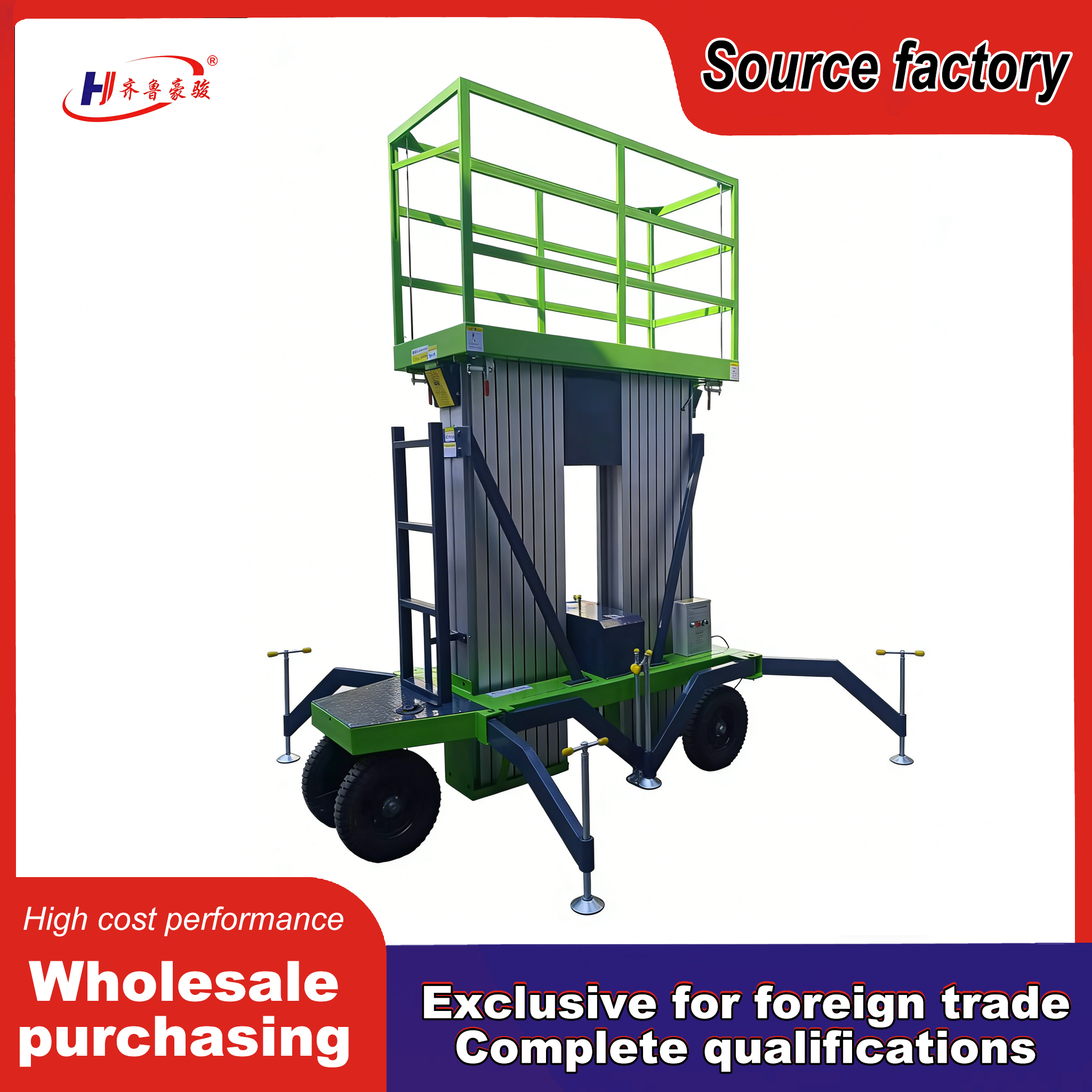
1. What does each additional mast actually give you?
Read the load column before the mast-count column. Every manufacturer publishes the same table, and the table says the same thing: capacity jumps once, from single to dual, and then stops.
|
Configuration |
Example model |
Platform height |
Rated load |
Machine weight |
Platform size |
|
Single |
Sinofirst SMA10-1 |
10 m |
100 kg |
370 kg |
0.62 × 0.62 m |
|
Dual |
Sinofirst DMA10-2 |
10 m |
200 kg |
680 kg |
1.38 × 0.60 m |
|
Dual |
MEWP Lifts GTWY12-2 |
12 m |
200 kg |
730 kg |
1.50 × 0.63 m |
|
Triple |
Sinofirst TMA14-3 |
14 m |
200 kg |
1,060 kg |
1.58 × 0.80 m |
|
Quad |
Sinofirst FMA14-4 |
14 m |
200 kg |
1,350 kg |
1.58 × 0.80 m |
|
Quad |
MEWP Lifts GTWY12-4 |
12 m |
200 kg |
1,050 kg |
1.57 × 0.90 m |
|
Six |
Sinofirst SMA21-6 |
21 m |
160 kg |
1,880 kg |
1.58 × 0.88 m |
The jump from single to dual is real: 100–125 kg becomes 200–250 kg, and the platform grows from roughly 0.62 × 0.62 m to 1.38 × 0.60 m. That is the only capacity upgrade in the range. From dual upward, capacity plateaus at 200 kg — and then falls to 160 kg on six-mast machines, because stability at 21 m requires more structure for the same allowed load.
Divide rating by machine weight and the difference becomes impossible to ignore. The 10 m dual carries 0.29 kg of load per kg of machine. The 16 m quad carries 0.13. The 21 m six-mast carries 0.085. That is the entire two mast vs four mast aluminum lift load capacity difference in one line: a buyer choosing four masts for payload pays twice as much steel for the same 200 kg on the plate.
The triple mast is the option most buyers skip, and often the correct one. At 14 m the Sinofirst TMA14-3 weighs 1,060 kg against 1,350 kg for the equivalent quad, yet both carry 200 kg on a 1.58 × 0.80 m platform. The 290 kg difference buys redundancy and a higher ultimate reach ceiling, not capacity on the day. If the job is a fixed 14 m ceiling, the triple does it. HAOJUN quotes both side by side for exactly this reason — the quad only becomes rational above 16 m or where an operator must work at full extension for hours.
So what is the extra structure for? Three things, none of them visible in a capacity comparison:
- Deflection control. At 14 m a twin-mast platform moves noticeably when an operator leans or pushes against a ceiling. Four mast sections with shorter unsupported overlap reduce that movement. This is a stiffness specification, not a load specification.
- Reach ceiling. Single mast stops around 10 m, dual around 14 m, triple around 16 m. Quad and six-mast configurations exist because no manufacturer can hold 14 m of reach on two columns without unacceptable sway.
- Platform geometry. Dual platforms are typically 1.38 × 0.60 m; triple and quad move to 1.58 × 0.80 m. The wider deck is often the real reason a quad wins a tender — two people and a tool case finally fit.
Deflection is measurable at delivery, even though nobody publishes it. Raise the platform to maximum height with one operator aboard, have the operator shift from the centre to the front edge, and measure the lateral movement at the deck with a tape against a fixed wall. A well-set quad will stay within roughly 50–80 mm; a dual at the same height often moves two to three times as far. HAOJUN runs this check on every multi-mast unit before packing, because the figure predicts operator confidence better than any line on the spec sheet. If a supplier refuses to discuss it, assume the overlap length is short.
HAOJUN publishes overlap length and mast section count alongside the load rating, because the two mast vs four mast aluminum lift load capacity difference alone tells a buyer almost nothing about how the machine behaves at full extension. Ask for the deflection figure at maximum height; very few suppliers will give one, which is itself useful information.
✅ Bottom line: Choose the fewest masts that reach the working height. Extra columns buy stiffness and deck space, not payload.
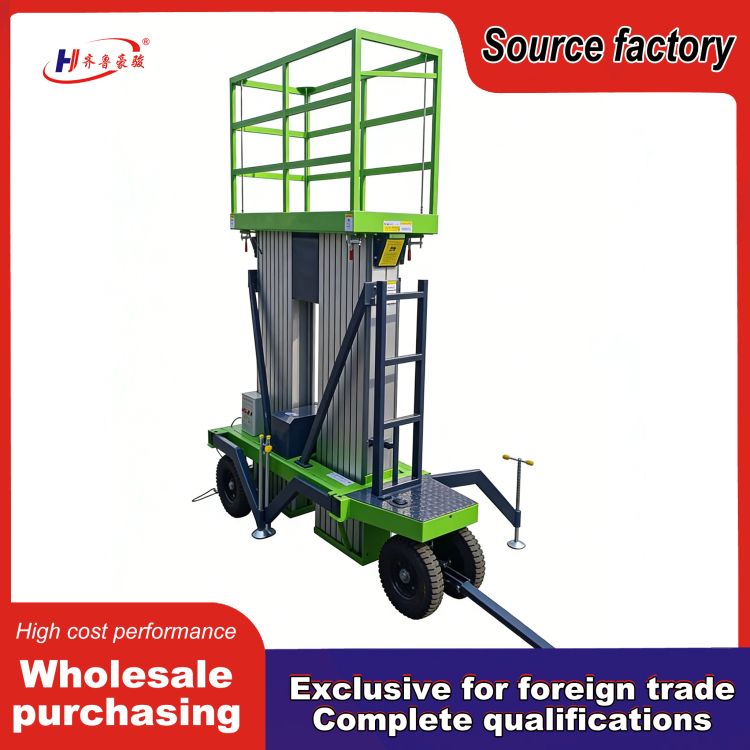
2. What do the extra masts cost to maintain, and how much floor do they need?
Every additional mast adds two more sliding interfaces to inspect. A dual machine has two columns with upper and lower slider sets; a quad has four. That doubling shows up in service time, in spare-parts inventory and in the number of things an operator can get wrong before elevating.
There is a persistent myth that this is a hydraulic vs chain drive mast lift maintenance comparison — as if some machines are hydraulic and others are chain-driven. Almost every aluminum mast lift on the market uses both: a hydraulic cylinder provides the force, and a double chain synchronises the sections. The genuine maintenance split is elsewhere:
|
Wear point |
Symptom |
Service threshold |
|
Nylon mast sliders |
Side sway at full height |
Replace above 0.5 mm clearance |
|
Lift chain |
Uneven section travel |
Replace on measured elongation, not age |
|
Relief valve |
Won't hold height under load |
Set 12–16 MPa, verify annually |
|
Return line |
Jerky or slow descent |
Bleed air — causes ~70% of descent complaints |
|
Outrigger pins |
Machine will not elevate |
Interlock must be satisfied before lift |
A technician who treats this as a hydraulic-vs-chain choice will stock the wrong parts. The chain rarely fails; the sliders and the air in the return line cause most callouts. That is why the hydraulic vs chain drive mast lift maintenance comparison should be reframed around slider count — a quad has twice as many interfaces to gauge, and a fleet buying OEM units should negotiate a slider kit into the spare-parts package. HAOJUN ships a gauge-and-replace chart with each service kit rather than a parts list alone.
The floor question is more decisive than the service question. The outrigger footprint dimensions for a 12 m mast lift are almost always larger than buyers expect, and they scale faster than the machine body:
|
Machine |
Stowed body |
Deployed outriggers |
Floor area occupied |
|
12 m dual (GTWY12-2) |
1.84 × 0.85 m |
approx. 1.75 × 1.55 m |
2.7 m² |
|
12 m quad (GTWY12-400) |
1.80 × 1.25 m |
2.19 × 2.19 m |
4.8 m² |
|
16 m quad (GTWY16-400) |
2.25 × 1.30 m |
3.00 × 2.84 m |
8.5 m² |
A quad 12 m machine can pass through a 1.4 m doorway on its 1.25 m body and then occupy 4.8 m² once the legs are out. In a retail corridor or a hotel back-of-house, that footprint — not the machine width — is what blocks traffic. The outrigger footprint dimensions for a 12 m mast lift should be on the site drawing before any order is signed, because unlike mast height, footprint cannot be engineered away after delivery.
Jinan Haojun Lifting Machinery Co., Ltd. supplies custom outrigger layouts for buyers whose floor space is fixed, and quotes wholesale slider kits with factory orders so a distributor is not ordering them piecemeal two years later. Send the corridor width and we will return the deployed footprint drawing, not just the brochure dimension.
✅ Bottom line: Count slider sets for maintenance cost and measure deployed outriggers for site fit; neither number appears on a capacity plate.
Frequently asked questions
Q: Is a four-mast lift safer than a two-mast lift?
A: Not by rating. Both are certified to the same MEWP standard and both carry the same platform load. The four-mast machine has lower deflection at full height, which matters for precision work, but it also has twice the slider interfaces to maintain. Safety comes from the interlocks and inspection regime, not the mast count.
Q: Why do six-mast machines carry less than dual-mast machines?
A: Capacity is a stability calculation. At 21 m the structure must resist far greater overturning moment, so the permissible load drops to 160 kg despite the machine weighing 1,880 kg. More masts extend reach; they do not increase the load envelope.
Q: Can a supplier build a two-mast machine to carry 300 kg?
A: Technically yes, but it would need a wider chassis and longer outriggers, which removes the reason to buy a mast lift in the first place. At 300 kg the honest comparison is a compact scissor lift. Ask an ODM supplier to quote both options rather than forcing one platform to do both jobs.
HAOJUN builds single through six-mast machines on shared platforms, so a distributor can hold one deck and several reach classes rather than six unrelated SKUs. Ask our factory team for the overlap-length table before committing to a quad.