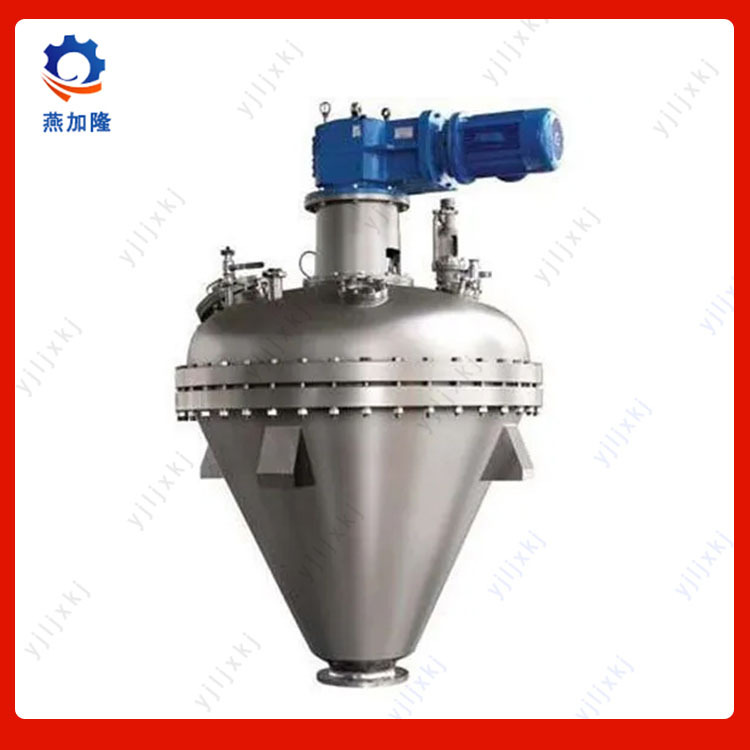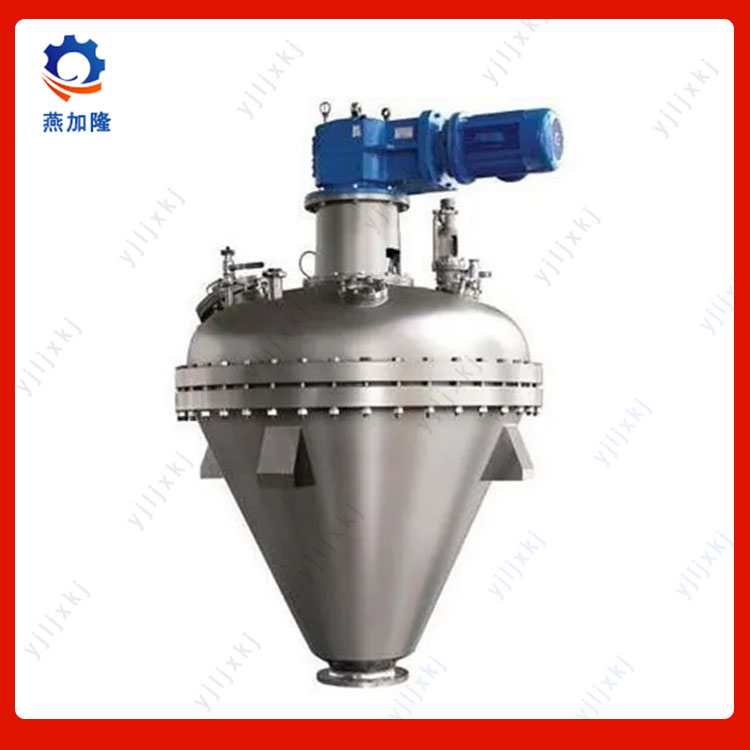
Single Cone Vacuum Dryer for Efficient Solvent Recovery
Working Principle
A Single Cone Vacuum Dryer operates by combining gentle tumbling motion with reduced pressure inside a conical vessel. As the vessel rotates at low speed, wet material is continuously lifted and cascaded along the inner wall, exposing fresh surfaces to heat transferred through a jacketed shell. The vacuum environment lowers the boiling point of solvents present in the material, allowing evaporation to occur at significantly reduced temperatures compared to atmospheric drying methods.
Solvent Recovery Mechanism
The solvent recovery process in a Single Cone Vacuum Dryer follows a closed-loop pathway:
- Evaporation – Under vacuum conditions (typically 10–50 mbar), solvents vaporize from the product at temperatures often below 60°C.
- Vapor transport – Evaporated solvent travels through a dust filter at the vessel outlet, preventing particulate carryover.
- Condensation – Vapor enters an external condenser where it returns to liquid form and collects in a receiver tank.
- Vacuum maintenance – A vacuum pump removes non-condensable gases, sustaining stable operating pressure throughout the cycle.
This arrangement allows recovery rates exceeding 95% for common organic solvents such as ethanol, acetone, and hexane, depending on condenser capacity and coolant temperature.
Technical Factors Affecting Recovery Efficiency
| Parameter | Influence |
|---|---|
| Jacket temperature | Controls heat input rate; must stay below product degradation threshold |
| Vacuum level | Determines solvent boiling point depression |
| Rotation speed | Affects material turnover and surface renewal |
| Condenser sizing | Governs vapor capture capacity per unit time |
| Seal integrity | Prevents air ingress that compromises vacuum stability |
Application Context
High Efficiency Single Cone Vacuum Dryer Unit are used across pharmaceutical, fine chemical, and battery material production where solvent-containing filter cakes or pastes require drying with simultaneous solvent reclamation. The conical geometry promotes complete discharge without residual heel, reducing cross-contamination between batches. Because the process occurs in a sealed, oxygen-limited environment, it also suits materials sensitive to oxidation or those classified as combustible dusts.
Operational Considerations
- Filter elements require periodic cleaning or replacement to maintain vapor flow.
- Condenser coolant temperature should remain at least 15–20°C below the solvent's boiling point at operating pressure.
- Loading volume typically ranges from 30% to 60% of total cone capacity for effective mixing.
- Cycle endpoints can be determined by monitoring condensate collection rate or inline moisture sensors.
The integration of drying and solvent recovery within one sealed unit reduces transfer steps, limits operator exposure, and supports compliance with environmental emission regulations.