
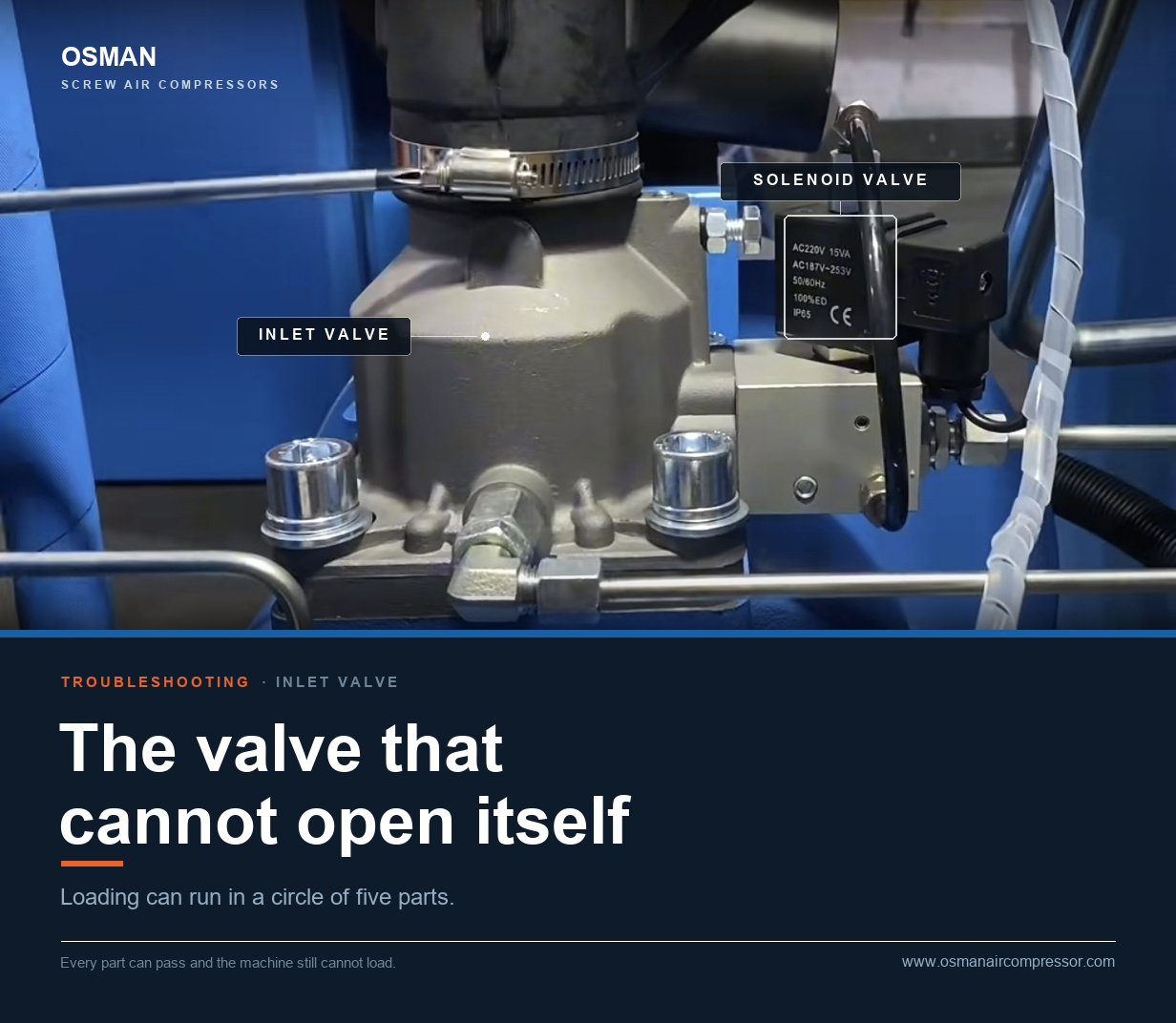
An operator calls this "not loading". The phrase covers three different faults, and each needs a different repair. One question separates them before anyone picks up a wrench.
The full list of screw compressor faults is longer than this article and mostly a list. This one follows the actual loading sequence, which narrows the cause.
What does the controller say it is doing?
Three faults wear the same complaint
A screw compressor loads by opening a valve at the intake. Air enters, the airend compresses it, and pressure builds in the separator tank, then the receiver. Three things can go wrong along that path.
The valve does not open, the machine runs unloaded and the gauge stays where it was.
The valve opens part way. The machine produces air, but less than its rating, and pressure climbs slowly or settles below the set point.
The valve opens fully and pressure still does not rise. The intake is doing its job, and the air is going somewhere else.
Some of those losses sit inside the machine. A blowdown valve that stays open during loading keeps releasing separator tank air, and pressure stops building normally. Internal leakage past worn rotors or a worn shaft seal removes air more slowly.
Others sit outside it. A large plant leak, or a machine too small for the demand, keeps the receiver below the set point.
That third case is the one that gets missed. None of the faults behind it will be fixed by touching the intake.
A first check at the inlet
Being told the machine is not building pressure is a description, not a diagnosis.
Start with the controller. Record discharge pressure, motor current and any active alarm.
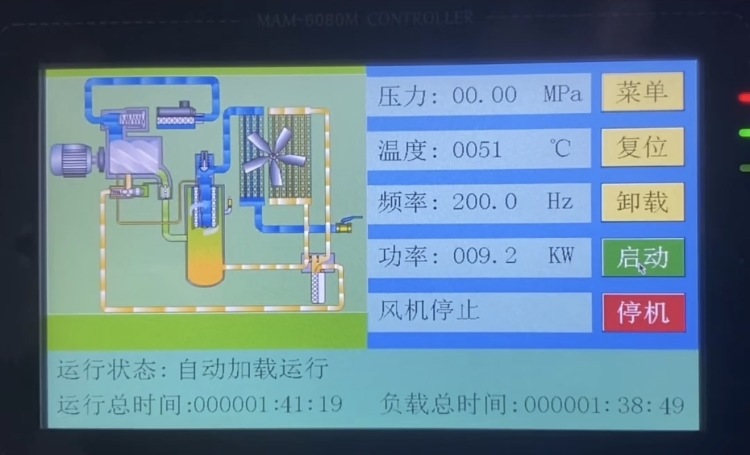
Do not pull the air filter element and look into the throat while the machine runs. An open intake pulls unfiltered air into the airend, and nothing in there is safe to reach into. Where valve travel has to be seen, follow the manufacturer's procedure and use the point it names.
The split between the three cases comes from instruments, not eyes. Read separator tank pressure and receiver outlet pressure separately. The half-open valve is the expensive one to miss, because the panel suggests nothing.
Loading is a loop, not a list
On an oil-injected screw compressor the intake valve is usually held open by air pressure, not by a motor. The controller signals, a solenoid opens, and air travels down a small line to a piston or diaphragm that opens the valve.
Where that control air comes from is a design choice. Many machines take it from the separator tank or an internal discharge passage and reduce it before the actuator. Others use a three-way valve, a separate circuit, or a mix of spring force and pressure. The manual is the only authority.
On the designs that draw control air from the machine's own pressure, the control sequence forms a loop.
The valve needs control air to open. Control air needs pressure in the tank. Tank pressure needs the valve open.
Something has to break that loop at every start. Residual pressure from the last run, a minimum pressure valve holding a floor under the tank, an inlet valve that cracks open before control pressure arrives. Which carries the start depends on the build.
The arrangement works until one element is weak. Then the machine sits inside the loop and never leaves.
Why the checklist fails here
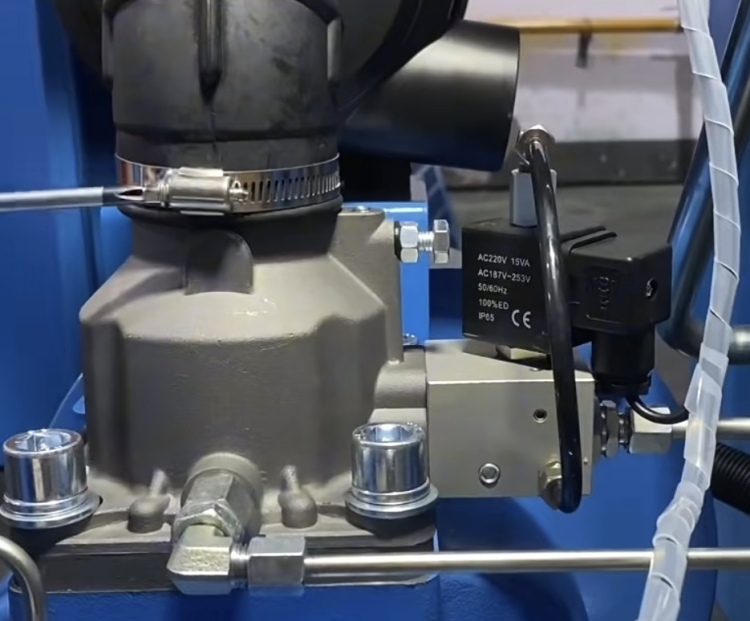
A technician with a list checks the solenoid. It clicks. The coil reads correctly. He works the intake valve by hand with the machine off. It moves freely. Every part passes and the machine still will not load.
Nothing on the list was wrong. The order was.
A part can pass on the bench and fail in the loop, because the bench does not reproduce the working condition. A solenoid can click without allowing air to pass. An intake valve can move by hand and still fail to travel when the actuator gets less pressure than it needs.
Judge the part in the loop, never on the bench.
Five checkpoints, in the order the load command travels
The command. Read the controller, not the gauge. A load signal with a clearly low receiver outlet points at everything after the controller. A display reading unloaded with the gauge below the load point means the controller is acting on a bad number.
The solenoid. It should respond when the controller asks for load. A click means the coil is energised, and that is all. A valve with a stuck spool, a blocked port or a failed seal clicks all day and passes nothing. Check the voltage at the coil, then confirm the valve changes the air path.
The control line. Look for cracks, loose push fittings, a tube flattened against a panel, a kinked section. A line can look perfect at rest and starve the actuator once it strokes. Where the procedure allows it, measure control pressure through the cycle.
The actuator. With control air supplied, the piston or diaphragm should carry the valve through full travel. A torn diaphragm gives part travel and a slow pressure rise. That reads as a weak machine, not a broken one, and half-travel faults stay undiagnosed for months.
Separator tank pressure. On machines that draw control air from the tank, this checkpoint explains the loop. The minimum pressure valve maintains a minimum pressure inside the separator tank, which helps ensure proper oil circulation and stable operation of the oil separation system. It also prevents compressed air from flowing back from the downstream system when the compressor stops. This valve leaking past its seat drops that floor on unload, and the next start has nothing to work from.
Less obvious control faults
A pressure sensor that reads higher than the actual pressure reports a full system when the receiver is empty. The controller sees a satisfied system and holds the machine unloaded. The opposite drift produces a machine that never unloads. Both live in the same sensor. A calibrated gauge on the test point settles it in a minute.
Set points get changed, restored from a backup, or left as they were when a machine moves to a different duty. Any of these can put the load point out of reach. The controller behaves correctly. The numbers are wrong.
An interlock holds loading off and often shows only a running state. High discharge temperature, low oil pressure, a load inhibit contact left open, an expired maintenance timer. The alarm history is where these live, and the first screen to photograph.
Four cases that look like a valve
An air compressor inlet valve stuck closed is the obvious suspect. Some of these calls have nothing to do with the intake at all.
The machine that was just serviced. A control line pushed off its fitting, a solenoid plug not seated, an actuator refitted one spline out of position. Service faults appear at the first start and cluster around what was touched.
The machine on a cold morning. Thick oil takes longer to circulate, and some machines hold off loading until the required temperature is reached. A slow first start in winter is not the same fault as one that never loads.
The machine with a shut isolation valve. A manual valve left closed at the receiver outlet, a filter housing with the element in backwards. Pressure builds to the blockage and stops. The compressor is loading perfectly and the plant cannot see it.
The variable speed machine. A VSD compressor matches output to demand mainly by changing motor speed. Most still have an inlet valve, which operates during starting, unloading and shutdown, depending on the control design. At low demand it may reach minimum speed and switch to unloading rather than keep reducing output. It can run for hours without doing what an operator recognises as loading.
When it is not a loading fault
An air compressor not building pressure is a symptom, and the intake is only one of the places it starts.
Read pressure at two points. Separator tank pressure shows the pressure inside the compressor's separation system. Receiver outlet pressure shows what the downstream system has available.
A significant difference points at excessive pressure drop between them. Check the minimum pressure valve, the separator element, after-treatment filters, dryer and isolation valves for restrictions.
If both readings stay low, establish two things before blaming the intake. Is the controller issuing a load command, and is the motor at the speed and load it should be?
Low pressure with no load command points at the controller or the loading sequence.
Low pressure with a confirmed load command and the machine at its expected speed points at insufficient air production or a pressure loss. Check the inlet valve position, the blowdown valve, the airend and internal leakage before blaming the plant.
On a VSD machine, read current with speed and controller status. Current alone says little when the motor speed is free to change.
Beyond the machine, the same complaint comes from capacity. A leak, an undersized machine, or a demand that grew all arrive described as won't load.
A compressor that makes air and loses it is a different fault with a different test. We have written about that one separately.
Frequently asked questions
Why does my screw air compressor run but not load?
A solenoid that will not pass air, an inlet valve stuck shut, insufficient control pressure at the actuator, or a controller holding the machine unloaded on a wrong reading. Which one it is depends on how the intake is controlled.
Can a faulty minimum pressure valve stop a compressor loading?
On designs that take control air from the separator tank, it can. It cannot on designs with a separate control circuit. Find out where the control air is drawn from first.
Why does my screw air compressor build pressure slowly? Part travel at the intake, a torn diaphragm, a control line that leaks only when it flows, or an airend worn enough to leak internally. Excessive downstream demand does it too, with nothing wrong with the machine. Slow is the one operators live with longest.
Before you order the part
Test the part in the loop, line connected, machine calling for load, where the procedure allows. Confirm air arrives at the actuator. Move the valve under control pressure, not by hand.
Record what the controller showed at failure: load signal or none, discharge pressure, discharge temperature, run hours, last alarm. A photograph of the screen answers most supplier questions. Then order. A valve bought to test a theory is money on a guess, nearly always the same guess.
The valves in this circuit do unrelated jobs and wear at unrelated rates. If you are deciding what to keep on the shelf, that mapping is worth reading before you buy. If you know the valve, the replacement parts range is listed by machine type.
Safety, and what to send us
Control air in this circuit sits close to system pressure. A line disconnected on a running machine can whip, and the fittings are small enough to be underestimated.
Before any work on the control circuit, shut the compressor down and isolate the electrical supply. Lock it out, then release stored air pressure per the manufacturer's procedure. Confirm the system is fully depressurised before disconnecting a control line or a fitting.
The solenoid circuit carries electrical power as well as air. Testing and working on it belongs to someone qualified.
If a machine will not load and the checks above have not found it, send the controller screen, the model and the pressure readings at failure. We can usually narrow the cause from those, and often tell you which part not to buy.