
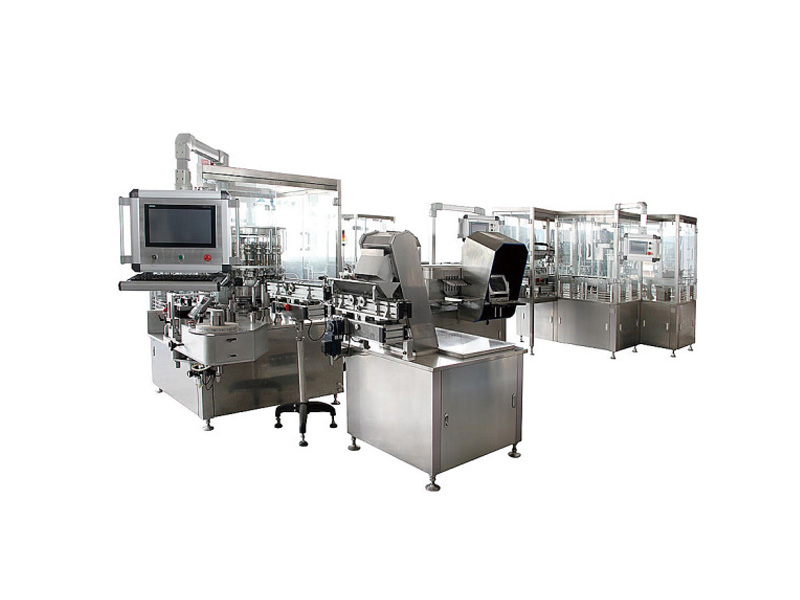
The payback math first, then the four failure points that turn a $150,000 upgrade into a $400,000 rebuild.
1. When Does Retrofitting Beat Buying New — and When Does It Fail?
Run the labor arithmetic before anything else: if manual inspection and loading consume more than $150,000 a year in loaded labor, automation repays its hardware in 12–24 months. Everything else in the decision is secondary to that number.
A 200-syringe-per-minute line running manual inspection needs 3 qualified inspectors per shift. At two shifts and a loaded cost of 30,000–45,000 per inspector per year in US or EU plants, that is 180,000–270,000 annually — against a 120,000–280,000 machine. Add the cost of defects that reach a customer and the case closes itself.
|
Condition on your existing line |
Verdict |
|
Under 8 years old, spare parts available, documented PLC |
Retrofit the weak stage |
|
Cam-driven mechanical filler, no servo control |
Replace the filling module — retrofit cannot add vacuum stoppering or checkweighing |
|
Nest or tub format differs from the new machine's transport |
Full replacement; adapting transport eats the savings |
|
Obsolete controls, no electrical drawings |
Replace — re-engineering undocumented I/O costs more than new hardware |
|
Less than 6 m of free floor length |
Redesign the room before quoting any machine |
The last two rows decide more projects than the first one. Migrating from standalone machines to a Pre filled Syringe Complete Packaging Line only pays when the tub never has to be re-oriented between stages — if your current machines handle bulk trays while the new equipment expects nested tubs, you are buying a line and a material-handling problem at the same time.
The filling module is the usual exception
Fillers age differently from the rest of the line. A 2015-vintage Syringe Filling and Stoppering Machine with rotary piston pumps and no weight feedback cannot be upgraded to ±0.3% accuracy by adding sensors — the mechanical dosing system caps it at ±1–2%. For high-value biologics that accuracy gap is worth more than the machine; at 10 million units a year, moving from 1% to 0.3% fill variation recovers roughly $200,000 of overfill per year at $50 per millilitre. Replace that module, keep the transport and downstream stations.
✅ Bottom line: Automate the stage with the largest annual labor or scrap cost first, and replace — not retrofit — any cam-driven filler or undocumented control system.
2. What Breaks During Integration — and How Do You Plan the Shutdown?
Four things break: height, handshake, validation and time. Three of them are visible on a drawing; the fourth only shows up when the line is already stopped.
The four failure points
- Height and pitch. Existing conveyors run at 850–900 mm with their own nest pitch; a new machine arrives at its own datum. Ask the supplier for a transport interface drawing at quotation stage, not after FAT. A 20 mm height mismatch is a $200 fix before install and a two-week delay after.
- Control handshake. The new station must exchange start/stop, fault and reject signals with your line PLC. Agree the protocol — hardwired I/O, Modbus or OPC UA — in the purchase order. Lines from different eras mix protocols, and every interface nobody specified becomes an engineering day on site.
- Validation scope. Adding automation outside the product path triggers IQ/OQ on the new unit plus a limited performance qualification. Touching the filling or stoppering boundary triggers a media fill. Budget 8–10 weeks of validation either way; it does not compress.
- Calendar. The install window is the risk nobody prices. Plan the shutdown around it, not the other way round.
A four-week shutdown that actually holds
- Week 0, offsite — complete FAT at the supplier with your syringes and placebo. A General Allpack retrofit ships only after running your actual nest format through the machine, which removes the largest single source of on-site delay.
- Week 1 — utilities rough-in (power, CDA, vacuum, network) while the line still runs.
- Week 2 — cut out the old station, set the new machine, align transport.
- Week 3 — wiring, PLC integration, dry cycling with empty tubs.
- Week 4 — engineering runs with product, requalification sampling, release to production.
Retrofits that skipped week 0 routinely stretch to 8 weeks. The delta is not installation skill — it is discovering a format mismatch with the line already open.
When the retrofit target is inspection
An automated Visual Inspection Machine is the most common first retrofit because it attacks the largest labor line item, but it changes your defect statistics on day one. A 1–3% false-reject rate means the re-inspection bench and its operator are part of the project, and your validated AQL sampling plan needs re-baselining against the new reject stream. Keep the manual booth as a backup — it costs floor space, not headcount, once automation carries the load.
✅ Bottom line: Freeze the transport interface drawing and the control protocol in the purchase order, and run FAT on your own nest format before the line ever stops.
FAQ
Q: Can we keep manual inspection as a backup after automating? A: Yes, and most auditors like seeing it. Standard practice is 100% automated inspection plus periodic manual AQL sampling of accepted units. The booth keeps its validated lighting and stays in the procedure as the fallback when the machine is down.
Q: How long does production actually stop for a single-station retrofit? A: Two to four weeks for one station, provided the FAT passed on your real format and utilities were roughed in beforehand. Each unplanned surprise — a pitch mismatch, a missing signal list — typically adds a week.
Q: Does the payback math still work in a low-labor country? A: Directly, less often — at 8,000–12,000 loaded labor per inspector, hardware payback stretches past four years. Justify the machine on scrap and escape cost instead: one escaped defect lot in a $50/mL biologic can exceed the price of the inspection station.
Q: Can an OEM integrate equipment into a mixed-brand line? A: Regularly — most plants run machines from three or four vendors. General Allpack supplies the transport interface drawing and signal list as part of the quotation, and as a China-based manufacturer builds custom nesting and format parts for lines it did not originally install. Factory-direct pricing on the retrofit module is quoted against your existing layout, not a catalogue.
Send Your Line Data, Get a Retrofit-or-Replace Verdict
Email General Allpack — the syringe equipment brand of Zhejiang General Machine Co., Ltd. (Jinuo) — with your current line layout, machine ages, nest format and annual inspection labor cost. You will receive a written retrofit-or-replace verdict per stage, a payback calculation in your own labor rates, and a four-week shutdown schedule — free, and specific to the machines you already own.
 Phone:+86 13235773171 Mail:[email protected]
Website:www.generalallpack.com