
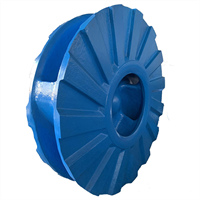
Clearance: the failure mode that leaves no debris
Front clearance is the gap between the impeller inlet and the throatbush. It is set during assembly, is not visible in operation, and opens progressively as both surfaces wear. As it opens, a proportion of the slurry being pumped is pushed back through the gap instead of out of the discharge. The recirculating flow is at high velocity and carries abrasive solids directly across the impeller eye and the throatbush bore.
The consequences are cumulative and self-reinforcing. Lost clearance means lost flow, which means the pump runs further from its best efficiency point, which increases recirculation, which accelerates clearance loss. By the time the operator notices reduced throughput, both parts are worn through.
Three practical measures reduce this substantially. Check clearance with a feeler gauge at every lubrication interval. Replace the impeller and throatbush as a pair rather than sequentially. Record installation dates so the interval is measured rather than guessed. Pumps run with maintained clearance typically see a meaningful extension in impeller life compared with pumps where clearance is corrected only at failure.
Cavitation and abrasion look different once you know what to look for
Abrasion removes metal where the slurry flows fastest and hits hardest — the vane outlet, the shroud periphery, the cutwater. The surface stays smooth and the edges stay defined, even as material disappears.
Cavitation removes metal where pressure is lowest — typically the suction side of the vane and the inlet eye. The surface becomes rough, spongy and cratered, with overlapping pits and no directional pattern. It looks, in the familiar description, like the casting has been eaten by worms.
The distinction matters commercially. Abrasion is solved by material. Cavitation is solved by hydraulics, and no alloy resists it for long. A pump cavitating hard enough will destroy a high-chrome impeller in weeks, and each replacement will be blamed on the foundry.
Cavitation also produces a signature that is audible before it is visible: a sound like gravel being pumped, together with fluctuating discharge pressure and vibration. Operators who know that sound save themselves an impeller.
Repair, rebalance or replace
Impellers are sometimes built up by welding and returned to service. The practice is legitimate in some applications and inappropriate in others, and the dividing line is straightforward.
Repair is reasonable where wear is localised, the base metal is sound, and the part will be re-machined and rebalanced afterwards. It is not reasonable where the shroud has been perforated, where cracks have propagated into the hub, or where the alloy is a high-chrome white iron — these materials are not readily weldable in the field, and a repaired high-chrome impeller frequently fails at the weld boundary rather than at the wear face.
Any repaired impeller must be rebalanced before installation. An unbalanced impeller transmits vibration directly into the bearing assembly, and bearing failure then gets recorded as a bearing problem. This is one of the more expensive forms of misdiagnosis in a maintenance log.
Specifying the replacement
Four parameters define a correct impeller order, and all four should be stated explicitly rather than inferred from the pump model alone.
· Outside diameter. Measured across the vane tips on the worn part. Trimming is common, and a pump may have been down-rated deliberately — ordering the catalogue diameter will restore flow the plant may not want.
· Vane count and profile. A change in vane count changes both the head characteristic and the passage size for solids. It is a legitimate engineering change, not a substitution.
· Material and hardness. Specify the alloy by standard and the hardness range by test method, so that both are verifiable at goods-in.
· Balance grade and inspection record. Ask for the balancing report. A supplier who balances impellers will have one; a supplier who does not will change the subject.
Where the pump model is known and the part number is available, the part number plus the measured diameter covers nearly every case. Where the nameplate is missing, measure the impeller diameter, the shaft diameter and keyway, and the bolt pattern on the suction side, and send photographs with a ruler in frame.