
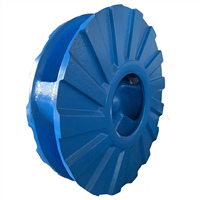
Reading Impeller Wear: A Field Guide to Slurry Pump Failure Diagnosis
The impeller is the most photographed component in a slurry pump, and the least often read correctly. Its wear pattern records how the pump has actually been running — which way the solids were travelling, where the pressure dropped, whether the clearance was maintained — long before the failure becomes visible as lost production. Replacing the part without reading the pattern is how the same failure gets purchased twice.
Why the impeller tells you more than any other part
A volute liner shows you where the slurry left the impeller. An impeller shows you what the slurry did while it was inside. Because the impeller is the only component that contacts the slurry at the point of maximum velocity and the point of minimum pressure in the same rotation, its surfaces record both the abrasion history and the hydraulic history of the installation.
That makes it the most informative part in the pump, and the one where a correct reading changes the purchasing decision. In a significant share of cases, the correct decision is not to buy a harder impeller at all, but to correct the condition that destroyed the last one.
Five wear signatures and what they mean
Photograph the worn impeller before it is removed from the site, from both sides and from the inlet eye. Then compare it against the patterns below.
|
Signature |
What caused it |
What to buy or change |
|
A. Deep grooves at the vane outlet |
Solids too coarse for the hydraulic passage; particles are being dragged, not carried |
A wider-passage impeller or a coarser-duty alloy; check the strainer and the maximum particle size in the duty data |
|
B. Ring-shaped scoring around the inlet eye |
Excessive clearance between impeller and throatbush; slurry recirculating at high velocity |
New impeller and new throatbush, fitted to the correct clearance. Replacing only the impeller repeats the failure |
|
C. Spongy, pitted, cratered surface |
Cavitation — vapour bubbles collapsing on the surface, not abrasion |
Nothing. Correct the suction condition: blocked strainer, undersized suction line, entrained air, excessive lift or too-high speed |
|
D. Cracks at the hub fillet or vane root |
Casting defect, thermal shock, or mechanical loading from tramp material |
Claim against the supplier with the heat number; check for tramp metal upstream and for a magnet or grate in the sump |
|
E. One vane worn, the others intact |
Localised recirculation or a distorted casing; sometimes a mis-set liner |
Inspect the volute and suction liner for distortion before ordering. A new impeller in a distorted casing will wear unevenly again |
Two of these five patterns — B and C — are routinely misread as "the metal was too soft". In both cases, buying a harder impeller makes no difference to service life, because the damage mechanism is not abrasion. This is the most common way money is wasted in slurry pump maintenance.