
Precision Gear Injection Mold Tooling: A Strategic Blueprint for Stable Torque Transfer and Long-Life Plastic Drives
Nov 22, 2026
Tooth-Profile Accuracy and Shrinkage Compensation: The Technical Roadmap for Repeatable Precision Transmission Parts
Plastic gears are increasingly used in compact actuators, office equipment, automotive mechanisms, medical instruments, robotics, pumps, and consumer devices where low noise, low mass, and corrosion resistance matter. Their commercial value depends on more than a clean molded appearance. Tooth geometry, concentricity, shaft fit, backlash, material conditioning, and long-term wear must work together inside the finished transmission. [Precision Gear Injection Mold Tooling] therefore links cavity machining, shrinkage planning, gate strategy, cooling balance, demolding, and gear inspection into one production-focused program.
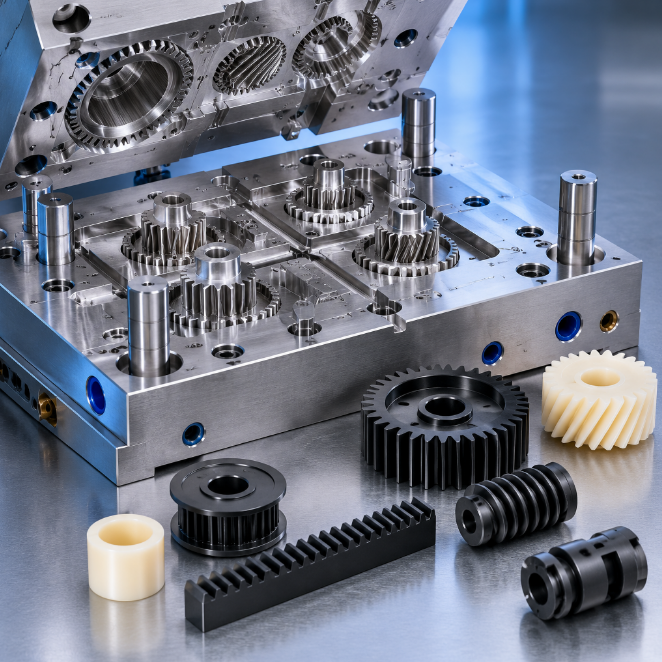
The first engineering priority is [Tooth-Profile Accuracy and Shrinkage Compensation]. A stable gear mold must reproduce involute teeth, root fillets, bore geometry, datum features, and support ribs while allowing for resin shrinkage and part ejection. Gate position, cooling symmetry, steel condition, cavity alignment, and ejection force can influence roundness and tooth-to-tooth consistency. Replaceable core details and serviceable wear regions help the tool remain maintainable when a critical bore, insert, or tooth-form surface requires attention.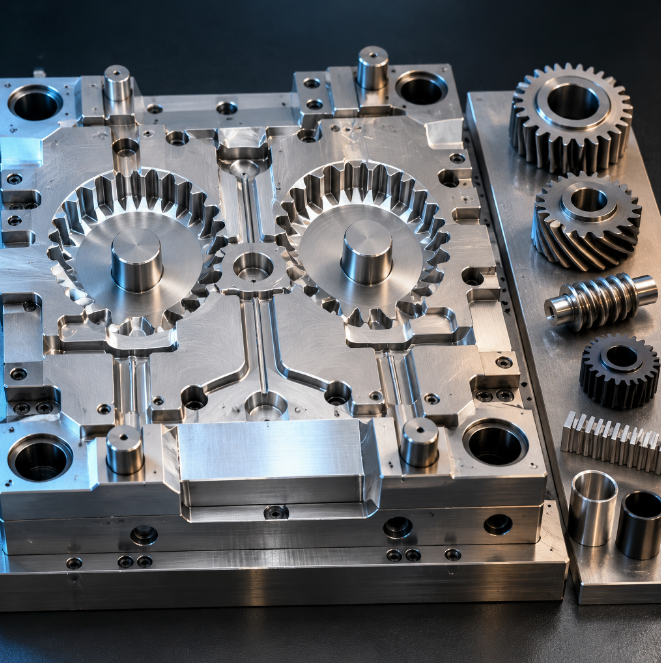
For transmission buyers, [Repeatable Plastic Gear Performance] means more than a gear that passes a first dimensional check. It means that gears, worm wheels, racks, pulleys, bushings, and drive couplers can maintain controlled mesh, shaft fit, noise behavior, and functional torque transfer across production lots. A practical qualification plan links cavity identification with gear measurement, bore and runout checks, backlash review, material-lot records, and functional mesh testing. This evidence gives engineering and sourcing teams a clearer route for separating molding variation from assembly or system-level causes.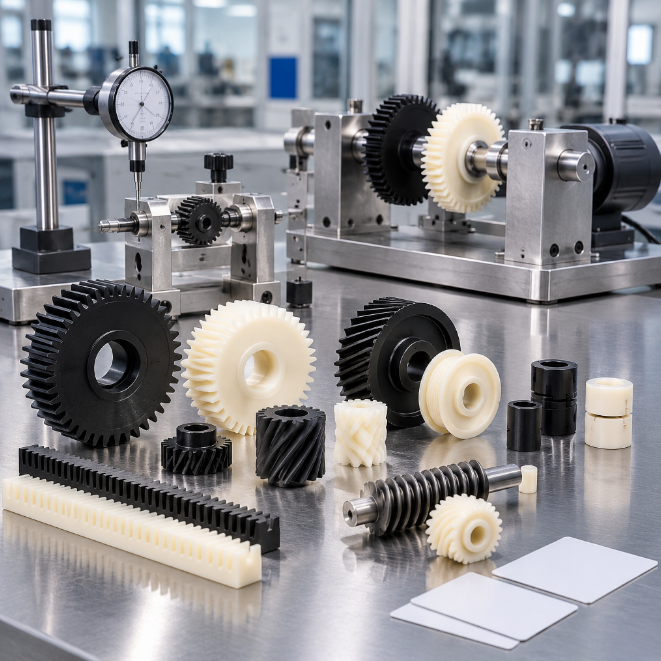
Long-term serviceability also matters because precision drives may remain in production across several product revisions. Access to core inserts, vents, ejectors, cooling circuits, and inspection datums should support planned maintenance without disturbing unrelated mold features. Defined spare parts, protected gear-form surfaces, restart checks, and retained reference gears reduce the risk of an avoidable dimensional shift reaching final assembly. When gear design, polymer selection, mold engineering, process qualification, and functional inspection are planned together, buyers gain a more reliable route from prototype transmission to stable production.