
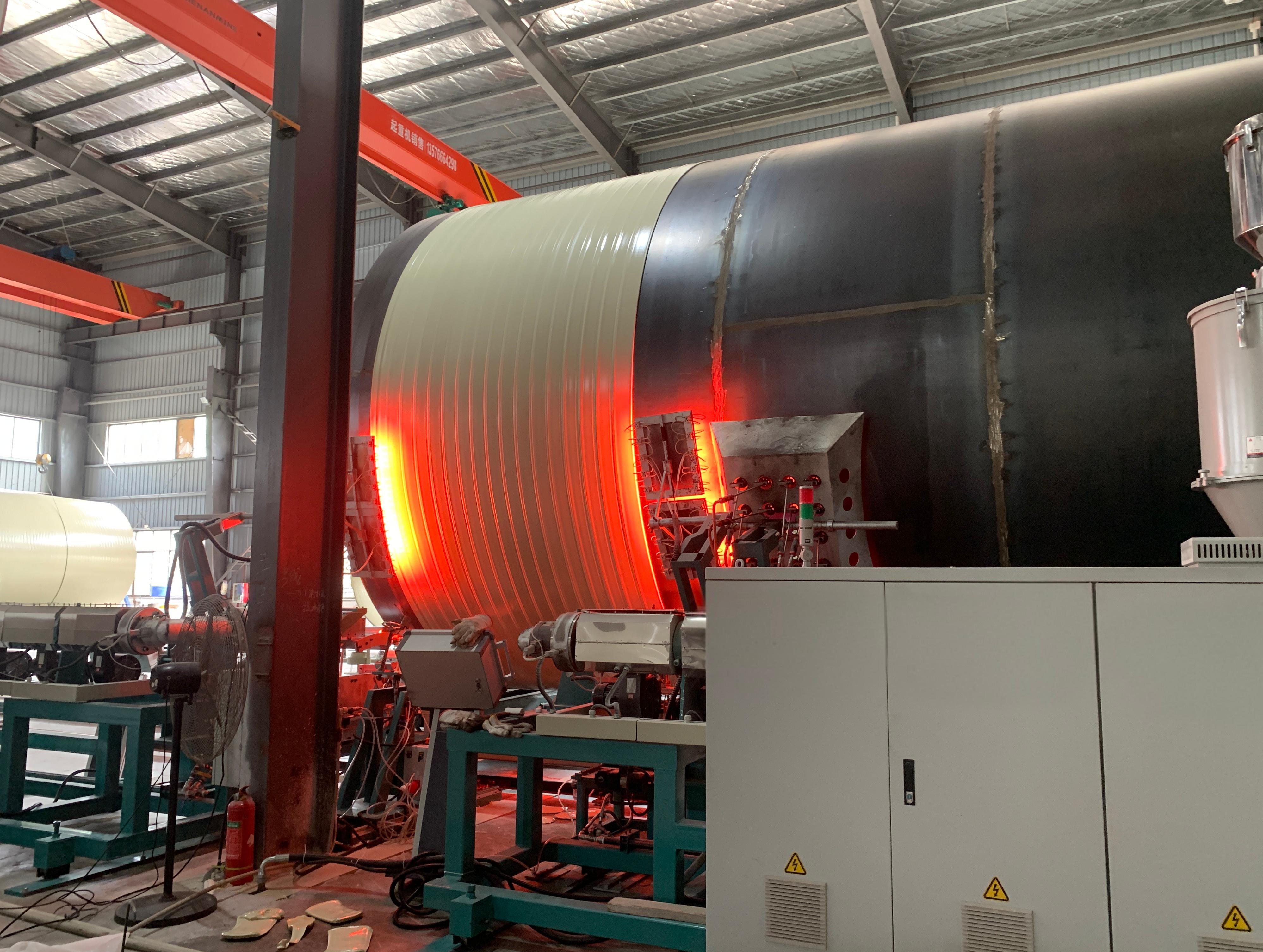
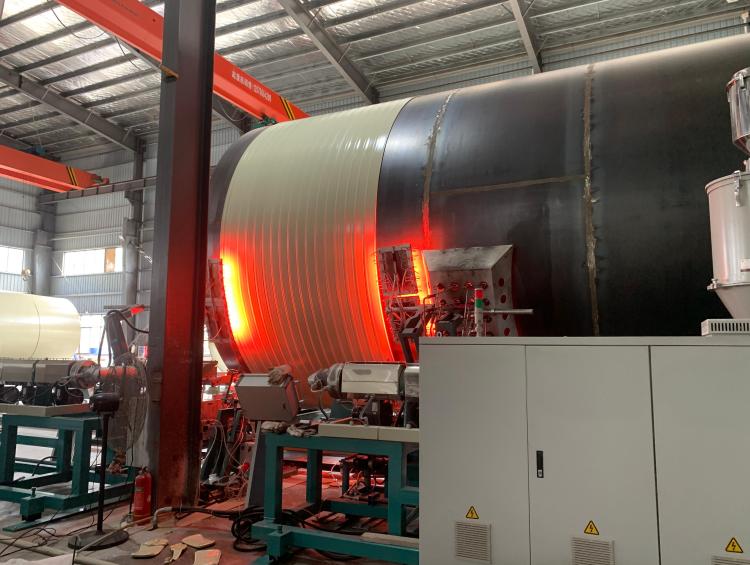
Two extruders sit on a dual-line winder, and they do not take turns. Both feed a melt band at the same time, one from either end of the shell, meeting somewhere near the middle as the mandrel turns. When the wall reaches thickness the machine stops, the tank cools, and what comes off has no weld running top to bottom. At Minghui's base in Jiangxi, every PPH Storage Tank leaves the line this way. The resin behind it is polypropylene homopolymer, and dual-line winding is the part of the job buyers rarely get to see.
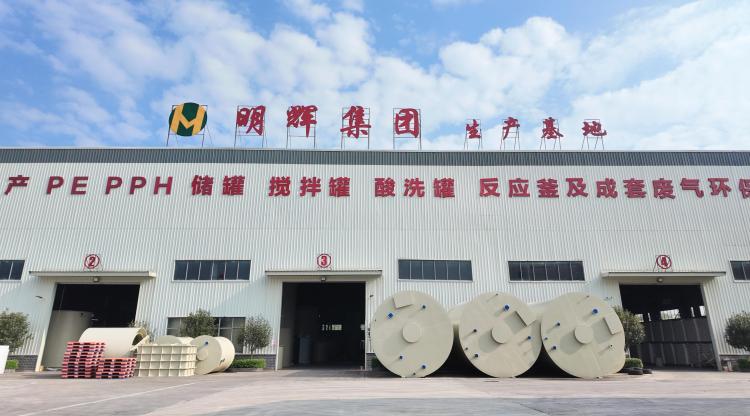
The Minghui production base in Jiangxi
Buyers tend to assume the resin decides everything. It decides a lot, but two workshops can run the same granule lot and still ship tanks that look identical in a photograph and part ways after a year and a half in a pickling room. What separates them sits in the gap between the die and the shell. Melt temperature wandering two or three degrees across a long run. A tension roller that reads right on the gauge and is not really holding. A lap that comes out wide on nights and tight in the morning, depending on who is running the machine. None of it shows on a datasheet, and by the time it shows, the tank is already bolted down.
Minghui runs more than one winding line, and the range coming off them is wider than most visitors expect. Polypropylene (PPH) and polyethylene (PE) vessels, tanks for pickling, mixing and reaction, plus the scrubbers and ducting that go with them. Small dosing tanks of a few hundred litres, horizontal storage units of several dozen cubic metres. Chemical plants order from that list; so do electroplating shops and wastewater stations; no two orders are drawn to the same dimensions.
Two methods dominate the trade. The older one uses a single extruder, one band, wrapped round and round with each pass lying on the one before. Dual-line winding uses two, starting at opposite ends and crossing in the middle under a controlled overlap. On paper it sounds like a question of speed. Where it actually shows is in the finished Polypropylene Storage Tank: a denser wall, fewer voids trapped between passes, and a shell that stays round under load.
Running it well is mostly a matter of not letting anything drift. Granules go in, melt comes out, and the band has to arrive at the shell at steady tension while the mandrel turns at steady rate. Pitch, lap width, die temperature, screw speed and haul-off all pull against each other, so move one and something else goes with it. Anyone who has spent an afternoon beside a winder knows the sound it makes when the band is running right, and notices when that sound changes. After the last pass the tank is left to cool and harden before it leaves the mandrel.
Strength comes from the cross. Where two bands meet at an angle the contact patch is wider than two passes laid flat over one another, and the layers key in more thoroughly. What that buys is stiffness. In a tall vessel holding heavy liquor, stiffness is what keeps the shell from bulging between windings, and on a large-diameter PPH Chemical Storage Tank it is usually the first thing an experienced buyer checks, hand flat against the wall, walking the length of it.
Heat is harder to see and matters just as much. The band leaves the die molten and consolidates as it cools, so each pass brings heat in and takes some away. One band working alone delivers that heat from a single side at a time, and the two flanks of a big shell can sit at noticeably different temperatures through the run. Two bands even it out. Cooling is more uniform, fusion reaches deeper into the layer beneath, and the stress locked into the wall after cooling is lower. Cracks and slow weeping joints usually start where that stress was left behind.
Seams are where acid does its work. A welded shell carries a heat-affected strip along both sides of every joint, and that strip is softer, dirtier and more stressed than the plate around it. Pitting usually starts there, and so does the first seep. Winding takes the joint out of the shell altogether: the wall goes down as one piece, with no strip for acid to work on. The laps where the two bands cross are pressed flat as they are laid, so the outside of a PPH Acid Storage Tank stays smooth to the hand, no ridge, no step for a gasket to sit on wrong. On a 20 m3 tank you would not see the difference. In year four, down at the bottom knuckle where condensate collects, that is usually what decides whether the tank stays in service.
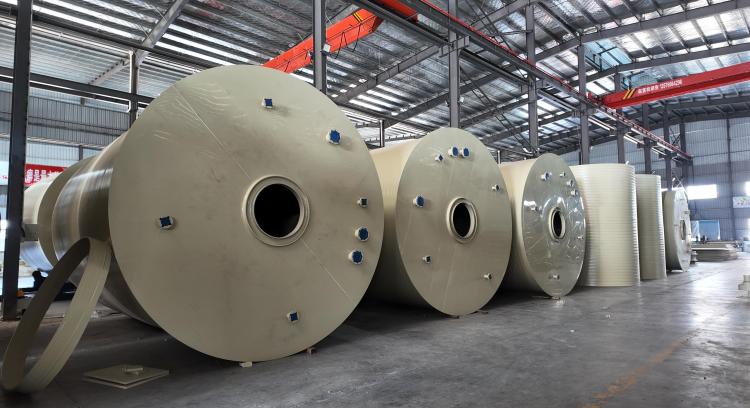
Large PPH winding tanks
Then there is delivery. A single-line machine ties up a big shell for two weeks or more; with both extruders running against the same shell that comes down to about a week, and the line is free for the next order. Nobody asks about this while quotations are being compared. They ask when a tank gives out mid-run and the replacement has to be standing on site before the shutdown ends. Two extra weeks is not a discount anyone can negotiate back.
Where these tanks end up is ordinary and demanding in equal measure. Acid and caustic storage. Dosing rooms where somebody tops up a day tank twice a shift. Effluent plants running continuously, where a repair means a shutdown nobody wants. Fittings are where a good tank shows itself: a Chemical Dosing Tank might need six nozzles in set positions, each welded, faired and tested without leaving a stress riser behind. A mixer needs its shaft and baffles seated so the mounting does not weep.
If you are comparing suppliers and cannot get to the workshop, ask for what is hard to fake. Close-up photographs of the lap area. Wall thickness readings at several heights rather than one. A straight answer on whether the shell carries a weld, and how many extruders were feeding the mandrel. None of it will decide a purchase on its own. Over five years in an acid room, it settles a good deal.
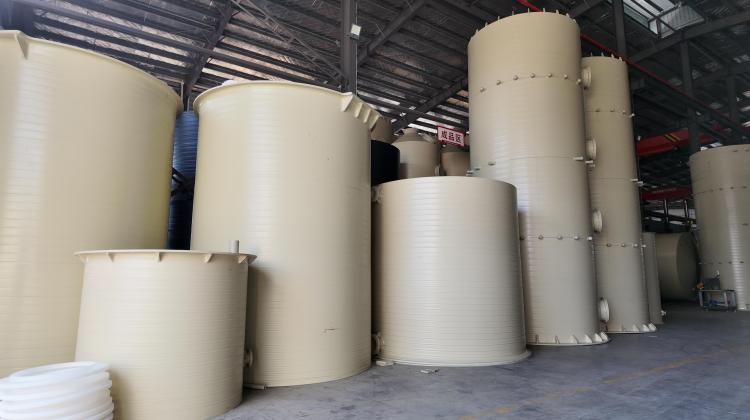
Finished PPH tanks of different sizes in the finished-goods area
Minghui has been winding tanks this way for years and the workshop stays open to anyone who wants to look. There is no ceremony to a visit. You walk the lines, watch a shell going round, put a hand on the wall while it is still warm, and ask the technicians whatever comes to mind. Buyers weighing a PPH Liquid Storage Tank against their own duty tend to find half an hour on the floor settles more than a month of emails.