
1. The Two Elastomers, and What Two Years of Data Showed
Both liners fail by cutting and tearing — not by the grooving that kills high chrome — which is why the polyurethane vs rubber liner for fine sand slurry question only makes sense at fine particle sizes. Beyond that, they are different materials with different failure triggers.
|
Property |
Natural rubber liner |
Polyurethane liner |
|
Hardness |
Shore A 45–60 |
Shore A 80–90 |
|
Cut / tear resistance |
Good |
Excellent — the key PU advantage |
|
Rebound (impact absorption) |
Excellent |
Moderate |
|
Temperature limit |
~90 °C |
~60–70 °C (softens; ester grades hydrolyse in hot water) |
|
Hydrocarbon / oil resistance |
Poor — swells |
Good |
|
Chemical tolerance |
pH 2–12, not solvents |
Good acids/alkalis; weak in hot steam, strong solvents |
|
Coarse particle tolerance |
Up to 5–8 mm rounded |
Up to ~10 mm, but impact chunks edges |
|
Cost per set |
Baseline |
1.2–1.4× |
The two-year field track covered roughly forty wet-end builds in river and marine dredging, sand washing and classifier circuits. Three patterns held across almost every site. First, in angular fine sand (d50 150–300 µm, crushed quartz), polyurethane liners — mostly throatbushes and frame liners — delivered 1.5–2.5× rubber life, because sharp 0.5 mm grains slice a soft rubber surface continuously but only abrade the harder PU skin. Second, in hot duties above roughly 60 °C — thickener underflow returning process water, or pumps sitting near heat exchangers — PU life collapsed below rubber, with ester-based polyurethane hydrolysing into a tacky, delaminating layer; ether-based PU held up better but still lost to rubber past 70 °C. Third, wherever the slurry carried oil, grease or diesel contamination — common on dredges — rubber liners swelled and degraded while PU was unaffected.
One more pattern matters for procurement: the advantage is size-dependent, not universal. On rounded river sand at low head, rubber and PU converge, and rubber's lower price wins. That convergence is worth checking before you pay the 20–40% PU premium — it is the honest answer to anyone asking for the best liner material for fine particle sand slurry pump duty without specifying the sand's shape and the slurry's temperature.
2. Selection Rules and Dredging Service Life
Turn the field patterns into five rules — in practice, this list settles most polyurethane vs rubber liner for fine sand slurry decisions without a lab test:
- Sharp or crushed fine sand, slurry under 60 °C → polyurethane. This is PU's home ground; expect 1.5–2.5× rubber life.
- Rounded river sand, low head, price-sensitive → natural rubber. The convergence point; PU rarely justifies its premium.
- Slurry above 60–70 °C, or hot water wash-down → rubber (or move the whole wet end to Cr27).
- Oil or fuel contamination in the sump → polyurethane. Hydrocarbon swelling destroys rubber quickly.
- Top size approaching 10 mm or tramp metal risk → neither; go Cr27. Both elastomers tear on coarse impact.
The dredging numbers make the economics concrete. On one river dredge pumping 400 m³/h of sharp fine sand at 25 m head, the tracked polyurethane slurry pump parts service life in dredging ran 2,300–2,600 hours on throatbush and frame liner sets against 1,400–1,600 hours for rubber — at a set price of $2,900 versus $2,200, cost per hour landed at roughly $1.15 for PU against $1.55 for rubber, a 25% saving before counting the two extra change-outs a year the rubber build required. On a second site with the same sand but 65 °C process water, the ranking inverted: PU sets failed at 900 hours against rubber's 1,900, and the plant switched the frame liners back to rubber mid-season.
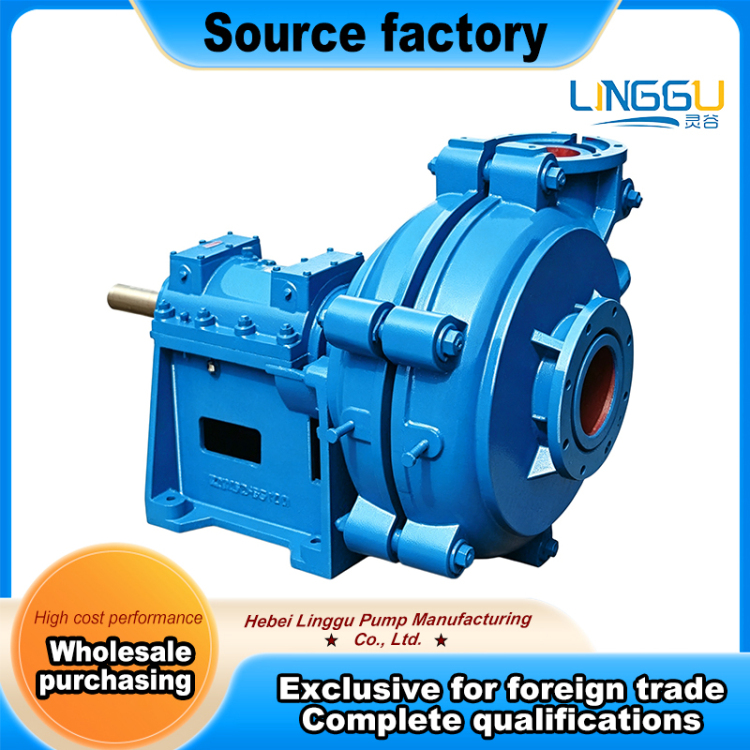
The practical build most sites settled on was a split wet end: PU throatbush and frame liner where the sharp fines concentrate, rubber or Cr27 elsewhere depending on temperature, and a Cr27 impeller whenever any coarse fraction exists — elastomer impellers are forgiving on sand but lose shape quickly against anything above 5 mm. JI NAN LING GU supplies liners in both elastomers on the same frame dimensions, so a plant can trial one PU set against its current rubber build for a season and compare hours directly.
Bottom line: PU buys its premium on sharp fines below 60 °C and pays for itself twice over; on hot or rounded duty it is an expensive way to buy rubber's problems.
FAQ
Q: What is the real temperature limit for polyurethane liners?
A: Around 60–70 °C continuous. Above that, PU softens and — for ester-based grades sitting in hot water — hydrolyses, losing hardness and delaminating within months. If your slurry runs hot, specify rubber up to 90 °C or move to a high chrome wet end; do not buy PU and hope.
Q: Can polyurethane handle coarse particles?
A: Up to roughly 10 mm in well-screened feed, but impact chunks the edges of PU liners once particles get hard and coarse, and a single tramp rock can tear a section out. Above 8–10 mm, or anywhere tramp metal is possible, the answer is Cr27 — that comparison is covered in our liner decision tree.
Q: Which wet-end parts make sense in polyurethane?
A: Throatbush and frame liner first — they see the highest fines velocity. Volute liners work in fine sand duty. Impellers only in all-fine, low-head service. And if you are still deciding, a single-season trial — run one PU set, log the hours, compare cost per hour against your rubber baseline — is exactly how polyurethane slurry pump parts service life in dredging gets validated in the field, and it answers the best liner material for fine particle sand slurry pump question for your exact sand better than any catalogue. JI NAN LING GU quotes trial sets in both materials on the same frame.
CTA
Send your sand spec — d50, particle shape, top size, temperature, oil contamination risk — and JI NAN LING GU will return a liner material recommendation with expected life range and a quotation for PU and rubber sets on the same frame, including single-season trial builds. Request a liner trial quotation from Hebei Linggu Water Pump Manufacturing Co., Ltd.