
1. Size: Work Backward From the Bolt
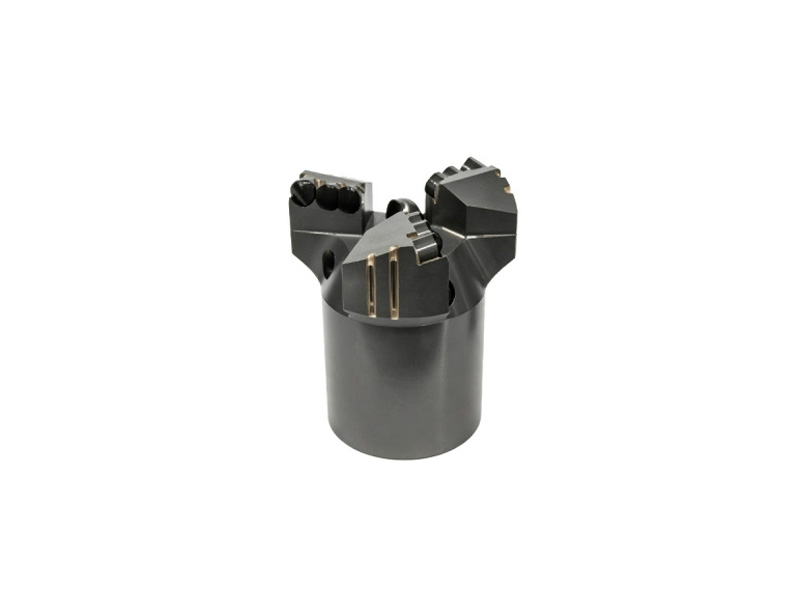
28mm PDC anchor bit specifications for coal mine roof bolting follow one governing rule: hole diameter = bolt diameter + 6 mm, which puts a 22 mm resin bolt in a 28 mm hole and gives the 2–3 mm annular resin clearance each side that full encapsulation requires.
The physics behind the rule is simple. Resin cartridge volume is fixed by bolt diameter, so hole diameter sets the glue annulus: too small and the cartridge cannot fill the annulus (dry patches, pull-out failure); too large and the resin column is thin and the bolt cures with voids. In coal measure strata with 22 mm threaded rebar, the practical window is 26–30 mm, with 28 mm as the standard — which is exactly why what size drill bit for 22mm resin anchor bolt coal mine drillers on site keep answering "28" is not folklore but a tolerance calculation.
|
Bolt diameter |
Resin clearance target |
Hole / bit diameter |
Common bit SKU |
|
18 mm rebar |
2–3 mm per side |
24–25 mm |
24 / 25 mm two-wing |
|
20 mm rebar |
2–3 mm per side |
26–27 mm |
26 / 27 mm two-wing |
|
22 mm rebar |
2–3 mm per side |
28 mm |
28 mm two-wing / three-wing |
|
24 mm rebar |
2–3 mm per side |
30–32 mm |
30 / 32 mm three-wing |
|
27 mm cable bolt |
3–4 mm per side |
33–35 mm |
33 / 35 mm heavy-gauge |
Two field notes that matter more than the table. Gauge tolerance beats nominal size: a bit marked 28 mm that measures 27.4 mm drills an undersized hole that passes visual inspection and fails on pull-out test — insist on ±0.1 mm and check 10% of each batch with a caliper. And hole length is set by bit body length plus rod, not by the bit head alone; a 1.5 m hole in soft coal needs a bit that clears cuttings fast enough that the second wing does not re-grind the first wing's debris.
Structurally the anchor bit is a compact Mining Drilling Bit — two or three forged wings on a threaded shank, sized for 1.2–1.8 m roof holes rather than the long-hole duty of a general-purpose PDC Drill Bit. That distinction matters when a supply officer substitutes a water-well bit of the same diameter: gauge and thread may fit, but the cutter layout is wrong for high-RPM short-cycle bolting.
✅ Bottom line: Bolt diameter + 6 mm = bit diameter, then verify actual gauge with a caliper — nominal size on the carton is not a specification.
2. Thread and Rod Compatibility
Thread is where selection failures get expensive, because a mismatched bit strips the rod as well as itself. Three combinations cover almost all coal-mine roof bolters in service:
- M14×1.5 on B19 hollow rod — the light-duty standard for handheld and small hydraulic bolters; typical for 27–30 mm bits
- M16×2 on B22 rod — the heavier pairing on most modern hydraulic roof bolters and jumbos; typical for 30–42 mm bits
- Custom/OEM threads — non-standard chucks on older or regional rigs; a factory that offers OEM threading can match them, a trading company cannot
Two checks before ordering. First, confirm the rod's thread pitch, not just the nominal diameter — M14×1.5 and M14×2 are not interchangeable, and both exist in the field. Second, confirm chuck clearance: a 42 mm heavy-gauge head can foul the bolter's guide on compact rigs even when the thread is correct. Thread and gauge conventions on quality bits follow published API practice, which is what makes cross-supplier swaps feasible — but only if both suppliers hold the tolerance.
Cutter families, meanwhile, trace back to Oilfield PDC Bit engineering: the same diamond-on-tungsten-carbide discs, scaled down and re-laid for a 28 mm face instead of a 200 mm one. Knowing that lineage is useful when a supplier claims a proprietary cutter — usually it is a standard grade under a private label.
3. Cutter Configuration vs Formation (f Value)
1304 PDC cutter anchor bit for medium hard sandstone is the sweet spot at f=6–10: the 1304 disc's thicker diamond layer survives abrasive sandstone impact that chips thinner cutters, while stopping short of the carbide-button territory above f=12 where PDC edges spall rather than cut.
The configuration decision has three axes:
|
Formation (Protodyakonov f) |
Cutter type |
Wings |
Bit type |
|
f < 4 — soft coal, cleated seams |
Full PDC, 1304 flat |
2 |
Standard two-wing |
|
f 4–6 — coal with thin partings |
Full PDC, 1304 |
2–3 |
Standard or saw-tooth face |
|
f 6–10 — medium hard sandstone, mixed roof |
1308 or reinforced 1304 |
3 |
Half-PDC / reinforced |
|
f 10–12 — hard sandstone bands |
Reinforced half-PDC |
3 |
Heavy-gauge |
|
f > 12 — quartzite, igneous intrusions |
Carbide button (not PDC) |
— |
Button bit |
Why 1304 for medium sandstone: the grade describes diamond layer thickness and wear resistance, and the thicker layer buys impact tolerance at a small cost in sharpness. A Polycrystalline Diamond Compact Bit cutter that is too thin chips at the edge on the first sandstone band; one that is too thick cuts slowly in coal and loads the rig. Matching grade to formation is the single highest-leverage decision in the table — more than wing count, more than brand.
Wing count follows from the same logic: two wings clear cuttings better and drill faster in coal, three wings hold gauge and resist bending in mixed and hard roof. Deviation problems in fractured ground usually come from a two-wing bit in three-wing territory, not from operator error.
✅ Bottom line: Pick cutter grade by f value first, wing count second, and accept that above f=12 the correct answer is a different bit family entirely.
FAQ
Q: Can I use a 30 mm bit for a 22 mm resin bolt to be safe?
A: No — a 30 mm hole in 22 mm bolt applications leaves a 4 mm annulus per side, thins the resin column and raises pull-out failure risk. If you are unsure what size drill bit for 22mm resin anchor bolt coal mine crews should be handed, the answer stays 28 mm. If your roof is so broken that 28 mm holes collapse, the answer is a faster-setting resin or a rebar with a larger diameter, not a bigger bit.
Q: Do 28mm PDC anchor bit specifications for coal mine roof bolting differ between bit suppliers?
A: The nominal numbers rarely differ; the tolerances do. Ask for gauge tolerance (±0.1 mm), thread class and cutter grade in writing — three suppliers quoting "28 mm M14 two-wing" can deliver three different products. Lituo publishes all three on the quotation.
Q: What should I stock for a mixed roof that alternates coal and medium sandstone?
A: Two configurations cover it: a 28 mm two-wing with 1304 cutters for the coal sections, and a 28 mm three-wing reinforced bit for the sandstone bands. That is the practical form of the 1304 PDC cutter anchor bit for medium hard sandstone recommendation — same diameter and thread, different cutter load-out, so crews never need to change rods.
Send Your Roof Log, Get a Matched Bit Spec
Send Lituo your bolt type, rod thread, roof f value and rig model, and the engineering team will return a written bit specification — diameter, gauge tolerance, thread, cutter grade and wing count — plus matched samples for a 50-hole trial. Factory-direct wholesale and OEM threading are handled by the same technical team that runs production.
 Phone:+86 13838182666 Mail:[email protected]
Website:www.lituodrill.com