
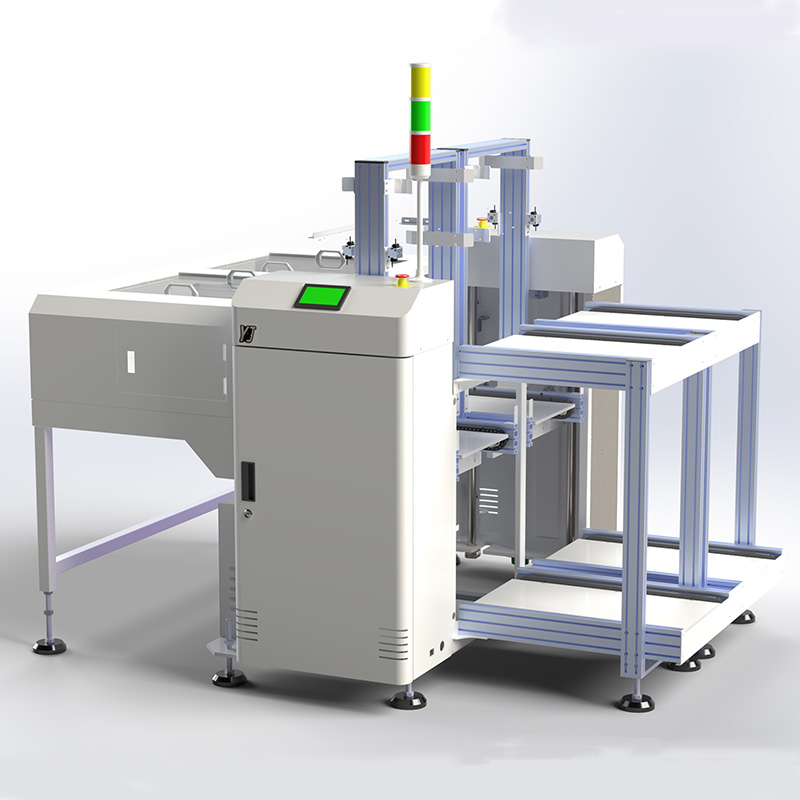
Chapter One: Why PCB Post-AOI Handling Needs Automation
AOI inspection is an important quality control process in PCB manufacturing. It can quickly identify soldering defects, component placement errors, missing parts, polarity problems, and other visible abnormalities. However, AOI inspection alone does not complete the production process. The inspected boards must still be transferred, classified, and stored correctly.
In many production lines, operators manually separate good and defective boards after AOI inspection. This approach may work at a small scale, but it becomes less efficient as production volume increases. Manual handling can create delays, increase operator fatigue, and introduce the risk of misclassification. If good and defective boards are placed in the same area, subsequent rework, shipment, or quality analysis may also be affected.
An automated PCB NG/OK Unloader provides a more stable solution. By receiving the classification signal from the AOI system, the equipment can automatically direct PCBs to the appropriate storage position. This reduces unnecessary manual intervention and helps manufacturers create a clearer, more consistent, and more controllable post-AOI process.
Chapter Two: What Is an NGOK PCB NG/OK Unloader?
An NGOK PCB NG/OK Unloader is an automated board-handling device designed to receive PCBs after inspection and separate them according to their quality status. The term “NG” generally refers to a board that does not pass inspection, while “OK” refers to a board that meets the programmed inspection requirements.
The equipment is normally installed after an AOI machine or another inspection system. Once a PCB exits the inspection equipment, the unloader receives the relevant status signal. It then uses its transfer and positioning mechanism to send the board to the designated OK or NG storage area.
Unlike a conventional unloading machine that only receives boards, a PCB NG/OK Unloader adds an important classification function. It helps prevent good and defective boards from being mixed and supports a more organized material flow. Depending on the production requirements, different equipment specifications and storage configurations may be selected.
Chapter Three: How the PCB NG/OK Unloader Works
The working process of an NGOK PCB NG/OK Unloader can be divided into several basic stages.
First, the AOI machine completes its inspection and sends the board status through the agreed communication interface or control signal. The unloader receives this signal and identifies whether the PCB is classified as OK or NG.
Next, the board enters the transfer section. The conveyor system moves the PCB at a controlled speed while the positioning mechanism keeps it aligned. Based on the inspection result, the equipment directs the board to the corresponding storage position.
During operation, sensors monitor board presence, transfer position, storage status, and safety conditions. If a board is not transferred correctly, a storage area is full, or a safety limit is activated, the intelligent alarm system can notify the operator. This allows the problem to be handled before it affects the entire production line.
The exact communication method, board orientation, storage capacity, and transfer speed depend on the selected model and the requirements of the connected AOI system. These details should be confirmed during the technical integration stage.
Chapter Four: Key Benefits for PCB Manufacturing Lines
The most direct benefit of a PCB NG/OK Unloader is improved handling efficiency. Manual board separation requires continuous operator attention, while an automated system can maintain a more consistent transfer rhythm and reduce repetitive work.
The equipment also helps reduce the risk of mixing good and defective boards. Clear classification and separate storage make it easier for operators to identify the material status and support subsequent rework, inspection, or shipment processes.
Another benefit is process stability. Human performance may vary because of fatigue, workload, or shift changes. Automated unloading provides a more repeatable operating method and helps create standardized production conditions.
In addition, the system can improve the use of labor resources. Operators can spend more time on quality verification, material management, or other value-added activities instead of performing repetitive board sorting. Intelligent alarms and safety protection further improve operational visibility and production safety.
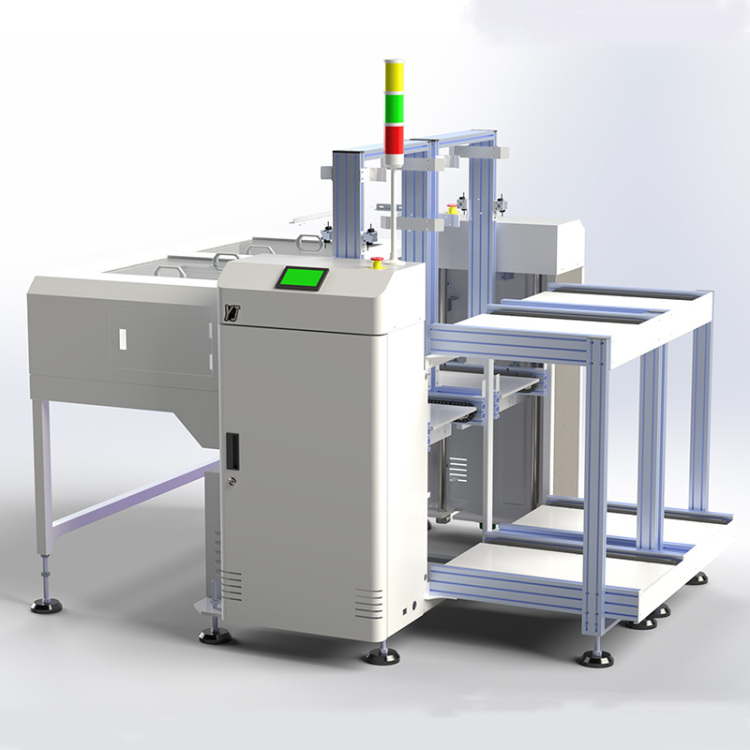
Chapter Five: Main Features of the NGOK Unloader
The NGOK Unloader is designed around several practical requirements of modern PCB production lines.
The first is AOI signal integration. The equipment can receive the inspection result from the connected AOI system and use it as the basis for automatic classification. Proper signal mapping and communication testing are important for stable operation.
The second is specification flexibility. PCB production lines may handle different board sizes, thicknesses, weights, and production speeds. Multiple equipment specifications can be selected to match different line layouts and board-handling requirements.
The third is intelligent error notification. When abnormal conditions occur, such as a transfer failure, storage capacity issue, or sensor signal problem, the equipment can issue an alarm to help operators identify and resolve the issue quickly.
The fourth is triple safety limit protection. Multiple safety limits can help monitor the movement and operating range of the equipment. When an abnormal position or unsafe condition is detected, the system can stop or restrict operation according to its safety design.
Before purchase, manufacturers should confirm the applicable PCB range, interface requirements, storage configuration, and safety functions with the equipment supplier.
Chapter Six: How to Select the Right PCB NG/OK Unloader
Choosing the right PCB NG/OK Unloader requires more than checking the equipment price. The first consideration is board compatibility. Manufacturers should provide the typical PCB length, width, thickness, weight, edge clearance, and handling direction.
The second consideration is production capacity. The unloader should match the AOI output rhythm and the required production takt time. If the transfer capacity is too low, it may become a bottleneck after AOI inspection.
The third consideration is communication compatibility. The AOI machine and unloader must have a clear signal exchange method. The supplier should confirm the required interface, signal type, handshaking logic, and abnormal-state response.
The fourth consideration is storage design. Different production lines may require separate OK and NG storage, multiple collection positions, or different unloading directions. The storage method should be convenient for operators and suitable for downstream processes.
Finally, manufacturers should evaluate safety protection, alarm visibility, maintenance access, installation space, and future expansion. A well-matched solution should support both current production needs and reasonable future changes.
Chapter Seven: Installation and Production Integration
Successful installation begins with a clear technical review. The supplier and factory team should confirm the AOI interface, equipment dimensions, conveyor height, board direction, storage location, power requirements, and safety space before delivery.
After mechanical installation, the conveyor should be aligned with the AOI output section. Signal testing should then be performed using both OK and NG sample boards. The test should verify whether the classification signal, transfer action, storage position, and alarm response are correct.
Safety verification is also essential. Operators should confirm the operation of safety limits, emergency stop functions, protective covers, and abnormal-state handling. Before mass production, the team should complete operator training and record acceptance results.
A structured integration process helps reduce commissioning time and prevents avoidable problems during production.
Chapter Eight: Maintenance and Troubleshooting
Routine maintenance is important for keeping the PCB NG/OK Unloader stable. Operators should regularly inspect the conveyor, sensors, positioning components, storage area, cables, and safety devices.
Sensors should be kept clean because dust or PCB debris may affect detection accuracy. The conveyor should remain free of foreign objects, and abnormal noise or unstable movement should be reported promptly.
If a PCB is not transferred correctly, possible causes may include incorrect board positioning, an obstructed conveyor, a sensor signal issue, or communication problems with the AOI system. If the OK and NG classification is incorrect, the signal mapping and handshaking logic should be checked first.
For repeated alarms, operators should follow the equipment manual and maintenance procedure rather than bypassing the safety function. Professional technical support should be contacted when the cause cannot be confirmed.
Conclusion
A stable post-AOI handling process is essential for efficient and controlled PCB manufacturing. When good and defective boards are separated manually, the production line may face unnecessary delays, inconsistent handling, and material-mixing risks.
The NGOK PCB NG/OK Unloader provides an automated way to receive, classify, and store PCBs according to AOI inspection results. With AOI signal integration, multiple specification options, intelligent alarm notifications, and triple safety limit protection, it can support a wide range of PCB production scenarios.
For the best result, manufacturers should evaluate PCB compatibility, production rhythm, communication requirements, storage design, safety conditions, and future expansion before selecting a model. With the right configuration and proper integration, an automated PCB NG/OK Unloader can help build a more efficient, reliable, and standardized production line.