
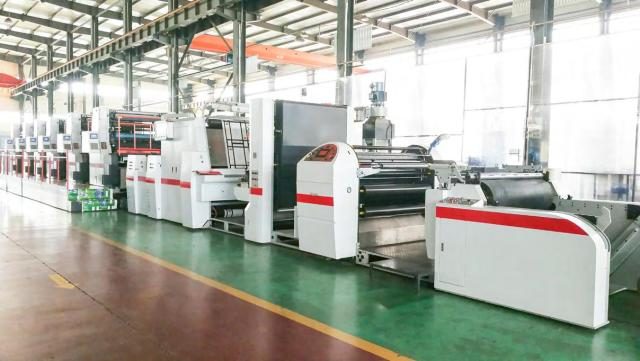
A laminating machine described as 2500 mm wide and capable of 150 m/min is stating the conditions it can be run under, not the number of square metres it will deliver next month. The gap between those two figures is where capacity plans go wrong. This guide turns published catalogue numbers into a realistic output estimate, sets out the six bottlenecks that cap a lamination line, and lists what a supplier should demonstrate before sign-off. It is written by Foshan Senruiyuan Machinery Technology Co., Ltd., a manufacturer of reel-fed laminating, printing and post-press equipment based in Foshan, Guangdong, China. The choice of process comes first and is covered in our article comparing thermal, water-based and solvent-free lamination.
What the published numbers actually mean
| Figure | What it really defines | The condition attached to it |
|---|---|---|
| Maximum working width up to 2500 mm | The widest web the frame, rollers and nip can carry | Running a narrow web on a wide machine does not produce wide-output economics |
| Up to 150 m/min, pre-coated film lamination | Speed achievable when no drying stage is required | Substrate, film and nip temperature still have to suit that speed |
| Up to 120 m/min, water-based dry lamination | Speed before the drying stage becomes the limit | Oven length, air circulation, coat weight and adhesive solids decide whether it holds |
| Up to 12 tons of adjustable lamination pressure | The available nip force range across different materials | Pressure is set per structure; it is not a speed setting |
| 30 mm reinforced side frame | Mechanical stability at speed, not a capacity figure | Vibration and register limits show up before the nominal speed is reached on some structures |
| Automatic splicing and rewinding | Whether the line keeps running through a reel change | Accumulator capacity and dwell time set how much changeover time is actually recovered |
Read every one of these as "up to, under stated conditions". Two plants can buy the same machine and record different output because their substrates, batch lengths and upstream equipment differ.
An output calculation you can run in a spreadsheet
Start with the theoretical ceiling, then apply an availability factor measured on your own line rather than borrowed from a supplier.
- Theoretical m² per shift = line speed (m/min) × effective web width (m) × 60 × running hours.
- Effective web width = the width actually printed and sold, not the machine maximum.
- Realistic m² per shift = theoretical × effective availability, where availability excludes warm-up, roll and job changes, first-article approval, cleaning, unplanned stops and rejected material.
Illustrative example, assumed values only. At 150 m/min with a 2.0 m effective width over an 8-hour shift, the theoretical ceiling is 150 × 2.0 × 60 × 8 = 144,000 m². At 70% effective availability, the realistic figure is 100,800 m². At 120 m/min on water-based work the theoretical ceiling drops to 115,200 m², but the drying section, not the drive, is likely to decide where the real number lands. These are assumed values for demonstrating the arithmetic, not measured results or a performance promise — replace speed, width, hours and availability with your own records.
The useful part of this calculation is not the result but the availability factor. If yours is 55%, buying a faster laminator will not raise output; the losses are elsewhere on the line. A week of shift logs will tell you which.
Six bottlenecks that cap real output
- Drying capacity on water-based work. Oven length, air circulation and drying roller diameter set the practical speed ceiling. Large-diameter drying rollers with vertical hot-air circulation improve how much heat reaches the web, but the limit remains a property of the adhesive and coat weight as well as the machine.
- Reel changes and splices. Automatic splicing and automatic rewinding allow continuous operation and reduce changeover time towards zero, but only if storage and dwell time are sized for your real line speed. Our separate guide to specifying a non-stop splicer and unwinder covers those numbers in detail.
- Coat weight, adhesive and curing. A heavier coat, a slower-drying adhesive or a required curing period before slitting changes the achievable running time even when the machine is capable of more.
- Substrate grammage and reel diameter. Heavier stock and smaller parent reels mean more roll changes per shift, and every change is a tension transient and a potential waste event.
- First-article approval and quality checks. Short runs spend a disproportionate share of the shift getting to the first accepted metre. A defined sampling length and stored job recipes recover some of it.
- The upstream press or downstream converter. A laminator inline with a printing press can only run as fast as the slowest unit and as steadily as the web handoff between them.
Matching the laminator to the press, not the other way round
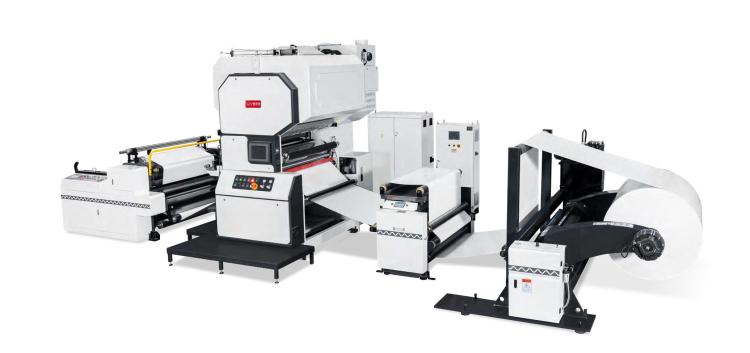
Roll laminating machines can be integrated directly with a printing press or other post-press equipment, so printed material moves into lamination without unloading, stacking or manual transport. That removes an entire handling and queuing step, which is often where a large share of production lead time sits.
The trade-off is that an inline line shares a pace. Before committing to it, make a short takt table: press speed at each job type, laminator speed on the same substrate, drying or curing requirement, reel change behaviour on both units, and how much buffer the line has when one of them stops. A stand-alone laminator with a small buffer is sometimes the higher-output answer for a mixed-order plant, even though inline looks tidier on a layout drawing.
What to ask a supplier to demonstrate at the factory acceptance test
- A continuous run on your own substrate and film, at your target width and speed, for an agreed number of hours.
- Output recorded as saleable m² per shift, with rejected material reported separately rather than silently excluded.
- At least one automatic reel change during the run, with the parent machine speed and the tension trace logged across the event.
- Roller surface temperature and coat weight recorded across the web width at steady state.
- Measured energy per 1,000 m² alongside the output figure, so throughput and running cost are judged together.
- A changeover between two defined jobs, timed from last saleable metre to first saleable metre.
Ask for the protocol and the acceptance values in the purchase order. A test defined after installation tends to measure what the machine does easily rather than what your plant needs it to do.
Request a capacity review
Send us your effective web width, substrate and grammage, process, target speed, shift pattern, batch lengths and the equipment upstream and downstream. Our engineers will work through the calculation and the bottleneck list with you before a configuration is proposed.
Browse the roll-to-roll laminating machine range or the water-based and thermal laminating machine, or see our overview of how a roll-to-roll laminating machine creates value across energy, productivity and quality.
Email: [email protected] | WhatsApp:+86 17328088404 +86 139 2827 4256
Foshan Senruiyuan Machinery Technology Co., Ltd. | No. 8, Jinxian, Jinli Community, Lishui Town, Nanhai District, Foshan, Guangdong, China
Frequently asked questions
Why is my line slower than its rated 150 m/min?
In most cases the limit is not the drive. Drying capacity on water-based work, substrate, coat weight, reel change frequency and the upstream press all cap the speed before the nameplate figure is reached. Record when the line actually slows down, then compare that pattern with the six bottlenecks above.
What availability factor should I use?
Use your own shift logs rather than an industry average. Divide saleable output by theoretical output over a representative week, including warm-up, changes, cleaning and rejected material. A number in the region of 60–80% is common discussion territory for mixed-order plants, but it is not a figure we would state for your line without your data.
Does a 2500 mm machine produce more on narrow jobs?
No. Output is speed multiplied by effective width, so a narrow job produces narrow-job output. A wider machine can still be the right choice for order flexibility, but the capacity case should be built on the widths you actually sell, and energy per m² is worth checking when a wide line runs narrow work.