
Mold Steel Selection for Custom Injection Molds: Balancing Tool Life and Production Risk
Nov 24, 2026
Mold Steel Is a Production Decision, Not Only a Toolroom Specification
For buyers commissioning custom injection tooling, custom injection mold steel selection should be treated as a production decision rather than a material line in a quotation. The selected steel influences cavity stability, polishing behavior, wear resistance, corrosion exposure, repair options, and the consistency of molded parts over the expected program life. A lower initial tooling price may become expensive if the steel grade cannot support the resin, surface requirement, cycle conditions, or maintenance plan.

Matching Steel Properties to Resin, Geometry, and Surface Requirements
The main question is not simply whether a steel is “hard.” Buyers and engineers should review hardness potential, toughness, corrosion resistance, polishability, dimensional stability after heat treatment, and the practicality of machining and repair. Hardened tool steel for injection molding can be valuable for wear-intensive applications, but hardness alone does not eliminate the need to control sharp transitions, unsupported thin sections, cooling distortion, and local stress around sliders or deep ribs.
For general-purpose non-corrosive applications, a pre-hardened mold steel may provide a practical balance between machining efficiency, stability, and serviceability. When the part demands a high-gloss surface or optical clarity, the steel must support consistent polishing and protect the cavity from defects that may transfer to the molded surface. When the resin or processing environment increases corrosion risk, corrosion-resistant steel or replaceable corrosion-resistant inserts may reduce maintenance exposure. When glass fiber or mineral filler increases abrasion, wear-resistant grades and replaceable components become more important.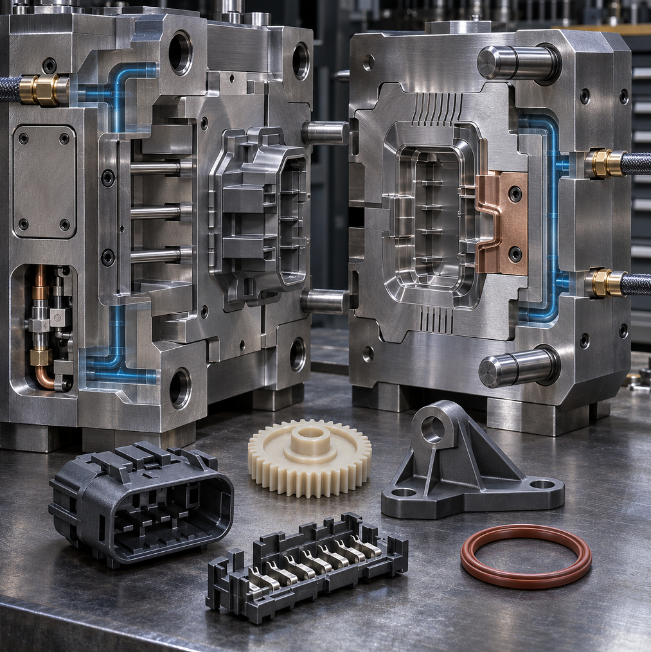
The Mold Components That Need Separate Steel Decisions
A mold is not always best served by one steel grade throughout. The cavity and core may require a different surface response from the mold base, while slides, lifters, shutoff inserts, wear plates, and interchangeable inserts may need their own balance of toughness, hardness, and repairability. A technically sound material plan identifies which surfaces define the part, which components absorb movement, and which elements are most likely to be polished, replaced, or adjusted during the production life.
This approach also supports controlled maintenance. If a wear-prone shutoff or texture insert can be replaced without rebuilding the entire mold, the buyer may reduce future downtime and protect the approved part geometry. The design should therefore connect steel selection with parting-line strategy, insert boundaries, fastener access, ejection layout, and inspection references before machining begins.
Heat Treatment and Machining Control Protect Dimensional Stability
Steel grade selection cannot compensate for uncontrolled processing. Heat treatment, stress relief, rough machining, semi-finishing, finishing, and polishing should be arranged to limit distortion and preserve the reference features used for cavity alignment. The manufacturing plan should also distinguish between the steel supplier’s material certificate, the mold maker’s heat-treatment record, and the inspection evidence for the finished component.
For complex cavities, the sequence matters. Leaving appropriate machining stock before heat treatment, supporting thin or deep features, and checking critical dimensions after each major operation can reduce the risk of late-stage correction. CMM inspection, optical comparison, surface-finish verification, and fit checks should be selected according to the part’s functional and cosmetic requirements rather than applied as generic paperwork.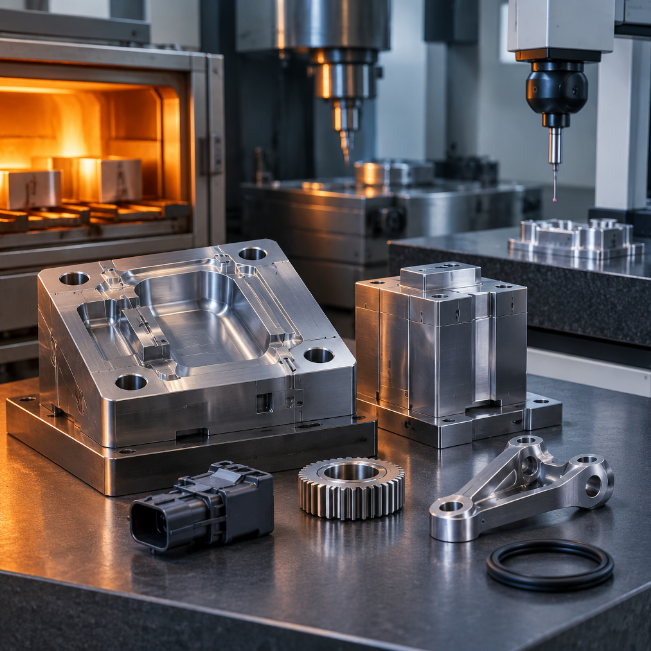
Cooling, Venting, and Steel Selection Must Be Reviewed Together
Steel is only one part of mold performance. Cooling channels must be arranged around the actual cavity geometry, while vents must release air without creating visible marks or flash. A material choice that looks suitable on paper may still produce unstable molding if the tool has uneven thermal control, insufficient venting, difficult-to-service inserts, or a sealing surface that is not adequately supported.
During DFM review, buyers should ask the tooling team to connect the material recommendation with the resin, expected production quantity, surface finish, gate location, cooling strategy, ejection method, and inspection plan. This creates a traceable decision rather than an unexplained steel grade copied from a previous project.
A Practical Selection Framework for Overseas Mold Buyers
Before approving the tool design, procurement teams can organize the review around six questions:
What resin will be molded? Consider corrosion, abrasion, shrinkage behavior, filler content, and processing conditions.
What surface must the part achieve? Clarify polish, texture, gloss, weld-line sensitivity, and cosmetic inspection criteria.
What is the expected production pattern? Separate prototype, pilot, repeat production, and long-running programs.
Which mold features are most exposed to wear or impact? Review sliders, lifters, shutoffs, ejector components, and thin cavity details.
How will the tool be maintained? Confirm replaceable inserts, spare components, lubrication points, cleaning access, and inspection references.
What documentation is required? Define material certificates, heat-treatment records, dimensional reports, trial-sample approval, and revision control.
This framework helps buyers compare quotations on production risk and maintainability instead of comparing steel names in isolation. It also makes it easier to identify assumptions that should be settled before the purchase order is released.
Connecting Mold Steel Selection with Total Cost of Ownership
The most economical mold is not necessarily the one with the lowest opening quotation. Tool life, corrective machining, spare inserts, maintenance labor, unplanned downtime, surface rework, and the cost of inconsistent parts can all affect total cost of ownership. A material plan that is slightly more deliberate at the design stage may protect a larger production investment later, especially when the same mold supports an international supply program.
HCS Mould can review steel selection as part of a broader custom tooling discussion, together with part geometry, DFM requirements, mold structure, sample approval, production quantity, inspection expectations, and assembly needs. Final material recommendations should be confirmed against the buyer’s resin, drawings, surface specification, production plan, and applicable quality requirements.
Conclusion
Mold steel selection is a cross-functional engineering decision linking material behavior, mold structure, surface appearance, maintenance, inspection, and production continuity. By matching steel properties to the resin and part requirements, separating critical components where appropriate, and documenting heat treatment and inspection controls, overseas buyers can make tooling decisions with clearer long-term risk visibility.