On a 10 t double girder in two-shift service, a modular European-style hoist runs about 20–30 maintenance hours a year against 40–60 for a conventional built-up hoist, and the ten-year parts-and-labour total lands near $23,000 instead of $40,000. So the direct answer to what is the maintenance cost of an overhead crane per year is roughly $2,000 for a modular unit and $3,500 for a traditional one at this duty level — before downtime is counted. Downtime is where modularity really pays: a hoist module swaps in 4–8 hours, a built-up hoist is rebuilt in place over 3–5 days.
1. What is the maintenance cost of an overhead crane per year?
Budget 1.5–3% of the purchase price per year for a conventional crane and 1–2% for a modular one, then check the arithmetic against hours. Percentage rules hide the two variables that actually move the number: duty class and access.
| Annual cost line, 10 t double girder, two shifts | Traditional built-up hoist | European modular hoist |
| Scheduled inspection, lubrication, adjustment | 40–60 h | 20–30 h |
| Labour at $45/h loaded | $1,800–2,700 | $900–1,350 |
| Consumables and wear parts | $500–900 | $350–650 |
| Unplanned repair contingency | $500–900 | $300–500 |
| Annual total | $2,800–4,500 | $1,550–2,500 |
| Hoist overhaul or module swap at year 10 | $3,500–6,000, 5–8 days down | $2,800–4,500, 1–2 days down |
| Ten-year total | ~$35,000–45,000 | ~$20,000–27,000 |
Three factors decide where you land inside those ranges, and HENGCHENG quotes all three with the crane rather than leaving them to the buyer to discover:
- ✅ Duty class dominates. An A3 crane at 8–10 moves an hour sits at the bottom of the range; an A5–A6 unit at 30+ moves an hour doubles both the hours and the parts consumption.
- ✅ Environment multiplies wear. Foundry dust, galvanising fumes and washdown plants push wheel, rope and brake consumption up 30–60% regardless of hoist design.
- ✅ Access decides labour hours. A hoist 12 m up with no walkway adds 30–60 minutes of access time to every task, which is how a 4-hour job becomes a 6-hour one.
The honest caveat: overhead crane annual maintenance hours European vs traditional figures assume in-house technicians at a loaded rate. Plants that outsource inspections at $80–120 per hour see the modular advantage widen, because the hours saved are billed hours. Ask any supplier for what is the maintenance cost of an overhead crane per year at your duty class and you should get hours, not a percentage of capital — HENGCHENG quotes both.
One number worth separating out is the year-10 overhaul, since it is the largest single line and the one most often left out of budgets. On a built-up hoist the drum, gearbox and motor are rebuilt on the crane over several days; on a modular hoist the whole unit unbolts and a replacement goes on. That difference is not a maintenance cost at all — it is a production cost.
✅ Bottom line: At two-shift duty, expect roughly $3,500 a year for a conventional hoist and $2,000 for a modular one, with the real gap appearing at the year-10 overhaul.
2. Are European modular hoist spare parts cheaper, or just faster?
Faster, and usually 15–25% more expensive per part — the trade is availability against unit price. The European modular hoist spare parts replacement frequency is lower for wear items because the modules are lighter and better balanced, but the parts themselves carry a premium, and that premium is the price of the swap-in-an-hour design.
What actually swaps, and how the two designs compare when something fails:
| Module | Failure mode | Built-up repair | Modular replacement |
| Hoist unit (motor, gearbox, drum) | Gearbox bearing or drum groove wear | 3–5 days rebuild in place | 4–8 h unit swap |
| Brake | Lining wear, torque loss | 4–6 h reline and adjust | 30–60 min cartridge |
| Motor | Winding failure | 5–10 days rewind | 2–3 h swap |
| Wheel block | Flange wear, spalling | 1–2 days | 2–4 h |
| Control card or contactor | Drive fault | 1–2 days diagnosis and sourcing | 30 min card swap |
The European modular hoist spare parts replacement frequency advantage is not that parts last longer in a laboratory sense — it is that a module failure takes a crane out of service for an hour instead of a week. On a line where downtime costs $2,000–8,000 an hour, one avoided week-long outage pays for a decade of parts premium.
Where modularity costs you, and buyers should hear it plainly:
- ❌ Proprietary lock-in. Modules are not interchangeable between brands, and a mid-life brand change means a new hoist, not a new part.
- ❌ Single-source pricing. Once you own the crane, the module price is set by one supplier; expect a 15–25% premium over generic equivalents.
- ❌ Obsolescence risk. Control cards are the first item to disappear from a catalogue; a 15-year-old card can be unobtainable while the mechanics are fine.
Three contract clauses neutralise most of that risk: a spare parts list with prices and 10-year availability, a commitment that wear parts remain orderable for the crane's design life, and a documented module interface so a third-party hoist can be fitted later. HENGCHENG issues the first two as standard documents with every unit.
Which crane type makes modularity worth paying for
- Overhead Bridge Crane — high duty and long spans mean frequent access; modularity converts a week of lost production into an afternoon.
- Suspension Crane — mounted high on roof trusses with the worst access of any type; a module that unbolts beats a rebuild at height every time.
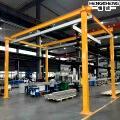
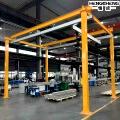
- Free-standing Crane — standalone structure with clear floor access, so the labour saving is smaller, but the resale value of a modular unit is materially higher.
The same hoist module is used across all three, which is what makes a mixed fleet cheap to run: one spare module covers an Overhead Bridge Crane, a Suspension Crane and a Free-standing Crane in the same plant.
✅ Bottom line: Modular parts cost 15–25% more each but cut years-10 overhaul from a week of downtime to a shift — buy the speed, and contract for the parts availability.
FAQ
Q: What is the maintenance cost of an overhead crane per year on a 5 t single-shift unit, and how many hours does that mean?
A: Roughly 12–20 hours a year for a modular hoist and 25–35 for a conventional one, including quarterly inspection, lubrication and brake checks. Add 4–8 hours if the crane sits above 10 m with no walkway, since access time is charged to the same job.
Q: Do the European modular hoist spare parts replacement frequency figures hold in dusty or high-heat plants?
A: They stretch, not break. Dust and heat shorten brake lining and rope life by 30–50% in both designs, but the modular unit still replaces them faster. In foundry or cement service, the overhead crane annual maintenance hours European vs traditional gap narrows to about 25% because inspection time is fixed, so plan on annual rather than biennial brake cartridge changes.
Q: Do you supply modular hoists across all three crane types with OEM options?
A: Yes. HENGCHENG — Hengcheng (Henan) Intelligent Equipment Co., Ltd. — fits the same modular hoist platform to its Overhead Bridge Crane, Suspension Crane and Free-standing Crane lines, so spare modules are shared across a mixed fleet. OEM and custom builds ship with a priced parts list and 10-year availability commitment, at factory-direct or wholesale pricing.
Get a Ten-Year Maintenance Budget With Your Quotation
Send tonnage, duty class, shifts per day and mounting height. The HENGCHENG engineering team returns a ten-year maintenance estimate — annual hours, parts consumption and the year-10 overhaul cost — alongside the quotation, for an Overhead Bridge Crane, Suspension Crane or Free-standing Crane configuration. Custom and OEM builds include the priced spare parts list from day one.
Hengcheng (Henan) Intelligent Equipment Co., Ltd. — European-design overhead cranes and modular hoists, manufactured in Changyuan, Henan. Factory-direct and wholesale supply for single units or fleet orders.
Email: [email protected]
Mobile: +86 18803739393
Website:www.hnhcequip.com