
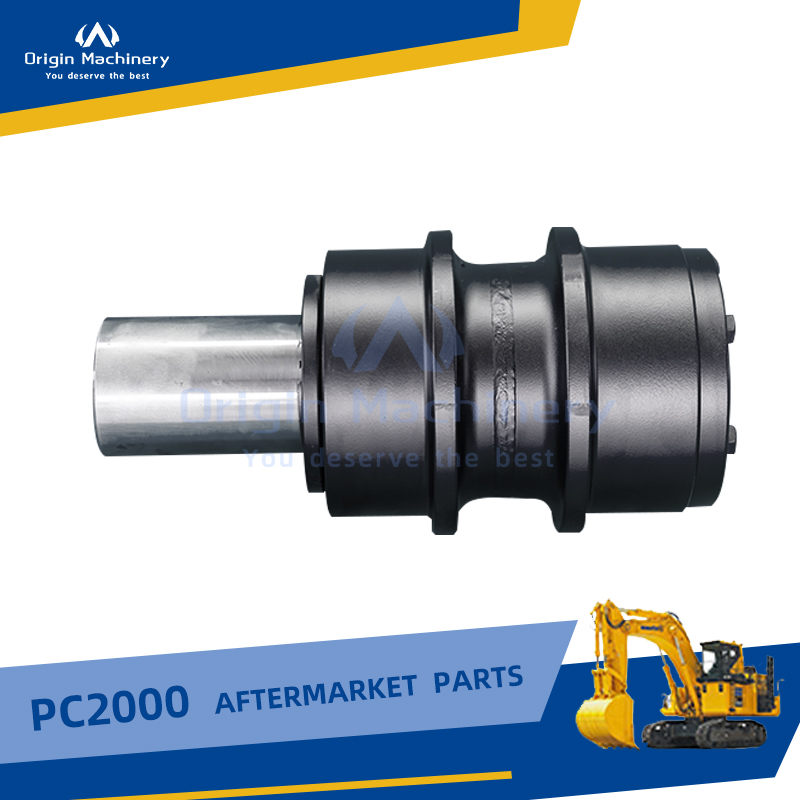
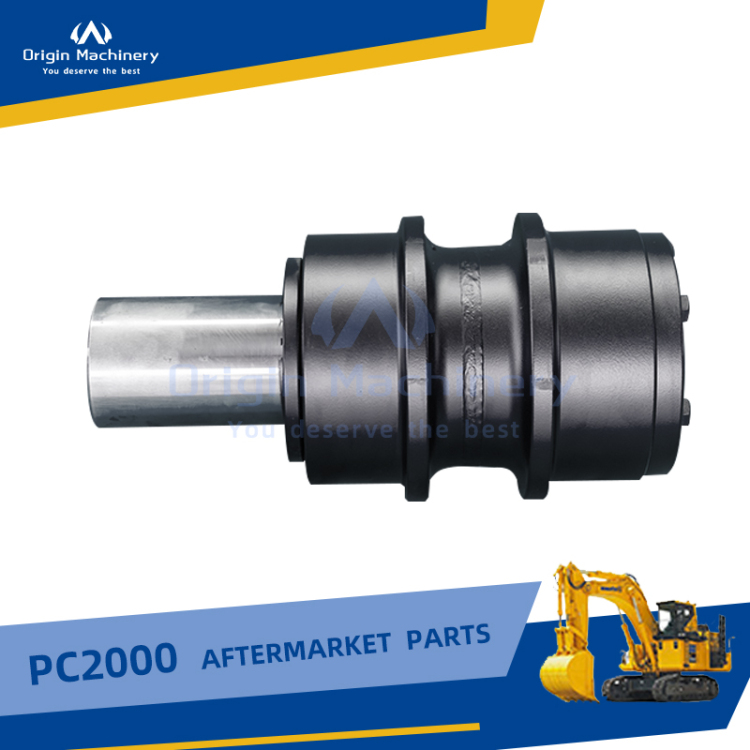
Walk past a mining excavator and the wheels you notice are the ones at the bottom — the track rollers carrying the machine's weight and the sprockets driving it forward. The carrier roller, bolted to the top of the track frame, gets almost no attention. It carries no machine weight. It does not transmit torque. In a walk-around it is often just a dark cylinder above the chain. Yet ask any undercarriage engineer which small component most often shortens the life of an otherwise healthy chain, and the carrier roller is near the top of the list.
That is because the top rollers do a job that matters far beyond their size. They support the return run of the chain over long spans, keep the links tracking straight into the front idler, and absorb the shock when a loaded bucket dumps rock onto the upper run. When they work, nothing is noticed. When one seizes, misaligns, or wears flat, it becomes a stationary grinding tool pressing into a moving chain. This article looks at the top roller as a precision sealed-bearing component, explains how to read its condition in the field, and shows why replacement decisions made here protect everything downstream. The same sealed-bearing principles covered in roller bearing and seal technology apply, but the top position adds a few twists worth understanding.
What the Top Roller Actually Does
The carrier roller sits on the upper frame and rides against the inner surface of the chain's link rails as the track returns from the sprocket to the idler. On large machines two or three top rollers per side span the gap between the drive sprocket and the front idler, holding the chain up so it does not sag into the frame. This is more than cosmetic support. A chain that sags between supports develops a whipping motion, and that oscillation is transmitted into the sprocket teeth and the idler tread on every revolution.
The top roller also sets the tracking of the chain. Its flanges keep the links centered laterally, guiding the chain into the idler at the correct angle. If a top roller is misaligned, worn on one side, or mounted with a bent bracket, it pushes the chain sideways. That side load shows up as uneven flange wear on the rollers, rubbed idler flanges, and eventually the chain climbing toward one side of the sprocket. In other words, the humble top roller is a tracking reference as much as a support, and mining carrier rollers that are out of alignment can damage components far more expensive than themselves.
A Sealed Bearing Living Above the Chain
Strip a carrier roller and the internal architecture is familiar: a hardened shaft, a bearing stack, a cavity of oil or grease, and a pair of floating face seals at each end. The shell is only a running surface. Everything that decides service life is sealed inside. The seals keep the lubricant in and keep quartz dust, slurry, and water out — the single most important job on a mining site, where fine abrasive dust with a Mohs hardness around seven finds its way into every joint.
The bearing and seal package is where quality separates itself. A properly forged roller shell with an induction-hardened tread resists the polishing wear of the chain rails, while a robust duo-cone face seal maintains contact pressure even as the parts wear and the frame flexes. Cheap rollers often save money on exactly these two items. The result is a roller whose seal hardens or loses preload after a few thousand hours, lets grit into the cavity, and turns the oil into grinding paste. From that point the bearing wears from the inside out, and a roller that looked fine externally begins to drag. This is the same failure physics seen in mining track rollers at the bottom of the frame; the top roller simply sees it with less load but more exposure to falling material.
Installation and Alignment Matter More Than Brand
A surprising share of premature top-roller failures has nothing to do with the part itself and everything to do with how it was mounted. The mounting bracket must be flat and square to the frame. Bolts must be torqued evenly and re-checked after the first hours of running, because the constant vibration of mining duty loosens unevenly tightened fasteners. A bracket that is bent from a previous impact, or a mounting face packed with rust and debris, tilts the roller and loads one flange harder than the other.
Alignment should be verified, not assumed. With the track lifted, spin each top roller by hand and watch the chain deflection. Use a straightedge across a pair of rollers on the same side to check that their running surfaces sit in a common plane, and measure the gap between each roller and the chain rail. An even, light contact across the face is correct; a hard rub on one edge means the roller is cocked. After the first shift, re-torque the fasteners and re-check the contact pattern. This short discipline pays for itself by catching a misalignment before it becomes a polished groove in the chain rail — the kind of damage that follows the chain all the way to the sprocket.
Reading the Warning Signs in the Field
Top rollers rarely fail without warning. The first signal is usually heat. After an hour of steady travel, run an infrared thermometer across each top roller in sequence. A roller running ten to twenty degrees Celsius hotter than its neighbours is fighting internal friction — a seal that has lost preload or a bearing that is starved of lubricant. The second signal is sound and feel. Rotate the roller with the track raised: smoothness and a slight free spin are healthy, while roughness, a rumble, or a tight spot means contamination has already reached the bearing.
Visual inspection completes the picture. Look for oil weeping at the hub ends, which means lubricant is escaping and dust is entering through the same path. Check the tread for flat spots, deep grooves, or a polished band on one side — each tells a different story about load and alignment. Also watch the chain itself: a top span that sags more than usual, or a chain that shuffles sideways at the idler, often traces back to a top roller that has stopped turning freely. Recording these observations with hours on the meter turns a one-off check into a wear-rate trend, which is the basis of condition-based replacement.
Replace in Pairs and Protect the Chain
Because top rollers work as a set that holds the chain straight, they should normally be replaced in matched pairs on the same side — or across the machine if both sides are near their limit. Fitting one new roller beside a worn one leaves the chain with an uneven support plane, and the new roller inherits a misalignment it was never given a chance to avoid. It is the same logic that governs mining front idlers and bottom rollers: components that guide a shared chain must be renewed as a matched group.
There is also a hard economic argument. A seized top roller grinds the chain rails and can destroy sprocket engagement within a few hundred hours, turning a modest roller replacement into a full undercarriage rebuild. For a machine running single or double grouser shoes and a sealed, lubricated chain, protecting that chain is worth far more than the price of the rollers supporting it. When the tread is down near its wear limit, the seal weeps, or the roller runs hot and rough, replace it on schedule rather than on failure. Confirm the part matches the machine model and serial number, use the correct seal and bearing specification, and re-check fastener torque after the first shift.
Conclusion
The carrier roller is a small, quiet component with an outsized influence on chain life. It supports the return run, sets chain tracking, and shields the rest of the undercarriage from shock and misalignment. Treat it as a sealed bearing system — verify the seal and bearing quality, install it square and torqued, read heat and weep signals early, and replace it in matched pairs — and it will protect a chain that costs many times more than the roller itself. Ignore it, and a cheap cylinder above the chain becomes the most expensive part on the machine.
Learn More: Explore Origin Machinery's full range of undercarriage components and talk to our engineering team about matching carrier rollers, track rollers, and chains to your excavator model and mining conditions. We help you build a condition-based undercarriage plan that lowers cost per hour — contact us today.