
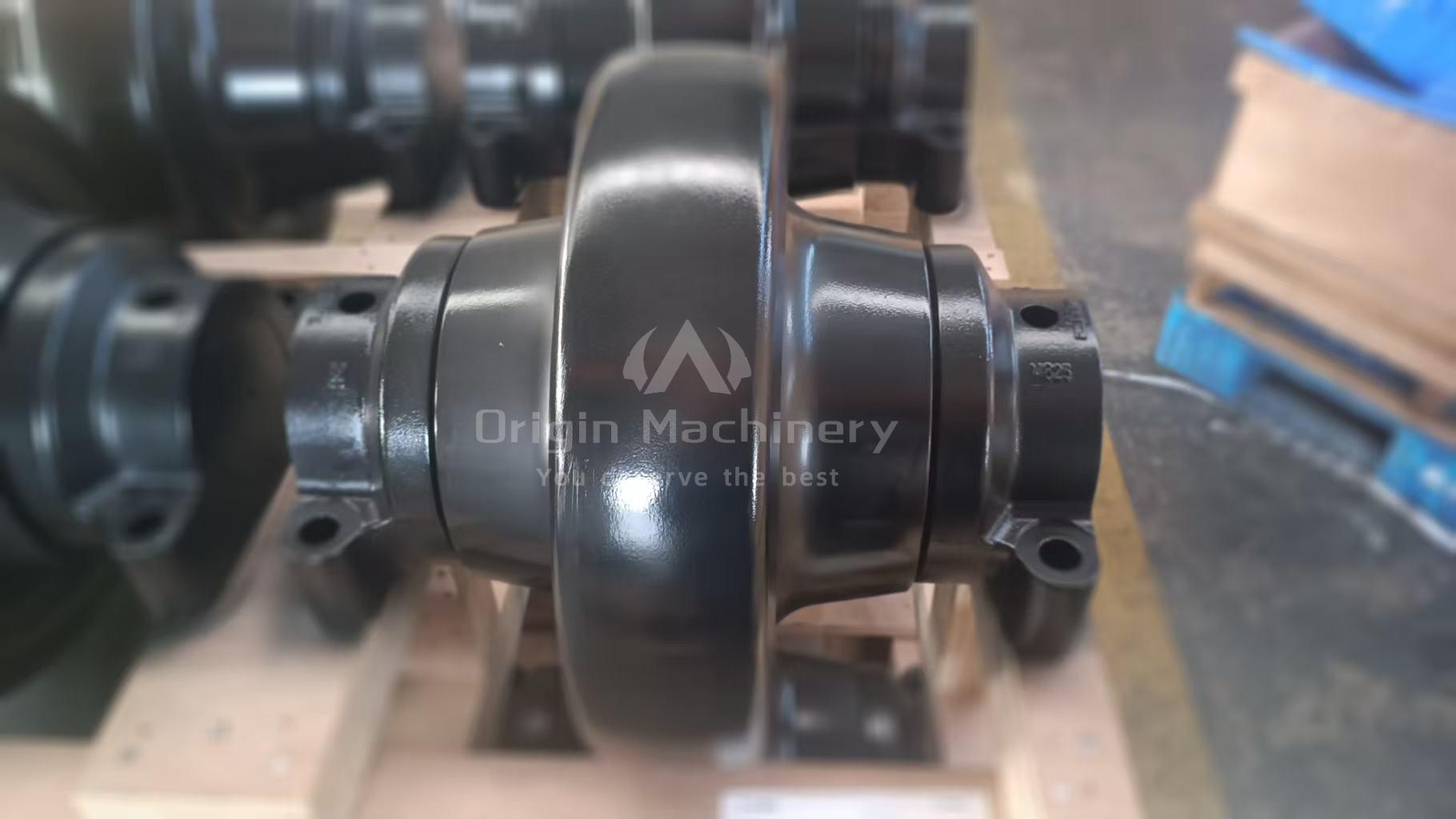
Track rollers are the most numerous load-bearing components on a mining excavator's undercarriage, and they are usually the least measured. They run buried in mud and rock, they rotate slowly under enormous load, and as long as the machine still tracks straight, they are left alone. The problem is that a roller gives very little obvious warning before it starts costing money. By the time a roller is visibly collapsed or seized, it has usually been grinding the chain, the sprockets, and the idlers for hundreds of hours. The discipline that separates a controlled undercarriage budget from an unplanned rebuild is simple, unglamorous measurement — knowing which dimensions to check, what the retirement limits are, and how to record them so that track roller inspection on mining excavators becomes a repeatable routine instead of a guess.
This article is a practical field guide to that routine. It sets out the measurements that actually decide a roller's remaining life, the surface patterns that tell you why a roller is wearing, and the maintenance multipliers — cleanliness and track tension — that determine whether a set reaches its expected hours or fails early.
Why Eyeballing a Roller Is Not Enough
A roller that looks acceptable from the walkway can be well past its useful life. Wear removes steel from the flange and the tread gradually and evenly, so there is no single dramatic moment at which a roller "breaks." The loss is measured in millimetres, and it accumulates across a set of perhaps forty rollers on a large machine. Because the load is shared, one worn roller hides among healthy neighbours until the whole group has drifted out of specification — at which point the chain is already being asked to run on an uneven track.
This is why a measurement-based approach to mining track rollers matters more than a visual one. A caliper reading takes seconds and produces a number that can be compared with a limit and tracked over time. A visual impression produces an argument. Crews change their minds; a logged diameter does not.
The Three Measurements That Decide Retirement
Almost every roller retirement decision comes down to three numbers, all taken with basic hand tools.
Flange thickness. The flanges are the raised rims that keep the chain track centred on the roller. Measure remaining flange height at several points around the circumference and compare with a new roller. When flange thickness has been reduced by roughly 30 percent of its original dimension, the roller should come out. Below that point the flanges can no longer guide the chain reliably, and the risk of the track climbing or derailing rises sharply — especially in side-slope work.
Tread diameter. Measure the rolling surface diameter and compare it with the new-part specification. A loss of around 20 percent of the original diameter is the usual retirement threshold. Running rollers at different diameters across one side of the machine makes the chain track at different heights, which loads the links unevenly and accelerates wear everywhere else. On a machine where the rollers have been cut down unevenly, a new chain will not last.
Bearing play and rotation. Lift the machine and check each roller by hand. Axial play above roughly 2.5 millimetres, rough or notchy rotation, or any visible wobble means the bearing is finished. A roller with a worn bearing is no longer a roller — it is a brake dragging the chain. The internal story behind this failure is covered in roller bearing and seal technology, but the field test is simply: spin it, feel it, measure the movement, and log it.
Read the Surface Before You Measure
Numbers tell you how far a roller has worn; the surface pattern tells you why. Read both, because the cause determines whether a replacement will actually fix the problem.
Even, symmetric wear across the tread is normal abrasion — the roller is doing its job against a consistent material. Heavy wear on one side of the flange points to misalignment or persistent side loading: the machine crowding a corner, travelling on a cross-slope, or running with a track that is out of line. Spalling, deep grooves, or a scalloped surface indicate impact and contamination — hard rock wedged between roller and chain, or debris packed solid around the flange. A roller that has gone blue or shows heat discolouration near the hub has been running with a failed bearing or a seized seal.
None of these patterns is corrected by simply fitting a harder roller. One-sided flange wear will destroy a new roller just as quickly unless the underlying alignment or operating habit is fixed. This is the same diagnostic logic used in reading track chain wear and in the broader mining excavator undercarriage inspection routine: the component tells you what the system is doing to it.
Seals, Lubrication, and the Service Interval
A roller lives or dies by its seals. The bearing runs in a sealed oil or grease chamber, and once that seal is breached, abrasive mud enters and the bearing life collapses. Visible oil weep around the seal face, a dark wet band on the flange, or a roller that feels tight when spun are all seal-failure signals. Continuing to run a leaking roller is false economy — the seal is a small part, and the bearing and the chain it now drags are not.
On machines with serviceable rollers, replenish lubricant on the manufacturer's interval — commonly around every 500 operating hours in abrasive mining duty, more often in wet or sandy ground. On sealed-for-life rollers there is no refill; the inspection is purely condition-based. Either way, record the date and the hour-meter reading at each check. A roller that has lost oil twice in one season is telling you something about the duty cycle or the seal specification that a single reading would hide.
Cleanliness and Tension Are the Two Multipliers
Two factors outside the roller itself decide whether a set reaches its expected hours. The first is cleaning. Mud and rock packed around the flanges act as an abrasive paste and hold the track out of alignment. Machines cleaned thoroughly at the end of each shift can see dramatically longer undercarriage life than identical machines left caked in material — the difference is commonly quoted in the range of 30 to 50 percent. Clearing the roller pockets is a five-minute job with a pressure washer and one of the highest-return maintenance tasks on the machine.
The second is track tension. A loose track slaps and hammers the rollers and accelerates bushing wear; an over-tight track overloads the bearings and seals and steals power. Check sag monthly against the specification, and keep left and right within a few millimetres of each other. The rollers do not adjust themselves — they simply absorb whatever tension the machine is given, for better or worse. The same relationship is explored from the top of the frame in the discussion of mining carrier rollers, where an upper-span problem shows up first as roller wear below.
Replace in Sets, and Record the Numbers
Because rollers share load, replacing a single failed roller in an otherwise worn set is rarely good value. A new roller standing proud among shortened neighbours takes more than its share of load and wears quickly, while the old rollers continue to punish the chain. The economics favour replacing rollers as a matched group on each side, at a point where the whole set is approaching its limit, and doing it at the same time as chain or idler work so the downtime is paid once.
Record every measurement: roller position, flange thickness, tread diameter, bearing play, seal condition, and the hour-meter reading. Over two or three inspection cycles that log becomes a wear-rate curve, and a wear-rate curve turns replacement into a forecast you can schedule — parts ordered, crew booked, production planned — rather than an emergency you react to. That is the difference between a cost centre that is managed and one that manages you.
Learn More
The roller is small, but it is where a surprising share of undercarriage life is decided. Measure flange thickness, tread diameter, and bearing play against defined limits; read the surface pattern to find the cause; keep the pockets clean and the tension correct; and replace in matched sets with a logged history. Origin Machinery supplies mining-grade track rollers, carrier rollers, and matched undercarriage sets for hard rock and abrasive duty. Talk to our team about specifying a roller package and inspection schedule for your machine class, material, and operating hours.