
Autonomous mobile robots (AMRs), inspection robots and mobile work platforms always have a basic engineering dilemma: engineers want larger payload capacity, higher dynamic responsiveness and longer runtime, but additional self-weight causes a bottleneck for drive and battery systems. Steel and aluminum have been the standard structural materials for a long time, with well established production and predictable cost, but little room for further weight saving. Fiber reinforced composites are the material of choice for lightweight robot modifications due to their good specific strength and stiffness. "Lightweighting [doesn't mean] we have to put carbon fiber everyplace we have metal pieces. This implies a thorough design of the structure, the correct choice of materials and a careful balance between the cost of the components in the first place and the value of the machine in the long term, which is a significant area for robotics R&D and procurement experts.
Why Lightweight Modification is Necessary for Mobile Robots
Removing a kilogram from the moving sections of the robot gives measurable improvements in key performance parameters. Firstly, it improves energy usage and battery life. A lighter chassis uses less power, which implies that it may operate for longer from the same battery pack, or a smaller and lighter battery can be specified without loss of run time. Second, the dynamic behavior is more reactive. Less weight and inertia means smoother acceleration and deceleration, better steering, less wear and tear on motors and gearboxes, less component wear, and longer service life for the entire drivetrain.
Lightweighting also allows for a weight budget for functional hardware such as sensors, grippers and inspection modules, which is especially useful for inspection and flexible handling robots. Also composites have a lower thermal expansion and greater damping than metals. Continuous operation minimizes structural deformation and vibration interference, enabling LiDAR and vision systems to retain consistent positioning accuracy.
But there are hard limits to lightweighting, weight reduction can never come at the expense of structural stiffness, impact resistance or long term fatigue stability. Blind weight cutting may cause chassis deformation, bracket resonance and fastener joint failure, which will eventually increase after-sales expenses. Thus, composite retrofitting should be backed by stress analysis rather than material replacement.
Methods for Selection of Composite Lightweighting Materials
There is a big composite family. diverse fiber-and-matrix combinations are suited to diverse load scenarios, batch quantities and operating environments. Huge disparities in total cost. Selection should be commensurate with position of force bearing, production scale and filed condition.
Carbon Fiber Reinforced Plastic CFRP
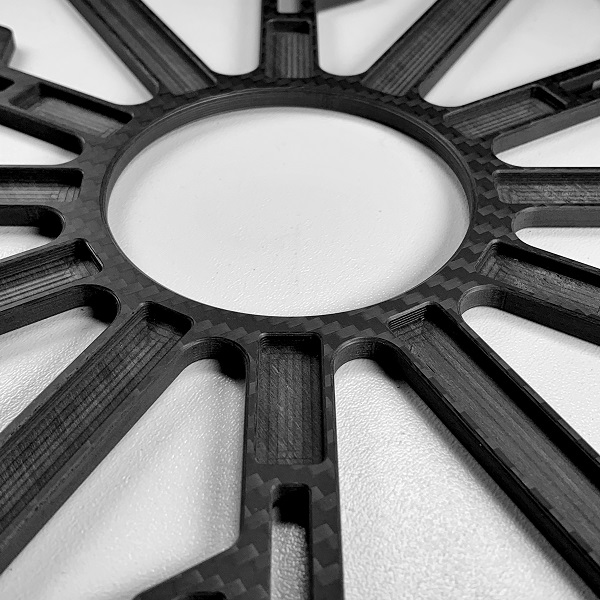
High performance mobile robots have as major lightweight solution carbon fiber sheets, carbon tubes and sandwich panels. Compared with aluminum, CFRP can save weight by 40 % for the same rigidity and even more compared with steel. For example, the fiber orientation can be adjusted by building up laminates along the essential load channels to deliver precise strength. Its dimensional stability and vibration-damping properties make it ideal for chassis main beams, cantilever brackets and long-span support frames where stiffness is essential.
The cons are also obvious. Raw material prices are high, CNC machining is pricey for low volume prototyping. Special cutting tools are necessary as wrong machining might result in delamination and fraying. CFRP is anisotropic too. The transverse impact resistance can be inadequate if the layup design is bad.
Glass Fiber Reinforced Polymer (GFRP)
GFRP is strong and cost effective, and has better impact resistance than carbon fiber at a quarter of the cost. It is suitable for non-critical protective covers, outer housings and auxiliary brackets and is the ideal choice for cost sensitive large volume applications. The penalty is a lower specific stiffness, limiting its weight saving potential for long span, dynamically stressed primary beams.
Aramid (Kevlar) Composite materials
Aramid composites have strong impact resistance, rip resistance and abrasion characteristics. Frequently used as external cladding panels in impact regions rather than the underlying structural framework. Both the raw material and the production costs are rather high. Deployment is for extraordinary protection needs.
A Recommended Practical Approach: Hybrid Structures of Different Materials
Most of the commercially available mobile robots are not amenable to an all-carbon-fiber design. The best compromise is a hybrid layout: primary loads on beams and cantilevers are taken by carbon fiber plates or pultruded carbon tubes; precision CNC-machined aluminum is still used for mounting bases, alignment datums and threaded connections to ensure assembly accuracy and joint reliability; outer guards and enclosures are made of GFRP or engineered plastics. Each material was selected for the best part it could play in the search for weight reduction, manufacturability and budget management.
Weight reduction by machining and structural methods
Material upgrades are only part of the answer. Effective lightweighting should start with design optimization, and not material substitution.
First, topological optimization and rib pattern optimization. Finite element simulation allows engineers to remove material from places of low stress or non-load bearing, and build in reinforced ribs, slices and sandwich cores to reach stiffness targets with less mass. In many cases, optimizing an existing aluminum structure can result in significant weight loss at a fraction of the cost of converting parts to composites.
The second is to select the right composite production route. If you are prototyping, or creating small numbers of parts there is no cost of tooling and design validation is faster with machining from pre-cut carbon sheets on a CNC. Compression molding can also be cost effective for mid-volume runs with the unit price dropping as the quantity grows. Pultruded carbon profiles are most suitable for long straight members and have a better value than machined solid plates. The 5-axis CNC fabrication allows for one-piece shape of angled and complex mounting pieces, eliminating seams and assembly stresses and maintaining the precise tolerances needed for robotic precision assembly.
Third, joint design carefully. Metals can be welded. Composites can not. Typical joining methods are adhesive bonding, embedded threaded inserts and bolted assemblies. Joints are classic failure locations, and designs must transmit the pressure evenly to avoid local crushing and delamination, determining the long-term durability of the repair.
Cost Trade-Off of Composite Refurbishment
This is the most significant portion of the project’s implementation. Composite component unit prices are typically higher than traditional metal equivalents, therefore evaluation must extend beyond the component procurement price and determine total cost of ownership (TCO).
Higher Direct Costs Upfront
1. Cost of material. Carbon prepreg and carbon panels cost more than aluminum or steel. Aramid materials are much more expensive.
2. Overhead for machining. With carbon and aramid fibers, tools wear out very quickly, leading to longer CNC cycle times and requiring strict quality control to maintain yield. The pricing for small amounts is way greater. And compression molding needs a mold up front, which only makes sense at higher volumes.
3. Costs of validation and inspection Further testing is needed to identify internal delamination and hidden flaws, including modeling work and mechanical sample verification during early development phase.
Premium Materials That Offer Lasting Benefits
1. Smaller power components: A lighter robot allows smaller motors, reducers and power sources to be used, which decreases spendings on core motion gear.
2. Battery optimization: You can reduce the battery capacity and still obtain the same runtime, or get longer working cycles out of the same battery, which is a big selling point for the end customer.
3. Lower maintenance costs: Lower vibration equals less wear and tear on sensors and transmission components. This results in fewer breakdowns, less downtime and fewer repairs. Composites are also outstanding at resisting fatigue, which enables 24/7 manufacturing operation.
4. Improved product positioning. Lightweight performance is a differentiator, and one that can attract a more competitive pricing for automation equipment.
The Cost Break Point
- R&D prototyping and small batch validation: CNC machining of carbon sheets to minimize mold cost and test weight saving and mechanical safety.- Moderate-volume production: Think of compression-molded composites, or hybrid assemblies of carbon tubes and aluminum joints.
- Inexpensive general handling robots: Optimize aluminum frames and then use GFRP for covers. use carbon fiber just on the high dynamic swing arms to keep total cost contained.- Heavy duty robots: Each composite conversion has risks. Composites are better for secondary weight savings but preserving metal for primary load bearing structures
Implementation - Common Errors and Best Practices
Many lightweight projects fail because the initial assessment is generally insufficient. Anisotropy is a typical hazard. Composites are robust in the fiber direction but prone to splitting and delamination when subjected to transverse pressures, hence layup orientation must match load pathways. Another element is environmental compatibility, regular resin composites are not resistant to prolonged exposure to high temperature, humidity or chemicals, thus protective coating selection is needed for outdoor and chemical-industry applications. Damage to composites can also be concealed. Standards for incoming and final item inspection must be established, as a pristine surface may be hiding internal delamination.
The design and fabrication specifications should also be defined. Outsourcing CNC composite work? Send STEP files, layup demands, tolerance criteria and edge-sealing directions. Work with your fabricator to establish composite-specific production rules that prevent fraying, delamination and dimensional aberrations.
Replacing aluminum with carbon fiber is just one part of lightweight retrofitting for mobile robots. It is a systematic optimization of materials, structure, manufacturing and cost. Weight reduction is possible using materials such as carbon fiber, fiberglass and aramid composites, which decreases inertia, saves energy and improves dynamic responsiveness. But they have higher obstacles of materials and processing, especially at low levels of output.
For most projects the way ahead is clear. The first topological optimization of the metal structures to achieve maximum potential weight reduction. Then selective usage of carbon fiber composites for dynamically stressed essential elements with aluminum alignment joints and protective covers of GFRP. This balances weight reduction , structural safety and budget . Early composite CNC machining partner involvement in the design review helps predict weight savings, safety margins and volume pricing, turning lightweight improvements into genuine product competitiveness, not wasted cost inflation.