At $15/hour, each eight-hour shift costs $240 in direct labor on a manual or semi-automatic machine and $120 on a fully automatic one — $120 saved per shift, or $30,000 a year across 250 shifts. The labor cost per shift screen printing semi automatic vs automatic gap is the easiest part of an equipment decision to quantify, yet it is usually quoted as "fewer operators" instead of dollars. This breakdown gives operator counts per automation level, pieces per operator-hour, and the annual saving at three wage levels.
1. How many operators does each automation level actually need?
A manual press needs two to three operators, a semi-automatic needs two, and an automatic line needs one plus a part-time packer — and the real difference is not headcount but pieces per operator-hour, which ranges from 120 to 1,800.
- Manual: 2-3 operators, 250-350 pcs/h, about 120 pieces per operator-hour.
- Semi-automatic: 2 operators (one loading, one unloading), 800-1,000 pcs/h, about 450 pieces per operator-hour.
- Fully automatic: 1 operator plus 0.5 packer, 2,500-3,500 pcs/h, about 1,800 pieces per operator-hour.
Table 1: labor per automation level at $15/h, single shift
| Level | Operators | Output | Pieces per operator-hour | Labor per 1,000 | Labor per 8h shift |
| Manual | 2.5 | 300 pcs/h | 120 | 125 | 300 |
| Semi-automatic | 2 | 900 pcs/h | 450 | 33 | 240 |
| Fully automatic | 1.5 | 2,700 pcs/h | 1,800 | 8 | 180 |
The counter-intuitive part: the automatic's shift cost is only 25% lower than the semi-automatic's, yet its cost per 1,000 prints is 75% lower. Labor per shift measures staffing; labor per print measures productivity. Buyers who compare shift wages alone miss three-quarters of the saving.
✅ Bottom line: Automatic cuts shift labor by 25% but cost per 1,000 prints by 75% — compare pieces per operator-hour, not headcount.
2. What does the saving look like per shift, and when does it pay back?
A $120-180 saving per shift sounds small until it is multiplied: 250 shifts a year is $30,000-45,000, which repays a $60,000 automation gap in 16-24 months.
The how many operators needed for fully automatic screen printing line question usually has a one-word answer — one — but that operator also supervises the dryer, the loader and quality, which is why the role changes rather than disappears. Plan for one machine minder per line and one floating operator per two lines.
Savings scale with wage level faster than with speed:
Table 2: labor cost per 1,000 prints by wage level (USD)
| Loaded wage | Manual | Semi-automatic | Fully automatic |
| $8/h | 53 | 18 | 3 |
| $15/h | 100 | 33 | 6 |
| $25/h | 167 | 56 | 9 |
At $8/h the automation saving is $15 per 1,000 prints; at $25/h it is $47. That is why the same machine pays back twice as fast in Germany or the US as in low-wage markets, and why the screen printing labor cost savings automation per shift story is really a wage story.
Three practical notes before you book the saving:
- Don't cut to zero. An automatic line still needs an operator for loading, color changes and inspection; budget 1.5 people, not 0.5.
- Count indirect labor. Screens, ink mixing and packing are often shared roles that stay after automation.
- Check the shift pattern. Savings only appear on shifts you actually run; a single-shift plant at 40% utilization saves little.
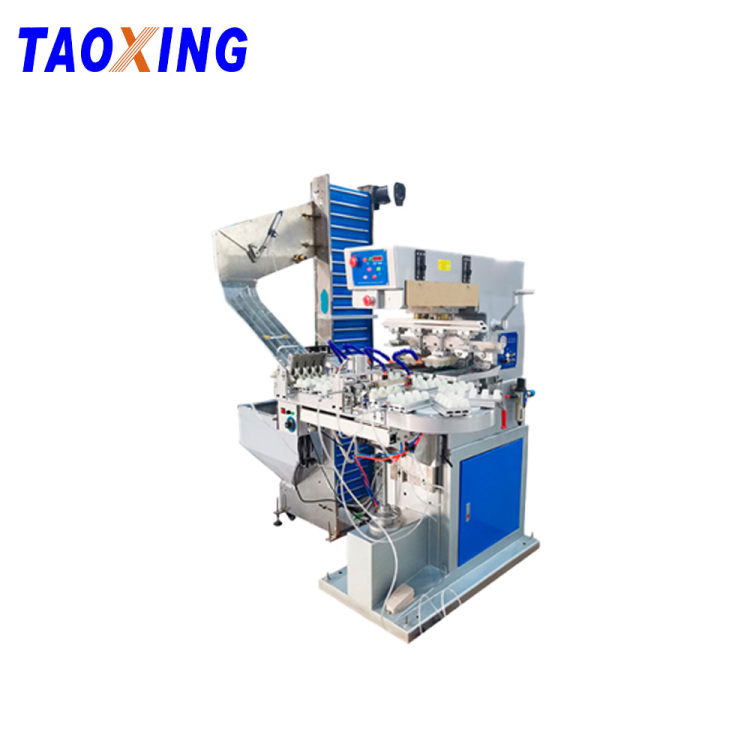
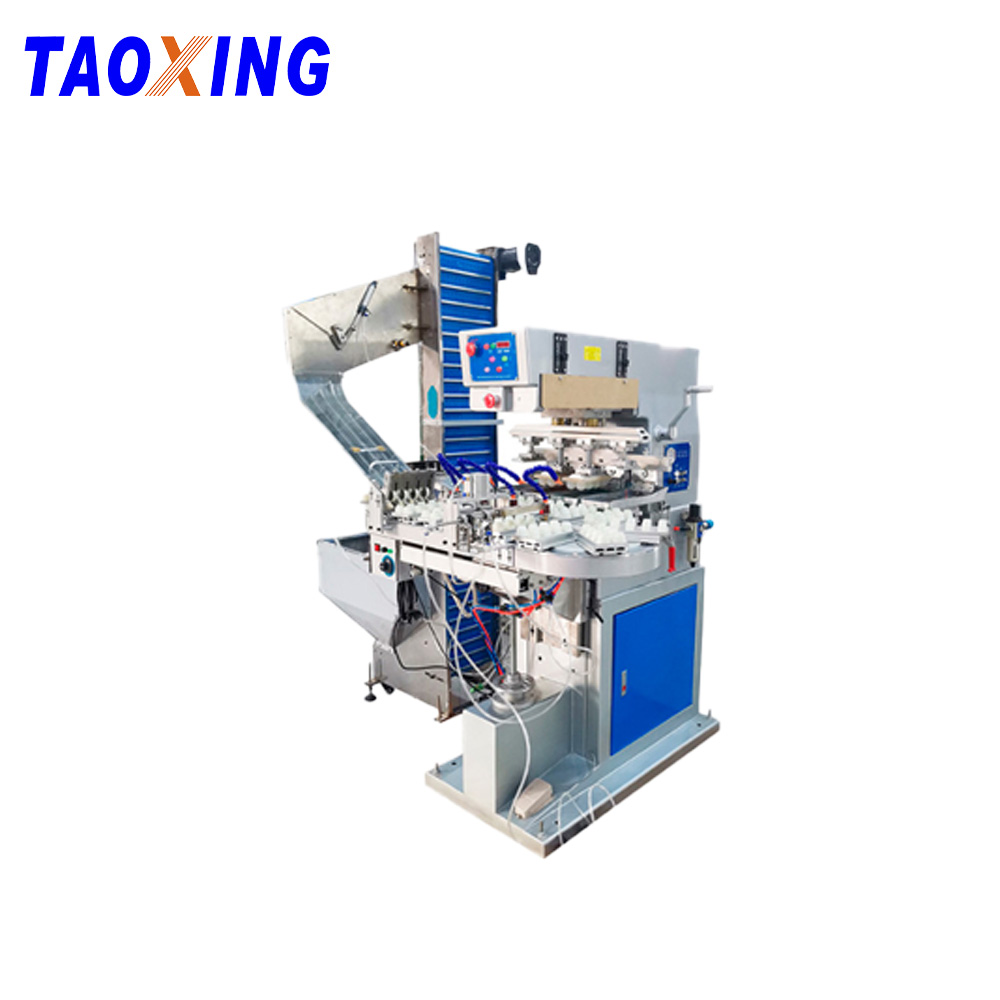
Sourcing note: operator count depends on how well the line is integrated. TAOXING, the brand of Zhejiang Zechen Intelligent Equipment Co., Ltd., builds the screen printing machine, pad printing machine and mesh stretching machine ranges on one site, so a line can be specified around one minder rather than three suppliers' interfaces.
Supervision is the other variable. One minder can cover two automatic lines if they sit within 10m and share a dryer; beyond that, walking time eats the saving, so budget 0.6 operators per line rather than 0.5. Training runs 3-5 days per operator on an automatic against 1-2 on a semi-automatic. Book that week into the first month's output, not into the annual plan.
✅ Bottom line: One automatic line replaces about one operator per shift and repays the automation gap in 16-24 months at $15/h labor.
FAQ
Q: How many operators are needed for a fully automatic screen printing line? A: One machine minder per line, plus about half a person for packing and inspection. The how many operators needed for fully automatic screen printing line answer assumes a line with automatic loading and a UV or IR dryer; add one operator if you run multi-color jobs with frequent screen changes.
Q: How much labor does automation save per shift? A: At $15/h, roughly $60-120 per shift against a semi-automatic and $180-240 against a manual press. The screen printing labor cost savings automation per shift figure rises with wage level: at $25/h the same line saves $250-330 a shift.
Q: Does automation really cut headcount, or just reassign it? A: Mostly reassign. The labor cost per shift screen printing semi automatic vs automatic saving is real in cost terms, but the people usually move to packing, inspection or a second line — plan the org chart before the purchase order, not after.
Get the operator plan before the quote
Send TAOXING your print volume, shift pattern and local wage, and our engineers will return a staffing plan and labor cost per 1,000 prints for semi-automatic and automatic configurations. Zhejiang Zechen Intelligent Equipment Co., Ltd. builds every TAOXING machine to order at its Deqing factory, with OEM/ODM options and wholesale pricing for distributors. Start at printerae.com.
Email: [email protected]
Mobile: +86 13588858598
Website:www.printerae.com