
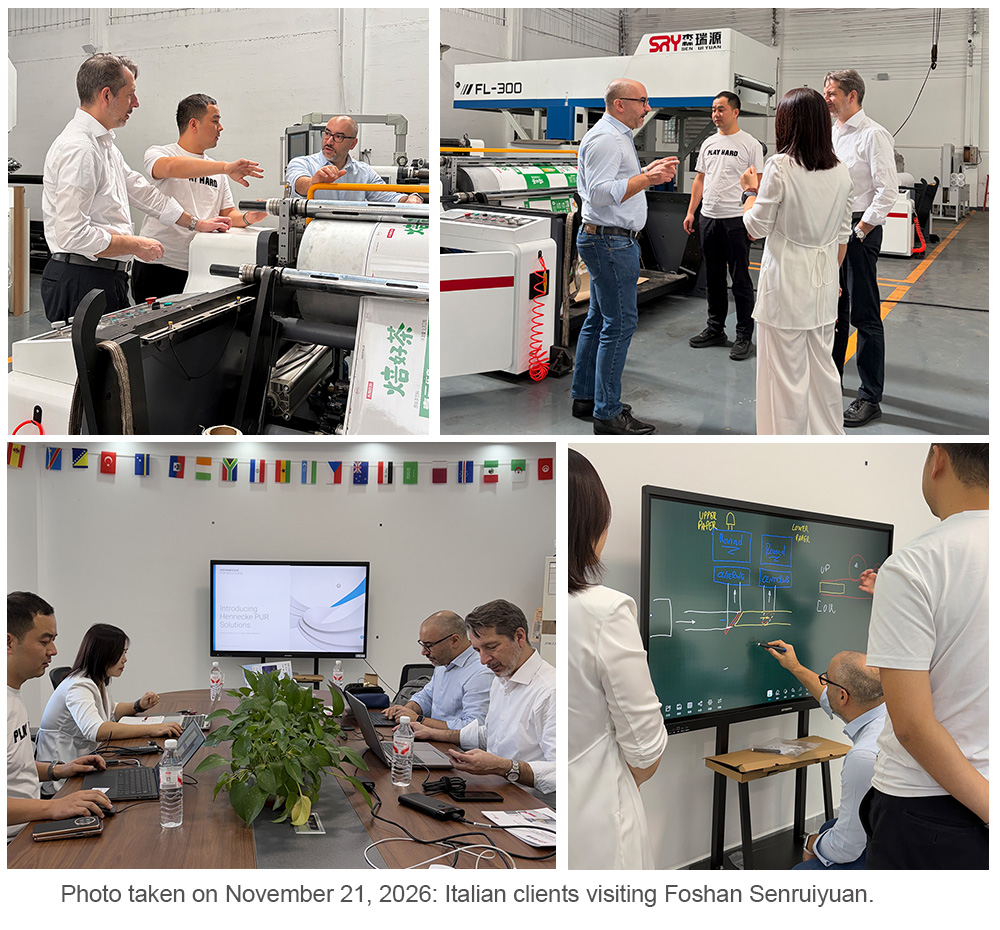
On 21 November 2026, a customer from Italy visited our Foshan factory to check a water-based dry roll-to-roll laminating line. In the workshop we looked at non-stop rewinding and at how the splicer is integrated with the line. A visit like this is useful not because of the photographs, but because both sides leave with the same written record of what was seen, what was checked and what was agreed. This article sets out what we looked at and how the meeting was run, as a reference for any buyer planning a factory verification.
On the line, the splicer and the rewind belong together
Non-stop is not a single machine setting. It is the whole line running through a reel change: on the unwind side the splicer joins the old reel to the new one, coating, drying and lamination do not stop, and on the rewind side the reel changes without the line coming down. What you can actually see on the floor is whether tension stays steady through those few seconds, whether the splice is detected and rejected, how much film the transition wastes, and whether coating and lamination return to normal once the line is back at its usual speed. These results belong to the line, not to a single machine. The same splicer fitted to a different line can behave differently, so they are readings to record at a trial rather than fixed values in a catalogue. If the process route itself is still open, the comparison of water-based, thermal and solvent-free lamination is a better starting point; if the question is output, read nominal speed versus actual laminator output before the visit.
The customer introduced their business first
The meeting opened with the customer walking us through their company on a presentation: what they make, where those products are used, and which parts of the equipment matter most to this project. Starting with the business rather than the specification gave both sides one reference point. It meant that configuration choices, installation conditions and acceptance items could be discussed against a real production situation, instead of reading numbers off a general sheet. We could answer to the way they work, not to a standard sample.
Drawing the web path on the whiteboard
The discussion centred on the scope of supply and configuration, and on installation conditions. To make the interfaces clear, the engineers on both sides went to the whiteboard in the meeting room and drew as they talked: which way the upper paper and the lower paper run, where rewinding and centering sit, and the path of the web from unwind to rewind, arrow by arrow. On the right-hand side of the board we drew the roll-change path for the upper and lower reels separately, leaving space in the middle for the interface with the customer's existing equipment. The non-stop rewinding and splicer integration we had just seen on the floor went onto the same drawing again. Which items are standard, which need adjusting to the customer's existing line, and where the machine will stand once it arrives, including access and service space, were confirmed point by point. Whatever could not be settled in the room went into the meeting minutes with an owner.
Because we serve customers in different markets, our engineers confirmed the ISO 13849 configuration required for the proposed line and the steps needed to put it in place. They also discussed the questions that come up around UL requirements when the same equipment is offered in North America. These points were confirmed in the meeting and are to be documented in the configuration review, with the applicable documents, their scope and the evidence to be supplied recorded in writing.
Why quality stays at the centre
Working to the standards expected in Europe is not something we put in a slogan. It is the reason we keep coming back to one point: quality is the core value of this company. It shows up in how tension holds during the few seconds of a roll change, in every guard and label, in every document that comes with the machine, and in every acceptance record. The customer arrived with a list, and we could put each item in front of them. That is more persuasive than anything we could say about ourselves.
Visit us in Foshan
We welcome customers from any country to come and look at the line properly. Bring your own material for a trial, bring a drawing to check an interface, or simply come to watch a line run from unwind to rewind; we will open the machine, the working conditions and the records. If you send your question list in advance, as this customer did, we can work through it item by item on the day. If travel is not convenient, an online machine viewing can come first. Either way, send the substrate structure, web width, current line speed and target output, and we will prepare a verification sheet for your line. For what happens after delivery, see what a full laminating machine service visit covers.
About Senruiyuan
Foshan Senruiyuan Machinery Technology Co., Ltd. builds roll-to-roll laminating, printing and post-press equipment in Foshan, Guangdong, China. The water-based laminator specification lists the configuration we can discuss at a trial; the lamination defect troubleshooting guide shows which readings matter when a result changes.
Contact Senruiyuan
Foshan Senruiyuan Machinery Technology Co., Ltd.
Email: [email protected] | WhatsApp: +86 17328088404
No. 8, Jinxian, Jinli Community, Lishui Town, Nanhai District, Foshan, Guangdong, China