
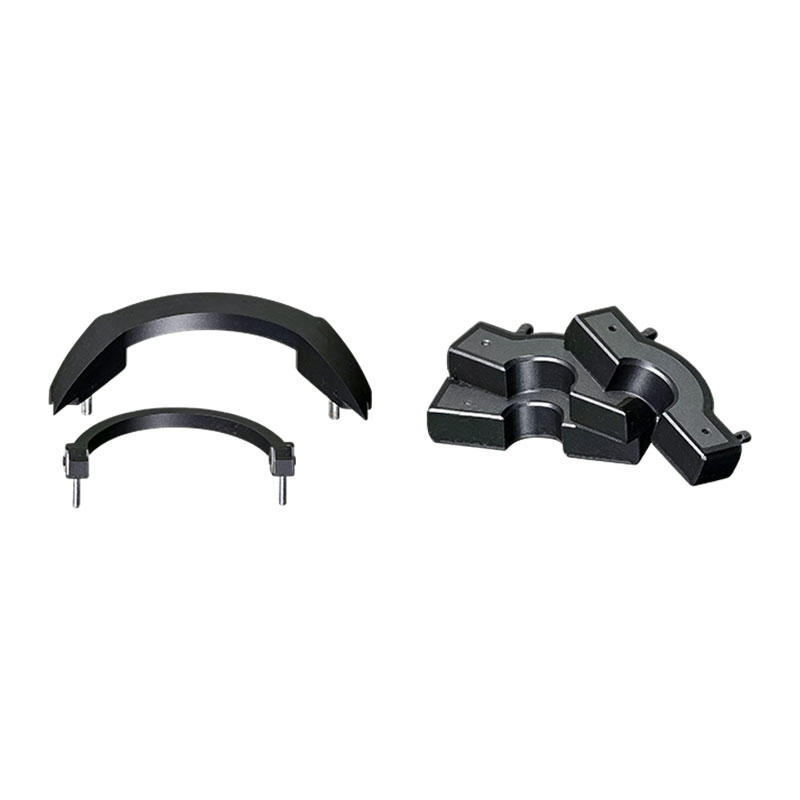
This guide opens the element up: what the inserts do, how the bond is made, and how a quality engineer proves it held.
1. how annular BOP packing element is manufactured vulcanization
The bond is not glue applied to a finished part — it is a chemical interface created inside the mould, while the rubber crosslinks, and it is only as good as the steel surface underneath it.
What is actually inside the element
A 13-5/8" annular element carries several crescent-shaped steel inserts stacked through the rubber section. They are the skeleton: they stop the compound extruding into the bore under 5,000 psi, and they give the sealing face enough structure to fold and recover. Without them the rubber would simply flow. The insert surface is bonded to the rubber across a thin adhesive system — break that interface and the reinforcement stops doing its job.
The manufacturing chain
how annular BOP packing element is manufactured vulcanization follows the same sequence in every serious plant:
- Metal preparation — grit blast with 80–120 mesh aluminium oxide to SA 2.5, forming a 1.5–3.0 mil surface profile, then alkaline clean and a zinc-phosphate conversion coat
- Primer — a metal-adherent coat such as Chemlok 205, applied at 0.2–0.4 mil dry film, within two hours of cleaning
- Cover cement — a rubber-compatible topcoat such as Chemlok 220 at 0.5–1.0 mil, dried fully before moulding
- Moulding — transfer or injection moulding with the coated inserts in the cavity, around 145–171 °C for 10–20 minutes under pressure
- Co-cure — the rubber's sulphur or peroxide system crosslinks the cover cement and the rubber together, forming a 1–10 μm interpenetrating diffusion zone
The primer bonds to the metal oxide and phosphate layer; the cover cement co-crosslinks with the rubber. Both must happen at once. That is why a vulcanised bond routinely out-strengthens the rubber itself, while any glue applied after cure is a fundamentally weaker joint.
|
Method |
Typical peel strength |
Failure location |
Correct use |
|
Vulcanised co-cure |
≥6 kN/m (≈34 lb/in) |
Through the rubber (R) |
Dynamic sealing parts, every BOP element |
|
Post-cure adhesive |
1–3 kN/m |
At the adhesive line |
Field repair, prototypes, static assemblies |
|
Mechanical encapsulation |
No chemical bond |
Insert pulls out |
Captive cores that carry no tensile load |
✅ Bottom line: The insert is the skeleton and co-cure is the joint — a bond made after cure is a different, weaker product.
2. packing element steel insert bonding failure causes: reading the fracture face
A debond is a process defect, not a wear pattern — rubber cracking is a material reaching its limit, but a clean insert surface means the joint never formed in the first place.
The fastest diagnostic is the fracture face itself. ASTM International classifies bond failures by where the separation happened:
|
ASTM D429 code |
Where it failed |
What the face looks like |
Usual root cause |
|
R |
In the rubber |
Rubber torn on both sides |
Correct — the rubber was the weak link |
|
RC |
Rubber / cover cement |
Hard, glossy metal with little rubber |
Pre-cure, thin cement film, low mould pressure, plasticiser migration |
|
CM |
Cement or primer / metal |
Bare, clean metal |
Oil, dust, inadequate blast or phosphate, dry spray |
|
CP |
Cover cement / primer |
Two distinct layers separated |
Contaminated primer, poor drying, wrong cement pair |
The 80/20 rule buyers should quote back
Roughly 80% of rubber-to-metal bond failures originate in metal preparation — the step that takes the least billable time. Chemistry gets the attention because the adhesive suppliers publish excellent data sheets, but a Chemlok system performs as specified on clean steel and no adhesive chemistry can compensate for contaminated or passivated inserts. Ask a manufacturer for its surface-prep specification before asking about its adhesive brand.
Five causes recur on incoming inspection at CHENGSEN: insufficient blast profile or a missed phosphate stage; skin oil from bare-hand handling of prepared inserts; pre-baking coated inserts to "speed up" drying, which degrades the adhesive before cure; cure time set by the thinnest rather than the thickest rubber section; and mould temperatures drifting between cavities.
rubber to metal bonding quality test for BOP parts
A rubber to metal bonding quality test for BOP parts is destructive by nature — you cannot prove a bond on the part you ship. ASTM D429 Method B (90° peel or conical tensile) is the standard fixture. The acceptance criterion that matters is not a single force number but the failure mode: a sound vulcanised bond gives 100% rubber tear, with the adhesive line intact and rubber tearing through its own section. A supplier quoting a peel strength but not reporting R-type failure is reporting a number without the guarantee behind it.
CHENGSEN samples each bonded batch destructively, retains the fracture faces, and records hardness and bond rating together — because a compound that passes compression set but fails at the insert is still a rejected part.
✅ Bottom line: Demand the failure mode, not just the peel number — rubber tear (R) is the only result that proves the interface was made correctly.
FAQ
Q: What are the most common packing element steel insert bonding failure causes in the field?
A: CM-type failures from poor metal preparation. A clean, shiny insert pulled out of the rubber means oil, dust or an inadequate blast and phosphate left the primer with nothing to key into — the bond was never formed.
Q: How is the rubber bonded to the steel insert?
A: The inserts are blasted, phosphated and coated with a two-layer system, then placed in the mould. During how annular BOP packing element is manufactured vulcanization, the rubber crosslinks with the cover cement at 145–171 °C, creating a chemical bond stronger than the rubber itself.
Q: What should a rubber to metal bonding quality test for BOP parts report?
A: The ASTM D429 Method B result plus the failure code. A passing result is 100% rubber tear (R). A force value with a CM or RC failure means the joint is weaker than the compound and will debond in service.
CTA: Ask for the bond report before you order
Send your element size, pressure rating, service temperature and suspected failure photo to CHENGSEN. You receive the manufacturing route, the surface-prep specification and the ASTM D429 result with its failure code — not just a hardness sheet.
Zhejiang Chengsen Technology Co., Ltd. compounds and vulcanises elements in house under an API Monogram licence to API Spec 16A, with grit-blast and phosphate preparation, two-coat bonding, batch destructive testing and custom compound development from single elements. Factory-direct pricing applies to repeat and fleet orders.
|
|
|
|
*Published: November 2026 |
By CHENGSEN Engineering Team* |