
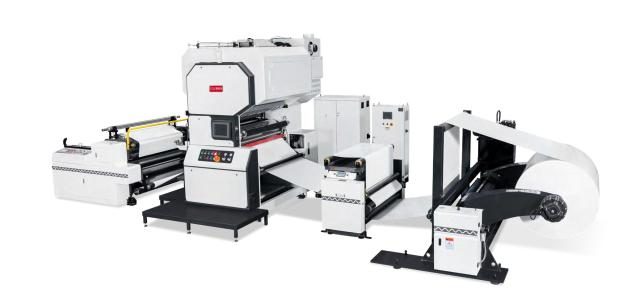
Two machines both described as "non-stop" can behave very differently on the same line. This guide is for the engineers and purchasing teams who have to write the specification: the figures that belong on a quotation, the interfaces to agree with the supplier of the press or laminator, and the tests to run before sign-off. It is written by Foshan Senruiyuan Machinery Technology Co., Ltd., a maker of web-handling, laminating and post-press equipment in Foshan, Guangdong, China. For the investment case rather than the specification, see why printing and packaging plants install automatic splicers; for the process choice, see our comparison of water-based, thermal and solvent-free lamination.
Start with the job, not the model number
Three plants can all ask for a "non-stop splicer" and need three different machines. The width sets the frame and the reel stand; what happens downstream sets the splice type and the control handshakes.
| Corrugated board line | Printing, laminating or coating line | Label and narrow-web converting | |
|---|---|---|---|
| Typical web width | Wide formats, roughly 1350–2550 mm | Medium to wide, roughly 1100–2050 mm | Narrow webs, roughly 350–850 mm |
| What the joint must survive | Heavy parent reels and high board throughput | The laminating nip, drying oven or printing unit | Register-critical printing with no added thickness at the joint |
| Configuration to ask for | Hydraulic shaftless reel stand, heavy-duty frame, zero-speed butt splice | Zero-speed butt splice, accumulator, closed-loop tension, splice signal to downstream | Head-to-head butt splice, edge position control, servo-driven infeed |
| Watch for | Reel loading aisle and floor rails | Accumulator dwell time at your real line speed | Tape coverage and lateral alignment |
Buying on web width alone is the most common mistake. A joint that performs well on a corrugator can still fail at a heated laminating nip, and a narrow-web machine will not carry a two-tonne parent reel. Our article on nameplate speed versus real output shows why catalogue maxima rarely survive a full production run.
Eight figures that belong on the quotation
The figures below come from published specifications in our unwinding and splicing and non-stop rewinding ranges. They are reference points, not a promise for your line: ask every supplier to restate each one against your own substrate and speed. For running cost, our energy cost and payback worksheet turns an energy claim into an annual figure.
- Web width and reel envelope. State the width range, maximum unwind diameter, maximum reel weight and the core sizes you run. One published mid-web unit lists 1100 mm width, 1400 mm maximum reel diameter, and 3-inch and 6-inch cores. Ask for your numbers in writing, not a catalogue range.
- Splice method and joint strength. A zero-speed butt joint avoids the doubled thickness of an overlap splice, which matters wherever the web passes a nip or a printing unit. Ask for joint strength as a percentage of base material tensile strength and how it is measured; a published figure is at least 85%.
- Accumulator capacity and dwell time. The most frequently omitted number, and the one that decides whether the parent machine really keeps running. Ask for live storage length and dwell time at your line speed. The same specification gives 90 m of storage for at least 90 seconds at 30 m/min: dwell time equals storage divided by line speed.
- Tension range and control method. Closed-loop control, a stated working range and a stated accuracy. The published example gives 100–600 N stepless adjustment with ±30 N accuracy and encoder feedback on the dancer. Ask which tension zones the supplier controls and where the load cells sit.
- Braking and reel stand. A dual-position hydraulic shaftless stand with a pneumatic multi-disc brake and proportional valve is typical for wide webs; the published unit also includes ±50 mm lateral trim. Clarify roll loading at the same time: floor rails, AGV or forklift, and the clearance each needs.
- Cut accuracy and repeatability. A published figure is ±0.5 mm. Ask what tolerance is guaranteed on your material, and over how many consecutive splices it holds.
- Controls and line interfaces. PLC and HMI platform, fieldbus, the speed reference from the parent machine, a splice-detection output for downstream inspection or waste rejection, and data logging. The published example uses a Siemens S7-1500 with PROFINET and a 12-inch HMI.
- Safety and utilities. Guarding and safety circuit rating (published example: ISO 13849-1 PL d), installed power (11.5 kW at 380 V, three-phase, 50 Hz), compressed air (0.7 MPa), footprint and overall height (6,800 × 4,000 × 2,900 mm). Height, floor rails and the loading aisle are building questions — settle them before the order.
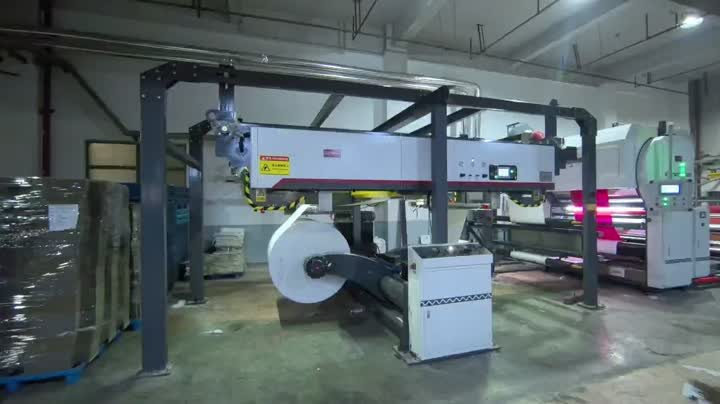
For a worked example of these items together, see the automatic non-stop butt-to-butt splicer in our range.
Five interfaces to agree with the main machine supplier
These are the questions that turn a "plug and play" promise into a commissioning problem.
- Who owns the line speed reference, and must the press or laminator decelerate during a splice?
- Where does web guiding sit relative to the splicer, and who corrects the lateral offset introduced by a splice?
- How is each splice flagged to downstream inspection or waste rejection, so the joint does not end up in a finished reel?
- How many tension zones are there, and who sets and records them at commissioning?
- What happens on a failed splice — automatic web-break stop, alarm, and safe access for re-threading?
Acceptance tests to write into the purchase order
A factory acceptance test is useful, but the decisive one is the site test on your material with your operators. Ask for the protocol and the acceptance values in the order itself, not after installation. If a joint later fails in production, our lamination defect troubleshooting guide gives a repeatable symptom-to-cause sequence.
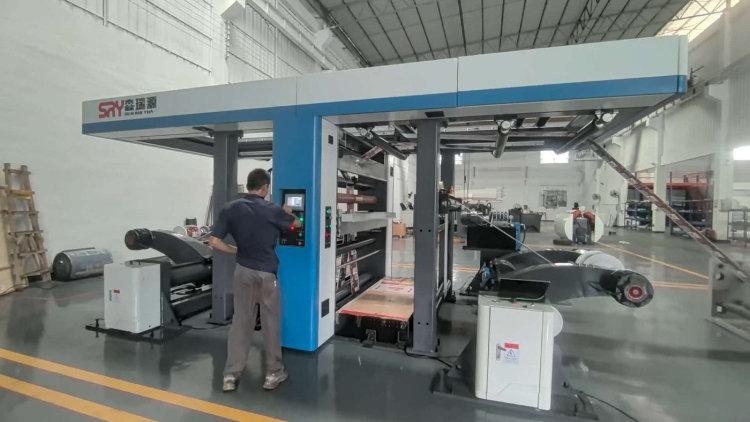
- A defined number of consecutive automatic splices on your own substrate at target line speed, with the success rate and the cause of every failure recorded.
- Joint strength and thickness measurement, plus a practical check that the splice passes the downstream nip, printing unit or coater without a bump or a break.
- A tension trace across the splice event, recorded from the machine controller, showing no spike beyond the agreed band.
- Parent machine speed during the change: confirm whether it held speed or decelerated, and by how much.
- Roll utilisation: measure the material left on the core at changeover, so savings can be verified rather than assumed.
- Safety functions and utilities: emergency stop chain, guarding, measured air and power consumption, and noise level where local rules require it.
Four mistakes that only show up after installation
- Buying on maximum line speed instead of accumulator dwell time at the speed you actually run.
- Assuming any butt splice passes every downstream process. Printed, coated and laminated structures need a trial with your own material.
- Forgetting the building. Dancer height, floor rails and the reel-loading aisle are easy to overlook and expensive to fix later.
- Treating the splicer as a stand-alone machine and never agreeing the handshakes with the press, coater or laminator.
Where this equipment sits in a web line
Foshan Senruiyuan Machinery Technology Co., Ltd. builds web-handling equipment alongside its reel-fed laminating and printing range: automatic splicing and unwinding units, non-stop surface rewinders, web guiding systems and print inspection units. The SL series of auto non-stop surface rewinders covers web widths from 650 to 2550 mm and paper weights from 100 to 450 g/m², with model-dependent speeds from 20 to 350 m/min. For narrow-web labels, the FL350/450/650/850 series uses zero-speed head-to-head splicing and edge position control so the joint adds no thickness to the web.
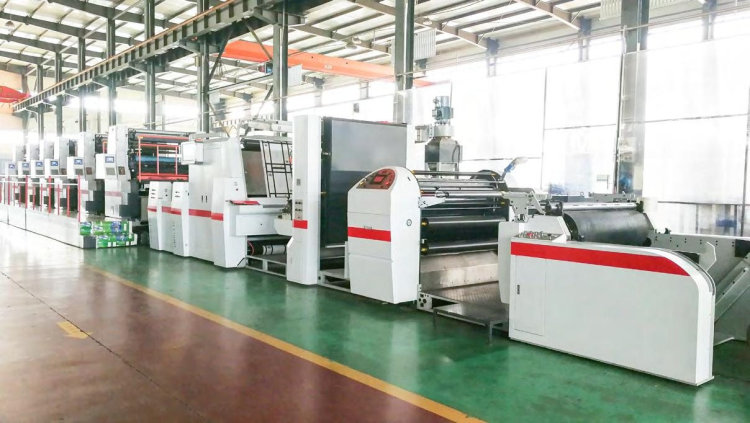
Quality control covers incoming materials, assembly and final inspection under an ISO 9001-certified management system. Equipment is supplied to customers in Europe, Turkey, India, Iran and Southeast Asia; recent export activity includes repeat orders for rewinding and web-guiding equipment from India.
Frequently asked questions
Butt splice or overlap splice — which one do I need?
A butt joint keeps the web at single thickness, so it is the usual choice where the joint must pass through a nip, a coating head or a printing unit. Overlap designs are mechanically simpler, but the doubled thickness can cause a bump, a registration mark or a web break downstream. Confirm with a trial on your own structure.
How much accumulator storage do I need?
Divide the live storage length by your line speed to get dwell time. Ask the supplier to state both numbers at your speed, not at a slow demonstration speed. The splice sequence, the roll change and any recovery time all have to fit inside that window.
Can a splicer be retrofitted to an existing line?
Modular units are commonly retrofitted, but the practical constraints are the five interfaces above plus floor space, web path height and access for roll loading. Agree these in writing before discussing price. Plants running short batches should also weigh changeover time; our note on short runs and frequent changeovers covers when one dual-process line beats two dedicated ones.
Which core sizes are supported?
Published configurations include 3-inch and 6-inch cores, and narrow-web machines may use other sizes. State every core you run, including legacy stock, in the enquiry.
Will the splice be visible in the finished product?
The joint should be detected and flagged so downstream inspection or waste rejection can remove it. Ask for a splice signal output and confirm where the rejection happens in your line.
What should a quotation include?
Web width and reel envelope, splice method and joint strength, accumulator storage and dwell time, tension range and control method, braking and roll loading, cut accuracy, control platform and interfaces, safety rating and utilities, optional modules, warranty, spare parts list and commissioning scope.
Request a specification review for your line
Send us your web width, substrate and grammage, parent reel diameter and core size, target line speed, and the equipment the splicer must feed. Our engineers will review the configuration and the interface points with you before a quotation is issued. Browse the unwinding and splicing range, or send an inquiry through our BOSSGOO store.
Contact Senruiyuan
Foshan Senruiyuan Machinery Technology Co., Ltd.
Email: [email protected] | WhatsApp: +86 17328088404
No. 8, Jinxian, Jinli Community, Lishui Town, Nanhai District, Foshan, Guangdong, China