
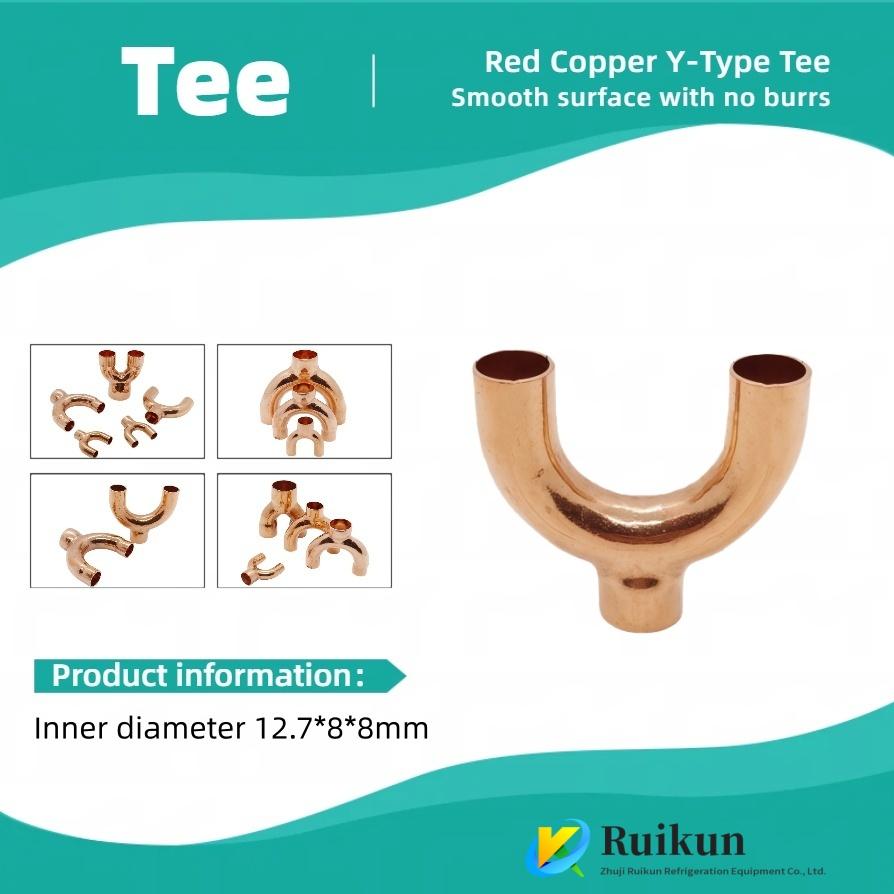
Every catalog, drawing and purchase order writes the sizes a little differently, and how to read reducing tee three outlet sizes is rarely explained by the people selling them. At Ruikun, a China-based copper fitting factory producing 41 tee variants in 99.9% C12200, our quoting team reviews buyer drawings every week, and the same three reading errors keep coming back: branch position confused with run position, nominal size confused with actual outside diameter, and metric and inch systems mixed on one drawing. This guide shows how to decode the three numbers correctly, then what to write on the PO so the quote comes back right the first time.
1. Which Number Is the Branch? Decoding the A × B × C Order
On a standard reducing tee, the first and third numbers are the two run (main-line) ends and the middle number is the branch — so a 22×22×15 fitting has a 22 mm main line with a 15 mm branch off the side.
The word "standard" is doing real work in that sentence. Four patterns cover almost every spec line you will meet:
|
Spec line |
Run inlet |
Branch |
Run outlet |
What the fitting actually is |
|
22×22×15 |
22 mm |
15 mm |
22 mm |
Straight main line, smaller side branch — the classic reducing tee |
|
28×22×22 |
28 mm |
22 mm |
22 mm |
Main line swage-reduced through the fitting |
|
22×15×15 |
22 mm |
15 mm |
15 mm |
End-of-line transition; branch matches the reduced run end |
|
25.4×19×25.4 |
25.4 mm |
19 mm |
25.4 mm |
Non-standard branch between equal run ends — needs a drawing, not a part number |
Two cautions taken straight from real RFQs:
- The smallest number is not always in the middle. 28×22×22 puts the large end first because the main line itself steps down. If you scan only for the smallest value, you will read the fitting backwards.
- Catalog conventions differ. The reducing tee run branch size order naming convention is not standardized across catalogs — most follow run × branch × run, but some list inlet × outlet × branch, and branded systems use their own codes entirely (NDL's W4032, for instance, is a 3/8 × 3/8 × 1/4 tee; W4049 is 1-1/8 × 1-1/8 × 7/8). Confirm against the vendor's datasheet before the number goes onto a drawing.
Buyers searching for the copper reducing tee 22 x 22 x 15 meaning are usually holding exactly this kind of line item — the sizes are clear, the roles are not. The safe habit costs nothing: label the roles in writing. A callout like "22×22×15 (run 22 / branch 15 / run 22)" removes the ambiguity for everyone downstream, from the supplier's estimator to the brazing crew on site.
✅ Bottom line: Read the two run ends first, then the branch; if the largest number sits at an end, the main line steps down through the fitting — confirm the order with the maker's datasheet.
2. Nominal vs Actual OD: Why a "1/2 Inch" Fitting Never Takes 1/2 Inch Tube
ACR copper fittings are sized by actual outside diameter, not nominal pipe size — the tube everyone calls "1/2 inch" actually measures 5/8 inch across, so the fitting stamped 5/8 is the one that fits it.
This is where plumbing habits quietly break refrigeration orders. Copper tube carries two parallel naming systems, and search results for the copper reducing tee 22 x 22 x 15 meaning almost never warn about the difference:
- ✅ ACR / refrigeration tube is sold and fitted by actual OD: a fitting marked 22 accepts tube measuring 22.0 mm outside diameter. ACR tube and fittings run from 1/4" to 4 1/8" (6.35–104.775 mm).
- ✅ Plumbing tube (the EN 1057 / ASTM B88 world) is sold by nominal size: 1/2" nominal = 5/8" actual OD. The same physical tube answers to two different names depending on which trade is talking.
- ✅ Mixing the two systems on one drawing is the single most common cause of "the tee doesn't fit the tube" rejections — the fitting was made correctly; it was specified in the wrong system.
Ruikun tees are formed and gauged to hold ±0.05 mm on every outlet, so a metric callout maps one-to-one onto the tube you buy — but only if the drawing states which system it uses. Writing "ACR, actual OD" next to the dimension takes seconds and kills the ambiguity at the source.
One more dimension buyers omit: socket insertion depth. The stamped OD tells you the tube fits; the insertion depth tells you how far in, which decides brazing quality and joint strength:
|
Tube OD |
Socket insertion depth |
|
15 mm |
12–14 mm |
|
22 mm |
16–18 mm |
|
28 mm |
18–22 mm |
If a supplier cannot state insertion depth per outlet, treat it as a signal to ask harder questions about their gauging process — a maker that controls outlet diameter to ±0.05 mm can always quote insertion depth; one that cannot, usually will not.
✅ Bottom line: Specify ACR fittings in actual OD and plumbing fittings in nominal size, never both on one drawing, and put socket insertion depth on the spec sheet alongside the three outlet numbers.
FAQ
Q: Is there a fixed rule for how to read reducing tee three outlet sizes?
A: Most catalogs follow run × branch × run, but the rule is not universal — the reducing tee run branch size order naming convention differs between catalogs, and branded VRF systems use proprietary part codes entirely. Request the datasheet for the exact part number and have the supplier mark which number is the branch before you release the PO.
Q: What exactly should I write on a purchase order to avoid five rounds of re-quoting?
A: Five fields: the three outlet sizes in mm with run and branch labeled; end types (C for solder socket, FTG for the male end that feeds another socket); material grade (C12200 / TP2); quantity; and the tube standard your system follows. A vendor who receives that complete set can quote once, correctly — this is the format Ruikun uses for factory-direct quotes on all 41 tee variants.
Q: Can a non-standard branch like 25.4×19×25.4 be made without a tooling charge?
A: In most cases, yes. Branch tees formed from tube do not require a hard die, so a custom copper fittings manufacturer can quote one-off and small batches directly from a drawing. Ruikun accepts MOQ 1, ships in 15 working days across branch outlets from 6 to 80 mm at ±0.05 mm, and every fitting is air-tightness tested and hydrostatically tested at 2.5 MPa (≈362 psi — a test pressure, not a design rating for R410A or CO₂ systems) before shipment.
CTA: Send Three Numbers, Get a Verified Reading
Before you order, email your spec line — even just the three numbers — plus the tube standard you work to. The engineering team at Zhuji Ruikun Refrigeration Equipment Co., Ltd. will confirm the run-branch reading, check it against actual OD, and return a factory quote for OEM or wholesale quantities: MOQ from a single piece, 15 working days, 99.9% C12200, every fitting pressure-tested before it ships. Getting the three numbers right costs nothing; getting them wrong costs a shipment.
|
|
|
|
Published: November 2026 |
By Ruikun Engineering Team |