
1. How to Match Drill Rod Thread to Shank Adapter and Bit
Start at the shank adapter, because the rig decides it, and only then work outward to the rods and the bit. The adapter carries two interfaces at once — a spline that fits one rock drill family and a thread that fits one rod — so it is the single component where a wrong choice is unrecoverable.
|
Step |
Component |
What it fixes |
Matching rule |
|
1 |
Rock drill / rig |
Spline type and power class |
COP 1238, COP 1838, HL 510/710 families each demand their own adapter |
|
2 |
Shank adapter |
Adapter thread |
Adapter thread must equal rod thread; no reducing bushes |
|
3 |
Rods |
Rod thread + length |
3,050 / 3,660 / 4,925 mm to suit feed length |
|
4 |
Sleeve |
Joint thread |
One sleeve per thread size, gauged, never mixed |
|
5 |
Bit |
Bit thread + diameter |
Bit skirt thread equals rod thread; 89 mm bit → T45 class |
The classic error is starting from the bit. A buyer sources 89 mm T45 bits at a good price, then discovers the rig's adapter is R32 — and no legal adapter exists that steps R32 up to T45 without sacrificing the shank. Work the table from top to bottom instead.
A single round extension drill rod must be traceable to that adapter thread, which is why we mark thread size and heat number on every rod end. On the joint side, the coupling sleeve is not a commodity: its thread class, shoulder face and case depth all have to match the rods it joins, and a sleeve bought on price alone is the most common source of bell-mouthed rod ends.
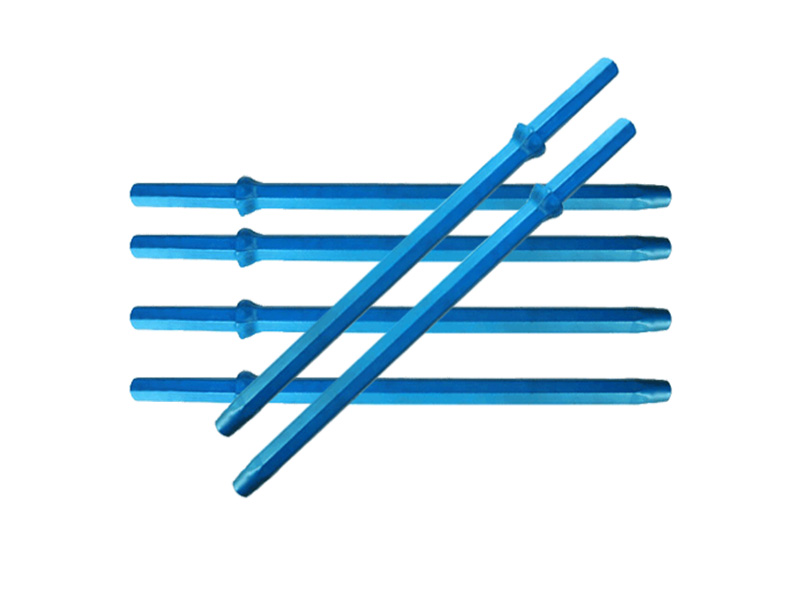
Not every rig needs this chain. Taper systems bypass it entirely — fully carburized taper drill rods seat straight into a taper chuck with no sleeve and no thread class to verify, which is why tapered drilling tools remain the default in small quarries where a mixed fleet has to stay simple.
✅ Bottom line: Fix the adapter first, then rods, then sleeves, then bits — a string matched backward from the bit almost always ends in an adapter that does not exist.
2. Can You Mix Brands in One String — and How Do You Verify It Before Making Up?
You can mix brands only when every component shares the same nominal thread standard and passes a gauge check; brand mixing without gauging is how joint failures start. The question crews actually ask is blunt: can I mix drill rods from different manufacturers in one string when one supplier is out of stock? The answer is yes with conditions, no without them.
Three things differ between brands even on the same nominal thread: flank tolerance, case depth and shoulder squareness. Any one of them out of spec shifts load onto the thread flanks instead of the shoulder, and that is a fatigue crack waiting for a deep hole.
That is why a thread gauge go no-go check before making up drill string sections is non-negotiable in a mixed pallet. It costs about 90 seconds per rod and catches the failures that visual inspection misses:
- GO gauge must run the full thread length by hand
- NO-GO gauge must not enter more than two turns
- Shoulder faces must show even contact, no bright crescent
- Sleeve bore wear under 0.5 mm, checked with a bore gauge
- Thread compound applied to the pin, never to the box only
Tuoyan's round extension drill rods ship with a gauge certificate per batch, so mixed pallets can be verified against a known reference instead of guesswork. If you run several brands, keep one threaded coupling sleeve family per thread size and segregate them by colour code in the store — a T38 sleeve in a T45 bin is a scrapped string the moment the drifter starts.
✅ Bottom line: Mix brands only after a go/no-go gauge check and shoulder inspection; unmatched case depth or flank tolerance will fail at depth, not at the collar.
FAQ
Q: In what order should we match components when building a new string?
A: Rig first, adapter second, rods third, sleeves fourth, bits last. That is the whole how to match drill rod thread to shank adapter and bit sequence, and it is driven by which part cannot be substituted.
Q: So can I mix drill rods from different manufacturers in one string if they are all T38?
A: Nominal thread alone is not enough — verify case depth and flank tolerance, then run a thread gauge go no-go check before making up drill string sections. Tuoyan will gauge third-party rods on request before shipping a mixed order.
Q: Do you supply complete matched strings rather than loose components?
A: Yes. Tuoyan quotes a full chain — adapter, rods, sleeves, bits — as one part list, with low MOQs, factory-direct wholesale pricing and OEM lengths from 1,000 to 6,400 mm.
Send Us Your Rig Model and Get a Matched Part List
Give us the rock drill model, feed length and hole diameter, and the Tuoyan engineering team will return a component chain with part numbers, thread sizes and gauge requirements within 24 hours, free. As a drill tools manufacturer in Luoyang, China, Luoyang Tuoyan Machinery Equipment Co., Ltd. supplies ISO 9001 and CE-compliant strings to mining contractors in 130+ countries.