
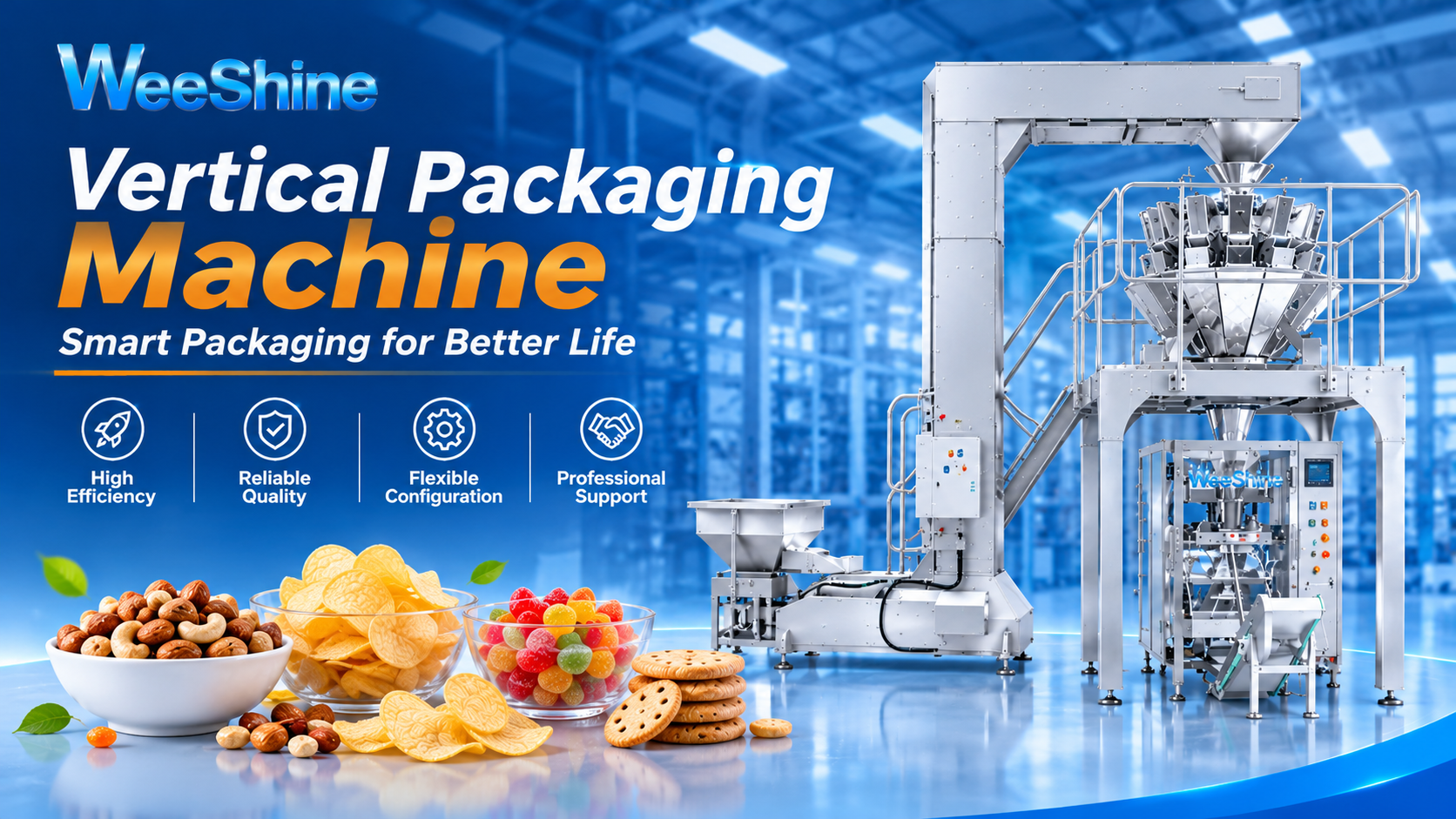
Packaging film plays an important role in the performance of vertical packaging machines. The right packaging material not only helps protect products but also affects bag forming, sealing quality, packaging appearance, and overall production efficiency.
For food manufacturers, choosing suitable packaging film is an essential step when setting up a new packaging line or upgrading existing equipment.
So, what should manufacturers consider when selecting packaging film for a Vertical Form Fill Seal (VFFS) machine?

1. Understand Different Packaging Film Materials
Different products require different packaging materials. Film selection depends on product characteristics, storage conditions, barrier requirements, and the desired packaging appearance.
Common packaging materials include:
-
PE (Polyethylene): Commonly used for flexible packaging applications where heat sealing is required.
-
PP (Polypropylene): Offers good moisture resistance and is widely used in food packaging.
-
PET (Polyester): Provides good mechanical strength and is often used as an outer layer in laminated packaging films.
-
Laminated Films: Combine different material layers to achieve specific barrier, strength, and sealing properties.
For products such as snacks, nuts, candies, grains, and powdered foods, laminated films are frequently considered because different layers can provide different functional properties.
The final choice should be based on the actual product and packaging requirements.
2. Consider the Product Characteristics
The packaging material should match the product being packaged.
For example:
Snacks and Potato Chips
Chips and other crispy snacks are sensitive to moisture and oxygen. Packaging films with suitable barrier properties can help maintain product quality during storage and transportation.
Nuts and Dried Fruits
Nuts and dried fruits may require protection against moisture and oxygen to help preserve freshness and product characteristics.
Candy and Gummies
Candy and gummy products may have different requirements depending on their sugar content, stickiness, and storage conditions. The film should provide suitable sealing and product protection.
Powder Products
Powders such as milk powder, coffee powder, and seasonings require packaging materials that provide appropriate protection against moisture and help prevent leakage.
3. Pay Attention to Film Thickness and Width
Film thickness and width are important parameters when configuring a vertical packaging machine.
Film thickness can influence material strength, flexibility, and sealing performance. Film width must match the machine's forming tube and bag dimensions.
Before purchasing packaging equipment, manufacturers should confirm:
-
Maximum and minimum film width
-
Film thickness range
-
Film roll diameter
-
Core diameter
-
Film material structure
Providing these details to the packaging machine supplier helps ensure that the equipment configuration matches the selected packaging material.
4. Check Heat-Sealing Performance
Heat sealing is one of the most important processes in vertical packaging.
Different films have different sealing characteristics, including sealing temperature requirements, sealing time, and pressure conditions.
If the sealing parameters are not properly adjusted, problems such as weak seals, wrinkles, or incomplete sealing may occur.
Therefore, manufacturers should test the actual packaging film on the machine before mass production.
Proper adjustment of sealing temperature, pressure, and timing helps achieve more consistent packaging results.
5. Match Packaging Film with the Bag Style
The required bag style also affects film selection and machine configuration.
Common vertical packaging formats include:
-
Pillow bags
-
Gusseted bags
-
Continuous bags
-
Customized bag formats
For example, pillow bags are widely used for snacks, nuts, candies, and grains. Gusseted bags can provide additional package capacity and a different product presentation.
The packaging film and forming system should be selected together to ensure compatibility with the required bag dimensions and style.
6. Test Packaging Materials Before Production
Even when a film material meets the basic specifications, testing is still important.
A practical film test can help evaluate:
-
Film feeding stability
-
Bag forming performance
-
Sealing quality
-
Cutting accuracy
-
Finished bag appearance
-
Compatibility with the intended product
Testing helps identify potential issues before large-scale production begins.
It also allows manufacturers to adjust machine parameters and confirm the suitability of the packaging material.
Weeshine: Vertical Packaging Solutions for Different Packaging Materials
Weeshine provides automatic vertical packaging machines and customized packaging systems for different industries.
Our VFFS machines can be configured for various products, including potato chips, snacks, nuts, dried fruits, candies, grains, rice, powders, and frozen foods.
By considering product characteristics, film specifications, bag dimensions, and production requirements, we help customers select suitable packaging machine configurations.