
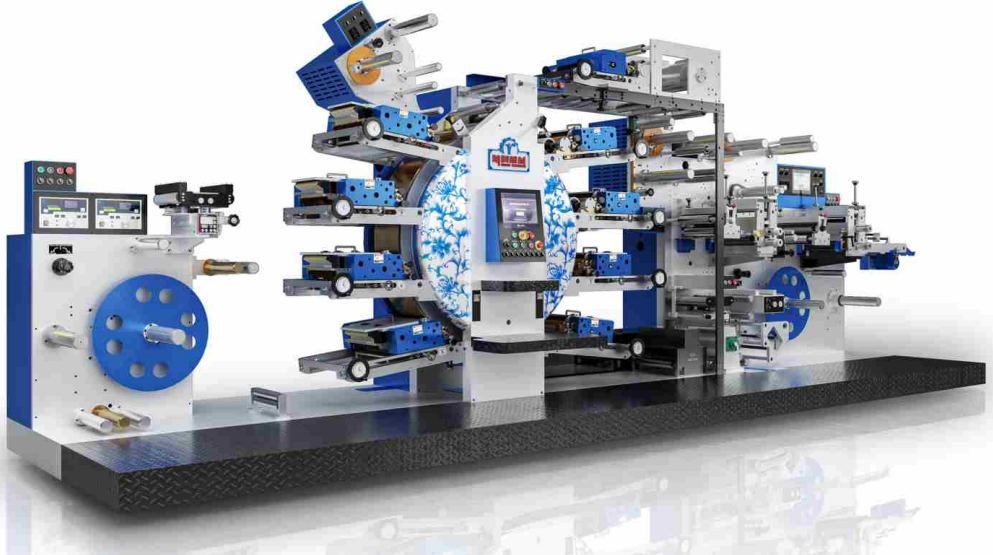
What Is the Price Range for a Flexographic Printing Press by Architecture?
Flexographic press pricing splits into four clear market tiers based on web width, drive train, and registration accuracy.
Comparing a $6,500 stack-type plastic bag press to a $150,000 narrow-web servo combination press does not work because they serve completely different converting jobs. The table below breaks down current market FOB price ranges by machine class so you can benchmark quotes against your actual job ticket:
|
Press Architecture & Tier |
Typical Web Width |
Drive & Registration |
Approximate Price (USD, FOB) |
Primary Converting Application |
|
Entry-Level Stack / 2-Color Film Press |
600–1,000 mm |
Common line-shaft gear drive; ±0.20–0.25 mm |
$6,500 – $15,000 |
Shopping bags, simple 1–2 color PE/PP film |
|
Entry-Level Narrow-Web Label Press (2–4 Colors) |
250–370 mm |
Mechanical / basic inverter drive; manual register |
$15,000 – $40,000 |
Blank logistics labels, basic 1–3 color paper tags |
|
Mid-Range Full-Servo Inline Flexo Press (4–12 Colors) |
370–550 mm |
Independent servo motors per unit; auto-register |
$40,000 – $180,000+ |
Pressure-sensitive labels, BOPP/PET films, cold foil & die-cut |
|
Wide-Web Central Impression (CI) & Gearless Presses |
800–1,600+ mm |
Gearless direct-drive drum; <±0.08 mm |
$200,000 – $650,000+ |
High-volume flexible food packaging, wide-web films |
Which Engineering Variables Drive Your Flexo Press Quote Up or Down?
Five core hardware specifications—color stations, web width, servo motor count, drying systems, and inline converting modules—account for over 80% of the variance between two quotes.
When two manufacturers quote a "6-color label press" with a $60,000 price gap, the difference usually hides inside these mechanical subsystems:
- Number of Print Stations (2 to 12 Colors): Every additional print unit adds a plate cylinder, ceramic anilox roller, doctor blade chamber, drying hood, and drive axis. Buying eight stations when 90% of your orders run four CMYK colors plus varnish ties up capital and increases web path waste during setup.
- Drive Architecture (Line-Shaft Gears vs. Multi-Servo): Gear-driven presses cost less upfront but suffer from backlash and register drift during acceleration or deceleration. Full-servo inline presses eliminate mechanical line shafts by dedicating independent servo motors to the plate cylinder, anilox roll, and chill drum, holding registration stable at 150–200 m/min.
- Web Width and Repeat Range: Wider webs (e.g., jumping from 370 mm to 550 mm) require heavier side frames, larger-diameter chill rollers, higher-wattage UV lamps, and costlier tooling.
- Drying & Curing Package: Basic hot-air or IR drying suits water-based inks on porous paper, whereas filmic labels (PE, PET, BOPP) require mercury UV or LED UV curing systems with water-cooled impression rollers to prevent web distortion.
- Inline Converting Modules: Adding rotary die-cutting, cold foil stamping, delam/relam turn bars, or 100% camera inspection turns a standalone printer into a single-pass converting line, adding $15,000 to $50,000+ depending on module complexity.
How Does the Qianrun S5 Series Balance Upfront Price and Operating Cost?
The Qianrun S5 Series In-Line Flexographic Printing Machine targets the mid-range full-servo tier, combining 27-servo synchronization (on an 8-color line) and a 200 m/min mechanical speed with a petal-type print unit that cuts make-ready ink waste down to a single cup.
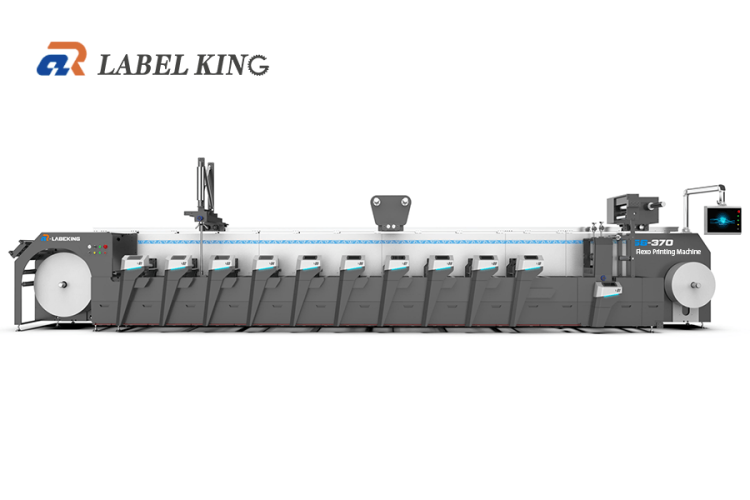
For converters evaluating mid-range inline presses from Guangdong Qianrun Machinery Sci&Tech Co., Ltd. (Labelking), matching the machine's published specifications to your daily SKU mix prevents both over-buying and early capacity bottlenecks:
|
Specification Parameter |
Qianrun S5 Series Published Value |
Production & Cost Impact on the Press Floor |
|
Model Width Variants |
370 / 450 / 550 mm |
Covers standard narrow-web label widths up to mid-web packaging |
|
Max. Web Width |
380 mm / 460 mm / 560 mm |
Provides 10 mm edge margin over max print width for web guiding and trim |
|
Print Color Configurations |
2 – 12 Colors (modular inline) |
Scales from simple 2-color logistics labels to multi-process decorative SKUs |
|
Print Repeat Length |
203.2 – 635 mm (8" – 25") |
Accommodates both small pharma labels and long-repeat wrap-around labels |
|
Max. Mechanical Speed |
200 m/min |
Actual run speed depends on substrate, ink rheology, and curing load |
|
Servo Drive Architecture |
Independent servo per unit (27 servos on 8-color press) |
Eliminates gear backlash and holds tight registration across speed ramps |
|
Max. Unwind / Rewind Diameter |
Ø 1,000 mm / Ø 1,000 mm |
Reduces roll-change downtime on long runs; optional non-stop auto-splicing |
|
Drying / Curing System |
Optional UV mercury lamp, LED UV, or Hot Air drying |
Configurable for UV inks on films or water-based inks on paper |
|
Inline Converting & Finishing |
Cold foil, lamination, delam/relam, rotary die-cutting, online inspection; optional screen, inkjet, or gravure units |
Completes multi-process labels in a single pass instead of offline secondary runs |
Where the S5 Series Reduces Recurring Operating Costs
Purchase price only represents roughly 20–30% of a flexo press's five-year total cost of ownership (TCO); consumables, make-ready waste, and changeover downtime make up the rest. The S5 architecture addresses three recurring shop-floor cost drains:
- Single-Cup Proofing & Enclosed Chamber System: Conventional open ink pans waste liters of UV or water-based ink during startup and suffer from ink misting or "meteor shower" spitting at high speeds. The S5 uses a closed doctor-blade system and petal-shaped print deck that lets operators pull proofs using roughly one cup of ink while preventing anilox edge splashing.
- Load-Bearing Impression Rollers: When changing plate cylinders between jobs, the S5's load-bearing roller design maintains preset nip pressure without requiring full mechanical re-calibration—at most needing minor micro-adjustment for specialty stocks.
- One-Button Repeat-Order Recall: Its full-vision automatic registration system stores job parameters in memory. On repeat orders, operators recall saved tension and register values with one button, automatically bringing the web back into register and cutting startup substrate scrap.
What Hidden Costs Sit Outside the Base Machine Quotation?
An FOB machine quote typically excludes 15% to 35% of your total project budget, covering auxiliary chillers, air compressors, tooling (cylinders, aniloxes, magnetic die rollers), freight, import duties, and startup consumables.
Before signing a purchase order, audit your supplier's scope of supply against these six line items so you do not get caught short after the container arrives:
- Printing Tooling & Anilox Inventory: Check how many sets of plate cylinders, magnetic die-cutting cylinders, and ceramic anilox rollers (e.g., 200–1,200 LPI) are included in the base price. Extra repeat cylinder sets cost several hundred dollars per station.
- Plant Utilities & Auxiliaries: UV-cured lines require chilled water circulation for the cooling drums, exhaust ducting (for mercury UV ozone extraction), and a clean, dry compressed-air supply (typically 0.6–0.8 MPa).
- Corona Treater & Web Cleaner: If you print on untreated BOPP, PE, or PET films, an inline corona treater and double-sided web cleaner are essential for ink adhesion and dust-free solids.
- Ocean Freight, Insurance & Customs Duties: International container shipping, port handling, and local import tariffs add 10–20% to your landed equipment cost depending on destination port and Incoterms (FOB vs. CIF/DDP).
- On-Site Installation & Operator Training: Confirm whether technician airfare, accommodation, daily allowance, and commissioning days are bundled into the contract or billed separately.
- Startup Consumables: Photopolymer plates (150 per color), sticky-back mounting tape, doctor blades, UV/water-based inks, and test substrates must be stocked before commissioning begins.
How Can You Get an Accurate Quote for Your Label or Packaging Line?
To get a line-item quotation rather than a generic ballpark estimate, send the manufacturer a six-point job specification covering your substrates, web width, color count, repeat range, finishing steps, and target shift output:
- Substrates & Thickness: Specify paper, self-adhesive labelstock, or film types (BOPP, PET, PE, foil) and micron/GSM range.
- Maximum Web & Print Width: Confirm whether a 370 mm, 450 mm, or 550 mm press bed fits your imposition layout.
- Color Count & Ink Chemistry: State total color stations needed (e.g., 6 or 8 colors) and whether you run UV mercury, LED UV, or water-based inks.
- Repeat Length Range: List your shortest and longest label repeat lengths (e.g., within the S5's 203.2–635 mm window).
- Inline Converting Modules: Note requirements for cold foil, lamination, multi-layer/delam-relam, rotary die-cutting, or camera inspection.
- Power Supply & Destination Port: Include local industrial voltage/frequency (e.g., 380V 50Hz or 480V 60Hz) and destination port for CIF/DDP calculation.
Frequently Asked Questions (FAQ)
How much does a 6-color inline flexographic label press cost?
A mid-range 6-color full-servo inline flexographic label press typically costs between $65,000 and $150,000+ (FOB) depending on web width (370–550 mm), UV/LED drying configuration, and inline converting modules such as cold foil or rotary die-cutting. Entry-level gear-driven 6-color presses cost less (45,000) but lack independent servo registration.
What is the maximum speed of the Qianrun S5 series inline flexo press?
The Qianrun S5 series has a maximum mechanical speed of 200 m/min across its 370 mm, 450 mm, and 550 mm width models. On the production floor, actual running speed depends on substrate stability, ink viscosity, curing power, and inline die-cutting complexity.
Why do two flexo presses with the same color count have very different prices?
Price gaps between presses with identical color counts stem from drive architecture (independent servo motors vs. mechanical line shafts), frame rigidity, anilox and doctor-blade chamber quality, drying systems (LED UV vs. basic hot air), and whether inline finishing modules like inspection cameras or non-stop unwinders are included.
Is an inline flexo press better than a CI (Central Impression) press for labels?
For pressure-sensitive labels, folding cartons, and multi-process work requiring inline cold foil, lamination, delam/relam, and rotary die-cutting, an inline flexo press like the Qianrun S5 is more modular and cost-effective. A CI flexo press is better suited for wide-web, thin, extensible flexible packaging films where a single central impression drum prevents web stretch.
How much extra should I budget beyond the base press price?
Plan an additional 15% to 35% above the base FOB machine price to cover plate cylinders, magnetic die cylinders, ceramic anilox rolls, water chillers, air compressors, ocean freight, import duties, installation, and initial ink and plate stock.