
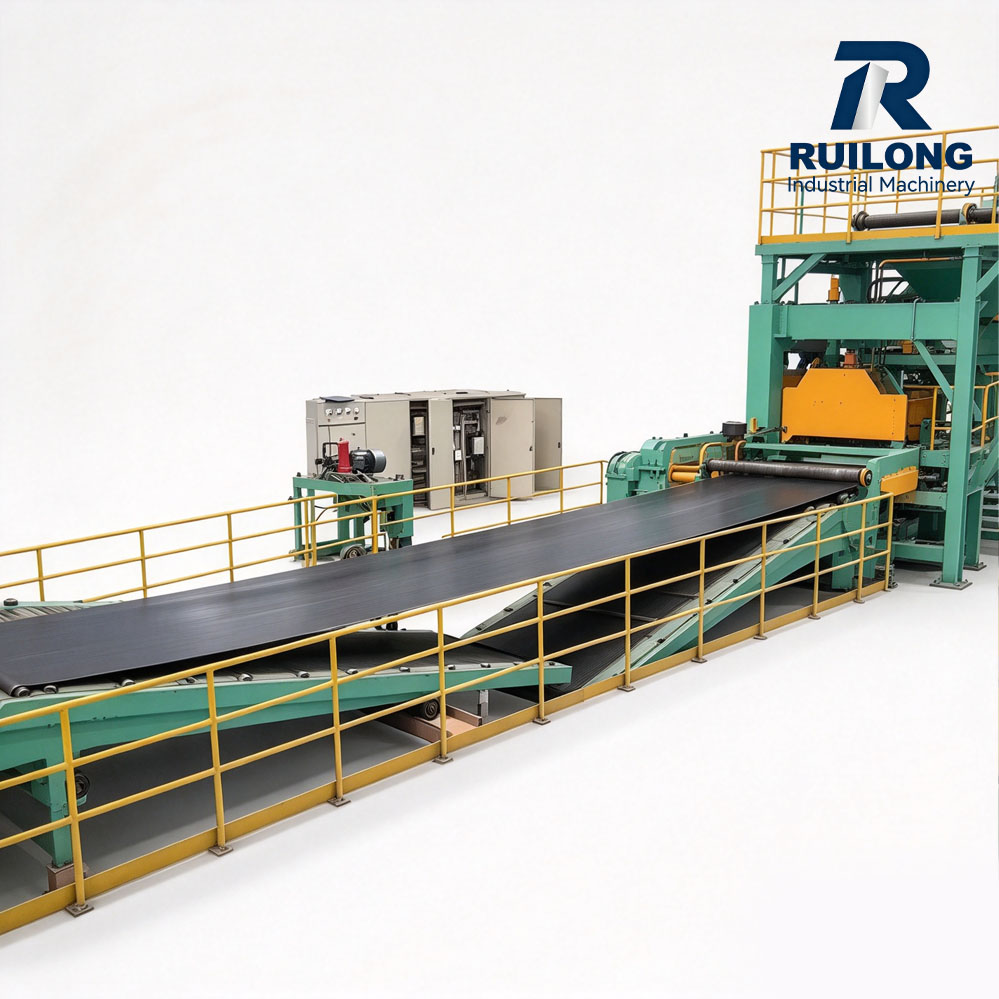
Short answer: the honest answer to how much does a cut to length line cost in 2026 is a matrix, not a number: FOB prices run from roughly US500,000 and beyond for an extra-heavy 2500mm line, and the spread inside each class is driven by gauge, width, automation and shear type. Below are the gauge-class matrix, the cut to length line price for 1500mm wide coil specifically — the most-quoted width in the market — and what a genuine cut to length line wholesale price from china factory quotation includes and excludes, so the three numbers you compare are actually comparable. Ruilong publishes these bands because a price quoted without a gauge-width class is not a price, it is bait.
1. The Gauge-Class Matrix — Where the Money Actually Goes
The leveler is the price-setting machine, and its cost scales with the force it must deliver — which scales with the square of thickness. Everything else on the line follows the leveler: a frame sized for its reaction forces, a shear that matches its output, a drive train that feeds it. That is why gauge class, not length of the line, is the first column of any honest price table.
|
Line class |
Gauge range |
Width |
Leveler force class |
Typical FOB (2026) |
|
Light gauge |
0.3–2.0 mm |
1,300 mm |
≤60 t |
US$80k–150k |
|
Medium |
0.5–6.0 mm |
1,300–1,500 mm |
60–150 t |
US$150k–280k |
|
Heavy |
3.0–12 mm |
1,500–2,000 mm |
150–300 t |
US$280k–400k |
|
Extra-heavy |
6.0–25 mm |
2,000–2,500 mm |
300–500 t+ |
US$400k–550k+ |
Two reading rules for the table. First, the bands overlap in gauge because width and automation push price within a class — a 6mm-capable line at 2,000mm width prices like a heavy line, not a medium one. Second, the force column is the spec to demand in any quotation: a seller who quotes "for your thickness" without stating the leveler force class is quoting a machine you cannot verify. The torque-squared physics behind the column is the same relationship our leveling-force article works through for individual grades.
Ruilong quotes the force class, the sustained rate at the customer's top gauge, and the FOB band together — three numbers that make any competing quotation auditable line by line.
✅ Bottom line: Gauge class sets the leveler, the leveler sets the price — demand the force class in every quotation before comparing numbers.
2. The 1500mm Column — and What a Direct-From-Builder Quotation Includes
Width is the second multiplier: every millimeter of line width is repeated across the frame, the leveler rolls, the shear blade and the feed system. Stepping from 1300mm to 1500mm adds roughly 15–25% across the mechanical scope; stepping to 2,000mm adds another step. The 1500mm column, quoted consistently:
|
Line class at 1,500 mm width |
Typical FOB (2026) |
|
Light gauge (0.3–2.0 mm) |
US$95k–170k |
|
Medium (0.5–6.0 mm) |
US$170k–300k |
|
Heavy (3.0–12 mm) |
US$320k–450k |
|
Extra-heavy (6.0–25 mm) |
US$450k–600k |
Against this column, a cut to length line wholesale price from china factory quotation should be judged on what it itemizes: the line itself, PLC and drives with brand names stated, commissioning spares, and the sustained rate at your top gauge — while excluding installation crew travel, import duties, special tooling and civil works, which belong in the project budget, not the FOB figure. European-built equivalents of the same class run two to three times the bands above; the gap is real but should be weighed against lead time and service structure, not assumed to be a quality verdict — the audit checklist in our builder-audit article is how to test either origin. What separates a wholesale quotation from a bait quotation is exactly this itemization, and it is the first thing Ruilong puts on page one: a seller who builds what they sell can name the force class, the drive brands and the scope boundary in a single page, because the shop floor actually produced the line.
One budget rule closes the comparison: whatever FOB number you land on, the project total lands at 1.25–1.45 times it once freight, installation, spares and contingency are counted — the landed-cost multiplier our shipping article documents. Budget the multiplier, not the machine. In other words, the how much does a cut to length line cost question resolves into two numbers — the gauge-class band and the landed multiplier — and a quotation that supplies either one without the other has not answered the question at all.
✅ Bottom line: Width repeats across every mechanical component — and a direct-from-builder quote is judged by what it itemizes, against a project multiplier of 1.25–1.45.
FAQ
Q: Why does the price spread so widely inside one gauge class? A: Automation level, shear type, drive architecture and component brands move the number 30–60% within a class; the gauge-width matrix narrows the band, and the nine variables in our price-driver article explain the rest.
Q: What does a line under US$100k actually get me? A: A light-gauge 1300mm machine at the simple end of the class — manual stacking, basic feed accuracy, no fine-leveler crown control — genuinely correct for simple duct and shelving duty, and quietly wrong for appliance-visible or high-tolerance work; match the machine to the duty, not the budget.
Q: FOB or CIF — what should the budget contain beyond the machine price? A: Freight, installation and commissioning, commissioning spares, special tooling and civil works — together they take the project to 1.25–1.45× the FOB figure, so start from the cut to length line price for 1500mm wide coil column if that is your width, and Ruilong will quote the project budget and the FOB band as two separate lines rather than blurring them.
Get Your Class Quoted Item by Item
Send Ruilong your gauge range, width and blank sizes, and the engineering team will return the force class, the sustained rate and an itemized custom quotation from the manufacturer: as the supplier behind Tai'an Ruilong Machinery Co., Ltd., we quote OEM-direct, free of charge and without obligation.