
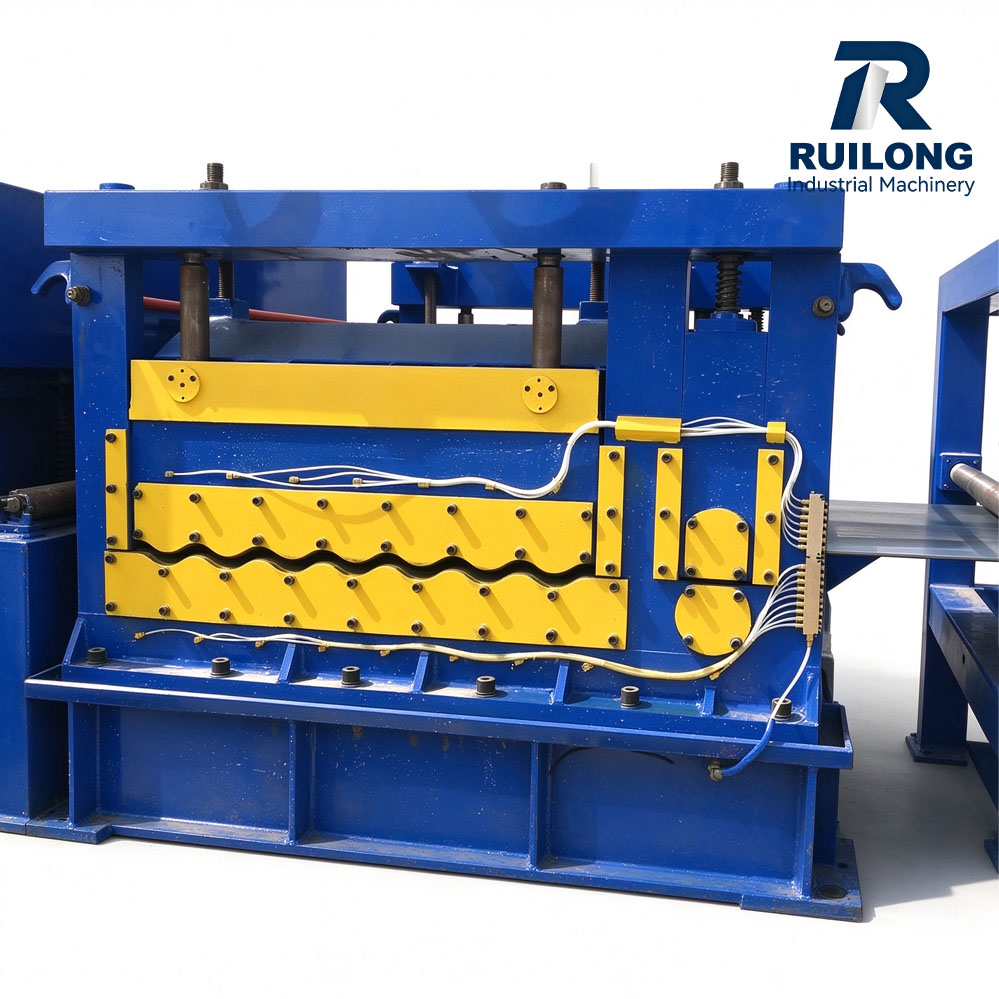
1. The Bite Physics — Why Count Follows Thickness
The governing number is the ratio of roll pitch to strip thickness, and it is bounded by grip, not by preference. The strip enters the leveler at a small angle; for the first work roll pair to pull it in, the pitch must stay within roughly 20–30 times the thickness for ordinary carbon grades — tighter for high-yield material that resists bending. Shorter pitch means more rolls per unit length, and more rolls means more reverse bends. Each reverse bend drives a little more plastic strain into the section, and flatness is achieved when every fiber of the strip has crossed its yield point enough times that the residual stress differences between center and edge wash out. That is why the count climbs as the gauge drops:
|
Gauge class |
Roll count |
Typical duty |
|
≥12 mm plate |
5 |
Structural plate, shot-blasted feed |
|
6–12 mm |
7 |
Plate and heavy strip |
|
3–6 mm |
9 |
General strip and mid plate |
|
1.5–3 mm |
11 |
Cold rolled strip, tube feed |
|
<1.5 mm |
17 |
Precision strip, appliance and press feed |
Two cautions sharpen the table. First, the count is only half of the flatness machinery — a 17-roll line with hard rolls and no tension discipline still waves thin strip overnight, which is the residual-stress problem covered in our waves-overnight article. Second, the count says nothing about roll diameter, which is the other ratio buyers miss and the subject of the next article; count and diameter trade against each other, and quoting one without the other is how a "17-roll" line ends up with rolls too thin to survive high-strength work. Ruilong states all three figures on the leveler datasheet precisely so the buyer can run this trade themselves.
✅ Bottom line: Pitch-to-thickness sets the bite, bend count sets the flatness — pick the row your thinnest product lives in, not the row you like.
2. When Count Is Physics and When It Is Marketing
Beyond the class boundaries, extra rolls stop buying flatness and start buying brochure lines. A buyer running 1.0–2.0mm cold rolled for shelving gains almost nothing between 11 and 17 rolls at the same roll diameter — the extra bends cost drive power and roll maintenance without moving the flatness number the press cares about. The gains are real only at the thin end, where a 17 roll precision leveler for thin gauge strip running 0.4–0.8mm appliance or laminating duty holds center buckle and edge wave to the levels in our appliance-flatness article; there the sixth-reverse-bend difference shows up on a straightedge within a week.
The honest evaluation is therefore three numbers at once: roll count, roll pitch and roll diameter, quoted together with the support-roll arrangement. When a Ruilong engineer reviews a competitor proposal, the first thing checked is whether the pitch was shortened to claim a count or to serve the gauge range — the same nine physical rolls can be marketed as "9-roll" or "17-roll" if support and idler rolls are counted in, and both labels describe the identical machine. The discipline that protects buyers is the blank list: name the thinnest and thickest product with its strength class, and the ratio logic picks the count — then ask for the first-piece flatness at both extremes during FAT, where the count either proves itself or quietly doesn't. Buyers upgrading for visible surfaces should also weigh a dual-leveler configuration, which our configuration article covers as a separate route to the same flatness target.
✅ Bottom line: Count the work rolls, check the pitch they sit at, and demand first-piece flatness at your gauge extremes — the label follows the physics, or it's marketing.
FAQ
Q: Is a 17 roll precision leveler for thin gauge strip overkill for 2mm cold rolled? A: Usually yes — 2mm sits comfortably in the 11-roll class; the 17-roll pays off below roughly 1.5mm or when the product mix includes 0.5mm laminating and press feed where buckle depth is contractual.
Q: Can roll count be increased later by retrofit? A: Not realistically — the leveler frame, drive power and roll spacing are designed as one system; if thin-gauge duty is credible within two years, buy the count now rather than a second leveler later, the dual-leveler article explains the split-machine alternative.
Q: What does leveler roll count versus flatness requirement look like for mixed product? A: Size for the thinnest 20% of the order book — that band sets the count — and verify heavy-gauge capability by roll diameter and frame force; Ruilong quotes both extremes on one sheet so the compromise is visible before the deposit, not after FAT.
Get the Roll Count Your Gauge Range Actually Demands
Send Ruilong your thinnest and thickest product with strength grades, and the engineering team will return the roll-count selection — count, pitch and diameter together — from our China factory: as the manufacturer behind Tai'an Ruilong Machinery Co., Ltd., we quote supplier/OEM-direct with the ratio logic written out, free of charge and without obligation. The custom configuration is derived from your blank list, not from a brochure row.