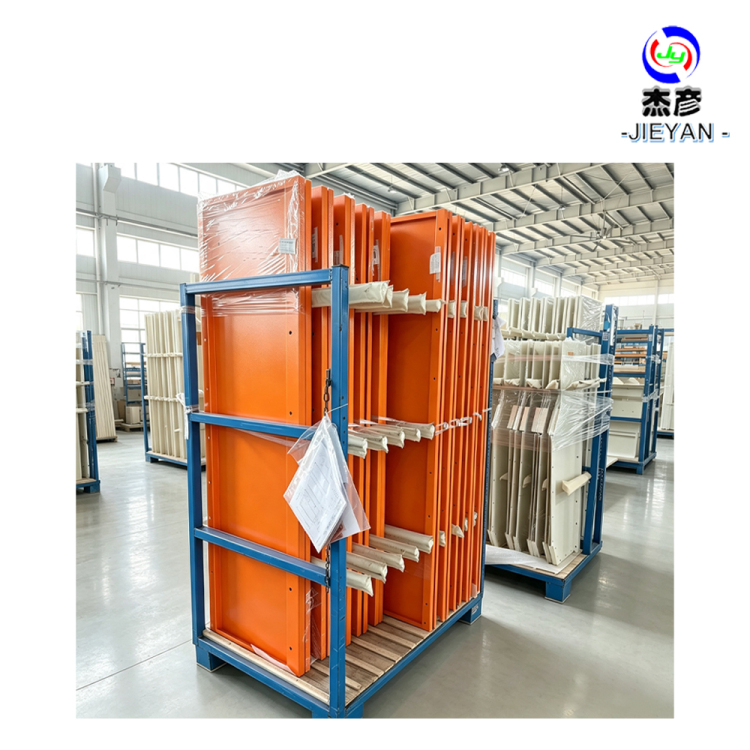
1. What structural requirements keep an HV door flat and rigid in service?
An HV door must resist sag and oil-canning at the hinge side, because a door that no longer sits flat breaks the gasket line and defeats the ingress rating. Rigidity comes from the interaction of plate gauge, edge returns, internal stiffeners and weld pattern — not from simply choosing thicker steel.
Start with gauge. Most 12–24 kV indoor cabinets use 2.0–3.0 mm cold-rolled steel; outdoor and seismic-duty doors move to 3.0–4.0 mm or stainless. Thinner sheet saves weight but oil-cans under latch load, so we pair a 2.0 mm skin with a 20–25 mm return flange on all four edges. The return is what turns a flat sheet into a stiff pan — skip it and even 3 mm plate will flex.
Internal reinforcement comes next. A hat-section or boxed stiffener behind the lock zone carries the point load when an operator pulls the handle. On tall doors we add a second stiffener at hinge height. Door skins are spot-welded at 80–120 mm pitch on the flange; continuous welds are reserved for corners and high-vibration programs, since excessive heat input is what causes the warping buyers complain about.
Tolerance is a design input, not an afterthought. JIEYAN cuts and forms doors on laser and CNC equipment held to roughly ±0.2 mm on critical features, because a 1 mm stack-up across a 2 m door is enough to open a visible gasket gap. The same discipline applies across our wider Sheet Metal Products range, where repeatability matters more than any single perfect part.
|
Design item |
Typical HV door requirement |
Why it matters |
|
Skin thickness |
2.0–3.0 mm CRS; 3.0–4.0 mm outdoor |
Balances stiffness and weight |
|
Edge return |
20–25 mm flange, all four sides |
Prevents oil-canning |
|
Stiffeners |
Hat/box section behind lock and hinge |
Carries latch load, stops sag |
|
Weld pattern |
Spot weld 80–120 mm pitch |
Limits heat distortion |
|
Flatness tolerance |
±0.2 mm on sealing face |
Keeps gasket compression uniform |
|
Max workpiece |
Up to 7 × 4 × 2.5 m assembled |
Covers large switchboard panels |
Large-format doors are where a fabricator's shop matters. Zhejiang Jieyan Automation Technology Co., Ltd. runs laser cutting, CNC bending, welding and an in-house pretreatment plus 250 m automatic coating line, so a 7 m panel can be cut, formed, welded and finished under one roof — fewer hand-offs, fewer tolerance surprises for the switchgear builder.
✅ Bottom line: Specify gauge, edge returns, stiffener layout and seal-face flatness together; no single one of them keeps an HV door rigid on its own.
2. How do you specify hardware, bonding and finish on the door?
Door hardware must be rated by load, cycle life and access needs, and the door must be bonded to the cabinet frame so it never becomes an isolated live part. Treat hinges, latch and earthing as one system — the most common field failure is a door that opens perfectly but fails a bonding check.
Hinges: a 2 m door typically needs three heavy-duty hinges rated above the door's weight with margin; taller or wider doors need four. External hinges are easier to service and replace; concealed hinges resist tampering but demand tighter tolerances. Specify hinge fixing as welded studs or rivnuts rather than self-tapping sheet screws, which strip after repeated use.
Locking: a three-point latch pulls the door evenly against the gasket and is standard on larger HV cubicles; a quarter-turn or plane lock suits smaller panels. Specify key interchange, padlock provision and tool-less emergency release where the site requires it. Aim for an opening angle of 110–120° so the door clears internal busbars without being folded back on its hinge.
Bonding and shielding: the door must carry a protective earth path back to the cabinet frame — a dedicated braided strap or earth stud at the hinge side, with paint masked at the contact area. For EMI-sensitive installations, a conductive gasket and continuous seam preserve shielding across the door. Grounding continuity and IP rating belong in the same clause as the hinges, because a seal compressed inconsistently changes both.
Finish: after pretreatment, 80–120 µm powder coat is standard; coastal or chemical sites move to epoxy-polyester or a galvanized base. Mask sealing and bonding faces before coating. The Steel Equipment Frames surrounding the opening should receive the same finish system, otherwise door and frame age at different rates. As a manufacturer with in-house spray capacity, JIEYAN controls pretreatment and coating on both parts — a real factory advantage over traders who sub-contract finishing.
✅ Bottom line: Rate hinges and latches for load and cycle life, and write the bonding strap and masked contact faces into the same spec — a door that opens well but does not earth is a failed door.
FAQ
Q: What steel thickness is standard for a high voltage switchgear door? A: Indoor 12–24 kV cabinets typically use 2.0–3.0 mm cold-rolled steel, with 3.0–4.0 mm or stainless for outdoor and seismic duty. Gauge alone is not enough — pair it with edge returns and stiffeners.
Q: Can JIEYAN build doors to our own drawings and tolerances? A: Yes. JIEYAN is a China-based OEM/ODM supplier and works from customer drawings, including custom hinge positions, lock sets, cut-outs and finishes. Send a DXF and we will quote tooling and unit cost.
Q: How do you prevent door sag on a tall switchboard panel? A: Use the correct number of rated hinges, a stiffener at hinge and lock height, and a full edge return. Keeping seal-face flatness within roughly ±0.2 mm is the practical target.
Get a door design reviewed before you freeze the drawing
Send your HV door drawing, quantity and target IP/earthing requirements to JIEYAN. Our engineering team will return a manufacturability review, a suggested hinge and stiffener layout, and an OEM quote from our China factory — including free samples of masked bonding faces and finish panels. Zhejiang Jieyan Automation Technology Co., Ltd. supports custom and wholesale switchgear programs for utilities, EPCs and panel builders worldwide.
Mobile: +86 13671807091
Email: [email protected]
Website:www.jieyanauto.com