
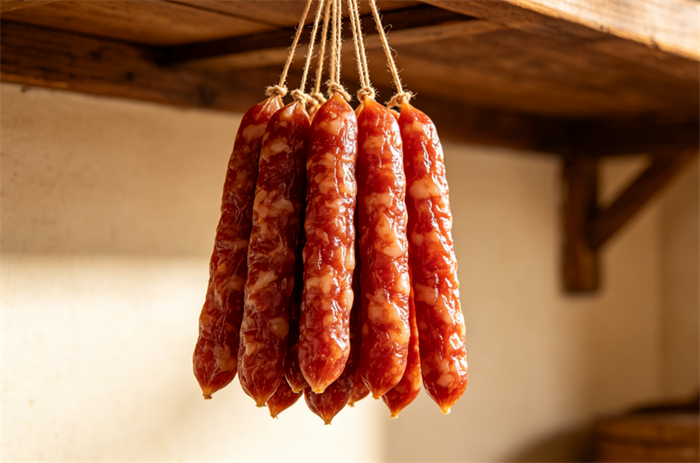
The core competitive advantage of Cantonese sausages lies in their distinctive flavor profile: wine-aromatic, savory-sweet, and rich in lipid notes. However, traditional production relies heavily on seasoned artisans judging by weather, color and texture, which leads to large batch-to-batch flavor variations and unstable quality — a primary pain point for industrial mass production.
In fact, flavor development in sausages is not an empirical mystery. It arises from four synergistic pathways: microbial metabolism, endogenous enzymatic hydrolysis, lipid oxidative degradation, and the Maillard reaction. As a typical cured meat product, Cantonese sausage does not have a separate fermentation step; fermentation and drying proceed concurrently. Among all process parameters, temperature-humidity gradients and drying rate curves serve as the most critical control levers for flavor regulation.
I. Where Does the Flavor of Cantonese Sausages Come From?
The flavor of Cantonese sausage forms a multi-layered composite system. Raw material formulations establish the flavor base, while flavor transformation, integration and maturation take place during fermentation and drying. Together, they define the final sensory characteristics.
Basic taste layer: saltiness, sweetness, umami and mild acidity. Salt and sugar provide the foundational taste. Amino acids and peptides generated by endogenous proteolysis contribute umami. Minor organic acids from microbial metabolism deliver refreshing notes and a sweet aftertaste. Ingredients such as rice wine and soy sauce directly supply primary aroma.
Characteristic aroma layer: the core of its recognizability. Controlled lipid oxidative degradation produces aldehydes, ketones and esters, delivering signature lipid and nutty aromas. Volatiles from microbial metabolism generate mild fermented notes. Maillard reaction products including pyrazines and furans create roasted and meaty aromas.
Flavor complexity: Metabolites from successive reaction stages accumulate and blend, yielding a well-rounded sensory experience: sweet on entry, umami in the mid-palate, and lingering lipid aroma in the finish.
For easier process control, the overall production is divided into a **fermentation-dominated phase** and a **drying maturation phase**. These are not discrete operations. In the early stage, dehydration proceeds slowly with microbial metabolism and enzymatic hydrolysis prevailing. In the later stage, dehydration accelerates, dominated by oxidation and flavor maturation. Essentially, parameter tuning uses temperature, humidity and dehydration rate to govern the intensity and sequence of these reactions.
II. Fermentation-Dominated Phase: Temperature and Humidity Define the Flavor Base
Cantonese sausage is a lightly fermented cured meat product. The fermentation-dominated phase relies on metabolism of natural microflora and endogenous enzymes to build the fundamental flavor framework. Temperature and humidity directly shape microbial community structure, metabolic rate and aroma formation pathways.
1. Temperature: governing fermentation rhythm and acid intensity
Lactic acid bacteria, staphylococci and micrococci are the dominant beneficial microbes. Their activity varies markedly with temperature, steering the final flavor direction:
- Low-temperature range (12–18°C): Fermentation proceeds gently with high microbial diversity. Acid production is mild and non-sharp. Endogenous proteases and lipases function sufficiently, yielding mellow flavor, noticeable sweet aftertaste and full lipid aroma. The downside is a long production cycle and low throughput, suitable for high-end custom and traditional batches.
- Medium-temperature range (18–25°C): The gold standard for industrial production. Lactic acid bacteria show moderate activity with balanced acid generation. Staphylococci exhibit strong aroma-forming capacity, and lipid degradation is thorough. This range delivers rich flavor while keeping cycle time practical, preferred for most premium mass-produced products.
- High-temperature range (>25°C): Fermentation accelerates sharply. Excessive propagation of lactic acid bacteria often causes sharp sourness. Lipid oxidation speeds up, readily generating off-flavor precursors. The risk of spoilage microbes also rises, creating food safety concerns. This window is only applicable to short-cycle fast-moving consumer goods, with tightly controlled duration and robust salt-sugar antimicrobial systems.
2. Humidity: affecting hydrolysis completeness and flavor intensity
Ambient relative humidity controls surface water loss rate, which in turn governs internal water activity and the uniformity of microbial and enzymatic reactions.
- High humidity (75%–85% RH): Slow surface evaporation maintains high water activity within the meat matrix. Microbes and enzymes act uniformly and fully, achieving high protein hydrolysis with strong umami and fermented aroma and a moist mouthfeel. However, excessive humidity may cause sticky surfaces and spoilage, requiring clean production environments and antimicrobial controls.
- Medium humidity (65%–75% RH): Fermentation and mild dehydration progress simultaneously. Acid production is moderate, resulting in clean, non-greasy flavor — the standard setting for most commercial batches.
- Low humidity (<65% RH): Rapid surface drying forms a hard crust, hindering outward moisture migration. Microbial and enzymatic activity is suppressed prematurely. Incomplete hydrolysis leads to bland flavor, inconsistent quality between surface and core, and the defect “dry outside, sour inside”; it may also result in non-compliant final moisture content.
III. Standard Control Points for the Fermentation-Dominated Phase
Instead of fixing a set number of days as the endpoint, adequate fermentation is judged primarily by a pH drop of 0.2–0.4 units from the initial value, with the final pH stabilized at 5.8–6.0 (typical initial meat batter pH: 6.0–6.2). Product temperature and weight loss should also be monitored to avoid purely empirical judgement.
Drying Maturation Phase: Drying Profile Shapes Flavor Complexity
Drying is not simple dehydration. It is a flavor maturation process accompanied by sustained enzymatic hydrolysis, lipid oxidation and progressive Maillard reactions. Drying rate and staged temperature-humidity gradients directly determine the layered texture and stability of the final flavor.
The following three-stage drying profile describes the logic for low-temperature slow-baking targeting traditional flavor. Medium-to-high-temperature fast-baking for quick turnover has shorter cycles but less full-bodied flavor.
Stage 1: Constant-rate Drying (Fermentation-Dominated, Days 3–5)
Core state: water activity 0.90–0.95. Evaporation mainly occurs at the surface with ample internal moisture migration; microbial and endogenous enzyme activity peaks.
Reference parameters: temperature 20–24°C, relative humidity 70%–75%, air velocity 1–2 m/s.
Flavor evolution: Extensive protein breakdown releases free amino acids, rapidly accumulating umami compounds. Lipases degrade fats into fatty acids and flavor precursors. Organic acids keep building up to establish the foundational taste framework.
Control note: Rapid dehydration must be avoided at this stage, as it terminates hydrolysis prematurely and causes insufficient umami and dry, tough texture.
Stage 2: Falling-rate Drying (Enzymatic Hydrolysis + Oxidation, Days 5–10)
Core state: water activity 0.80–0.90. Surface evaporation outpaces internal moisture migration. Microbial activity declines while endogenous enzymes remain highly active. Lipid oxidation and Maillard reactions initiate and intensify gradually.
Reference parameters: temperature gradually reduced to 18–22°C, relative humidity lowered to 60%–70%, air velocity maintained around 1.5 m/s. Adjust temperature and humidity slowly to prevent surface crusting.
Flavor evolution: Lipid oxidative degradation generates abundant aldehydes, ketones and esters, quickly forming the signature lipid aroma of Cantonese sausage. Maillard reactions between amino acids and reducing sugars produce roasted and meaty notes, rapidly boosting flavor complexity.
Control note: Excessively high temperature promotes over-oxidation and rancidity precursors; too low temperature restricts aroma formation and yields bland flavor.
Stage 3: Equilibration & Maturation (Flavor Integration, Days 10–15)
Core state: water activity drops to 0.65–0.75. Microbial and enzymatic activity largely ceases. Slow oxidative condensation and flavor compound integration dominate.
Reference parameters: temperature 15–18°C, relative humidity 55%–65%, low air velocity or intermittent ventilation.
Flavor evolution: Harsh, sharp sensory attributes fade. Sourness, sweetness and lipid notes blend into a balanced, mellow and rounded profile, developing the mature characteristic flavor of Cantonese sausage.
Control note: Low-temperature slow maturation is critical for smooth flavor. Excessively high temperature triggers over-oxidation and shortens shelf life.