
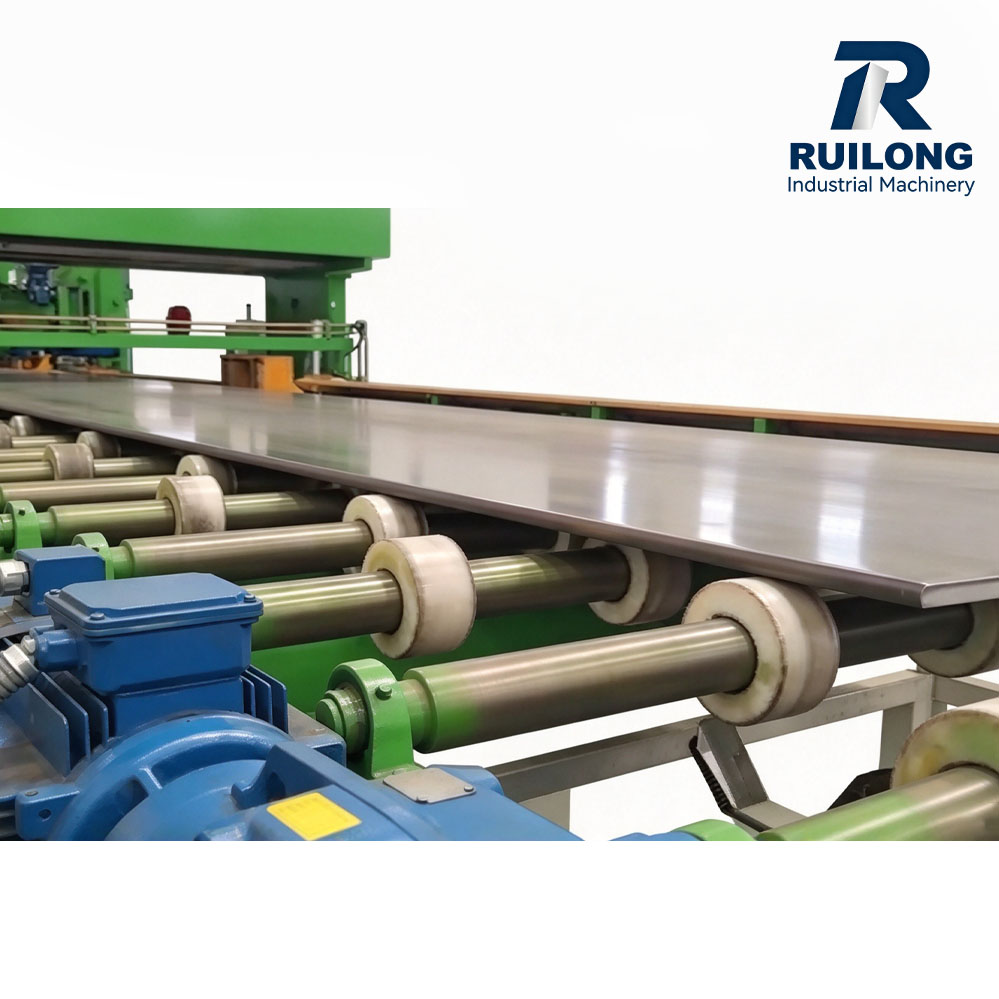
1. The 30-Sheet Protocol — What Is Measured and What Passes
Four dimensions carry the test: length, diagonal, burr and flatness, each with a tolerance fixed in the contract, not negotiated on the floor. The batch is produced at the thickest, widest, highest-strength coil in the acceptance matrix — the duty point the line will actually live at — and the sheets are numbered in production order so drift is visible:
|
Dimension |
Method |
Typical pass band |
|
Length |
Calibrated tape or laser gauge, every sheet |
Per contract, e.g. ±1.0 mm |
|
Diagonal (squareness) |
Two-diagonal difference |
≤1.5 mm per 2,000 mm diagonal |
|
Burr height |
Micrometer, both edges |
≤10% of gauge |
|
Flatness |
Straightedge + feeler, mm/m |
Per gauge class |
The statistical logic of the thirty-sheet run matters more than any single sheet: sheet 3 and sheet 30 both inside tolerance is the real pass condition, because drift — a loosening guide, a warming knife, a wandering intermesh — shows up as a trend across the run, not as one bad sheet. The protocol also fixes two hold points: no adjustments between sheet 1 and 30 except contract-stated settings, and a re-run from zero after any mid-test correction, which removes the "tune between sheets" theater that turns demonstrations into passes. The tolerance bands themselves come from the chart in our tolerance article, so the contract and the test speak the same numbers.
The run sheet stays deliberately boring. Every sheet is stamped with its number, every measurement goes into the log in production order, and the log itself is a contract deliverable — because a pass without a record cannot be defended later, and a fail caught at the builder's plant costs an afternoon while the same fail caught at your site costs weeks. Ruilong supplies the log format with the protocol sheet, pre-filled with the contracted bands, so both sides sign the same paper at both stages.
✅ Bottom line: Thirty sheets, four dimensions, no mid-test tuning — a pass you can sign is a trend, not a snapshot.
2. FAT vs SAT — Same Protocol, Different Risks
The protocol is identical; what changes is which failure class each stage can catch. FAT, at the builder's plant, catches machine faults: drive accuracy, shear cycle, leveler settings, control stability — with the builder's coil, power and crew ten steps from the workshop. SAT, on your floor, catches everything FAT cannot see: your coil's character, your civil works, your power quality, your crew's first month of operation. Skipping FAT to "test it all on site" sounds efficient and costs months — a machine fault found at SAT means the builder's engineer flies back, the line sits, and production slips while both sides argue about whose coil was wrong.
The division of blame stays honest when both stages are documented identically: the same sheet, signed at FAT, becomes the baseline at SAT, and any dimension that passed at FAT but fails at SAT is by definition a site variable — coil, power, foundation — which is exactly the split our installation-timeline article prices into the schedule. Crew training belongs at SAT too, deliberately: the acceptance run is the crew's first supervised production, and a protocol they watched once at FAT is a protocol they can execute once at SAT. Ruilong ships the FAT report with the machine, and the SAT run opens by reproducing the FAT numbers on the buyer's coil; where they diverge, the cause is usually the incoming coil's camber or crown, which is an incoming-material conversation, not a machine one — the boundary our telescoped-coil article draws in detail. The 30-sheet discipline is short enough for a day's run and long enough to catch what ten sheets hide, which is why it is the standard at both stages.
✅ Bottom line: FAT catches machine faults, SAT catches site faults — run the identical thirty-sheet protocol at both, or every disagreement becomes unfalsifiable.
FAQ
Q: Why 30 consecutive sheets and not a smaller demonstration batch? A: Because drift is the enemy — a loosening guide or warming knife passes a ten-sheet demo and fails a thirty-sheet run; the 30 consecutive sheet acceptance test flatness rule is sized to expose trends while staying cheap enough to repeat after any correction.
Q: Whose coil is used for the factory acceptance test for cut to length line work? A: The builder's, at the contracted duty point — your coil character is tested at SAT; asking the buyer to ship coil for FAT adds weeks and tests logistics, not the machine.
Q: What belongs on a site acceptance test checklist cut to length line crews actually sign? A: The same four dimensions plus power and safety sign-offs, run on the buyer's coil at two duty points — Ruilong supplies the combined FAT/SAT sheet so both stages produce comparable, signed numbers.
Put the Protocol in the Contract, Not the Corridor
Send Ruilong your duty point and tolerance bands, and the engineering team will return the FAT/SAT protocol sheet — 30 sheets, four dimensions, two hold points — ready to attach to the contract from our China factory: as the manufacturer behind Tai'an Ruilong Machinery Co., Ltd., we quote supplier/OEM-direct with the acceptance bands in writing, free of charge and without obligation. The custom protocol is signed before the deposit, not argued after.