
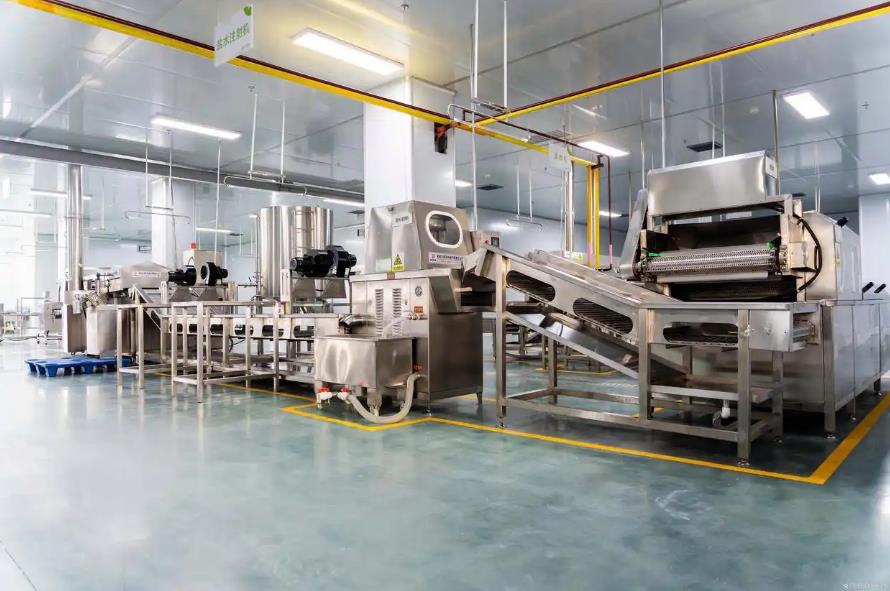
For central kitchens serving schools and catering institutions, the core principle of equipment layout for primary processing and cutting is separate processing lines by food type, with strict segregation of raw and cooked food. Generally, two independent workflow lines are set up: one for vegetables and the other for meat and aquatic products. Equipment is arranged around the sequence of washing — peeling/portioning — cutting — draining/temporary storage.
Equipment for Primary Processing and Cutting of Vegetables
Vegetable processing features large batch volumes, so equipment prioritizes mass washing, peeling and versatile cutting.
Washing equipment: Bubble washers or vortex washers are the standard foundation. They separate sediment and impurities through tumbling air bubbles, and are often linked with elevators and spray devices to form a continuous washing line. For root vegetables, roller brush washing and peeling machines are adopted to complete cleaning and abrasive peeling simultaneously.
Cutting equipment: The core unit is a multi-purpose vegetable cutter. By replacing cutting discs, it can perform slicing, shredding, dicing and segmenting, covering most processing needs for leafy greens and root vegetables. Some production lines are additionally equipped with dedicated dicers or heavy-duty vegetable cutters to boost efficiency for specific processes.
Auxiliary equipment: Centrifugal dehydrators or vibration air dryers are used to remove excess surface moisture from cut vegetables for subsequent cooking or packaging. Stainless steel worktables, draining racks and sorting conveyor belts are also standard for manual sorting and temporary storage.
Equipment for Primary Processing and Cutting of Meat and Aquatic Products
Meat processing places high emphasis on safety protection and targeted portioning, and its equipment must be fully isolated from the vegetable line.
Portioning and cutting equipment: Configurations vary based on processing depth. Bone saws are commonly used for cutting bone-in meat or frozen meat; meat grinders for minced meat production; meat slicers/shredders/dicers to turn large meat blocks into standardized semi-finished products. Large-scale central kitchens may deploy visual-guided precision portioning machines, which cut ingredients to preset weights and dimensions to reduce waste.
Washing and auxiliary equipment: Meat is cleaned in dedicated sinks with hot and cold water supply. Worktables, knives and cutting boards are marked with color codes to prevent cross-contamination with the vegetable line.
Key Selection Guidelines
Equipment capacity shall match the catering scale during configuration. For example, in a school central kitchen serving thousands of diners, a typical multi-purpose vegetable cutter delivers an output of 300–800 kg/h, while meat grinders run at 200–500 kg/h. Preference should be given to "knife-free" equipment fitted with safety guards and concealed cutting blades to reduce the risk of operator injury.