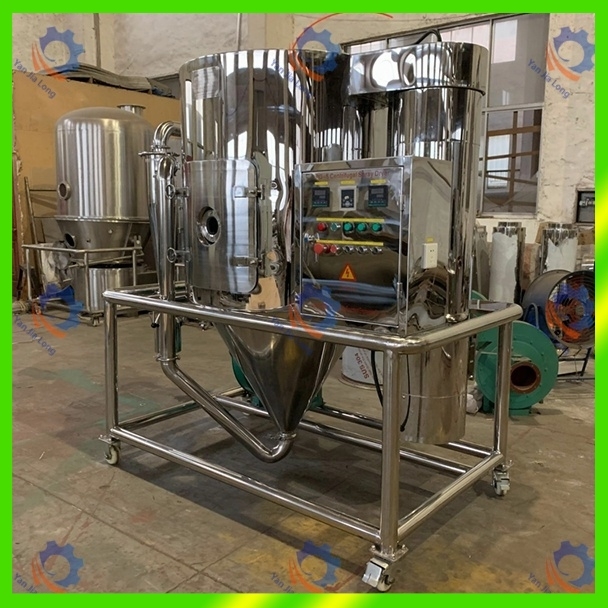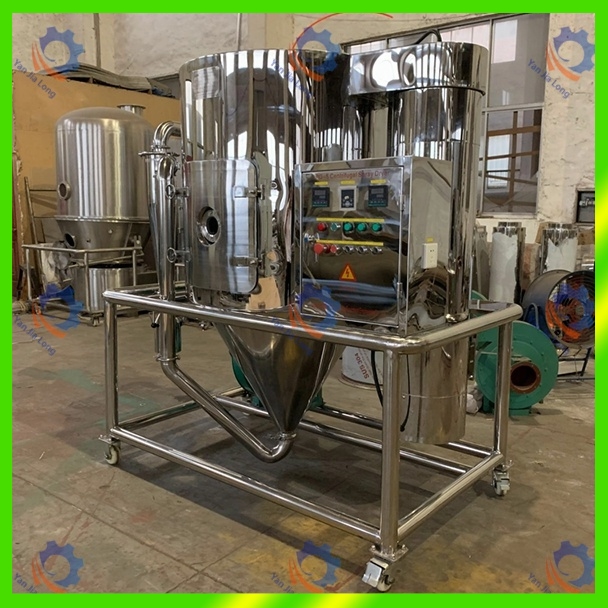
In the industrial process of converting liquid materials into powder, the long-term operational stability of equipment often takes precedence over peak production capacity. The widespread adoption of the Robust LPG Centrifugal Spray Dryer Design in fields such as chemical, food, and ceramic materials is primarily due to its robust alignment between structural logic and process requirements.
From the perspective of the hot air distribution system, such equipment typically adopts a top air inlet and spiral flow guidance structure. This design is not solely for uniform air distribution but primarily to mitigate the risks of localized overheating at the tower wall and material adhesion. When hot air enters the drying chamber tangentially, the resulting rotational airflow field can maintain a relatively consistent motion trajectory with the droplet stream generated by the centrifugal atomizing disk, thereby extending the effective drying distance and preventing wet powder from prematurely contacting the wall. For heat-sensitive or high-sugar content materials, this detail directly determines the yield rate and cleaning cycle.
The atomizer is the core component of the Continuous LPG Spray Drying System, typically operating at rotational speeds ranging from 10,000 to 20,000 revolutions per minute. The focus of robust design lies not in pursuing higher speeds but in the rigidity of the bearing support system, dynamic balance precision, and the reliability of the sealing structure. During actual operation, minor vibrations of the atomizing disc are amplified into deviations in particle size distribution, subsequently affecting subsequent dust collection efficiency and product flowability. Therefore, the machining tolerances of the main shaft assembly, lubrication methods, and design margins of the cooling circuit are key indicators to determine whether the equipment is truly "durable.".
In terms of the tower structure, the taper ratio, inner wall smoothness, and weld seam treatment methods are equally crucial. An excessively steep conical bottom facilitates material discharge but may compress the drying space, while an overly gentle slope increases the risk of powder accumulation. Appropriate geometric parameters must be verified based on the specific material's bulk density and angle of repose, rather than relying on generic templates. Additionally, the inner wall polishing grade directly impacts residue levels, particularly in scenarios involving multi-product production switching, where the difficulty of cleaning validation often hinges on these seemingly basic manufacturing details.
The design philosophy of the control system also embodies a robust approach. Rather than piling up complex algorithms, it prioritizes the accurate sensing and timely response of key parameters such as temperature, airflow, and feed rate. A PLC program with clear logic and moderate redundancy, coupled with essential safety interlocks, far better ensures the safety of continuous production than flashy human-machine interfaces.
Ultimately, the "robustness" of the Laboratory Scale Centrifugal Spray Dryer is not an abstract adjective but is reflected in the engineering restraint behind every structural decision: avoiding blind pursuit of novelty, omitting no verification, ensuring the equipment can withstand the test of time under real working conditions.