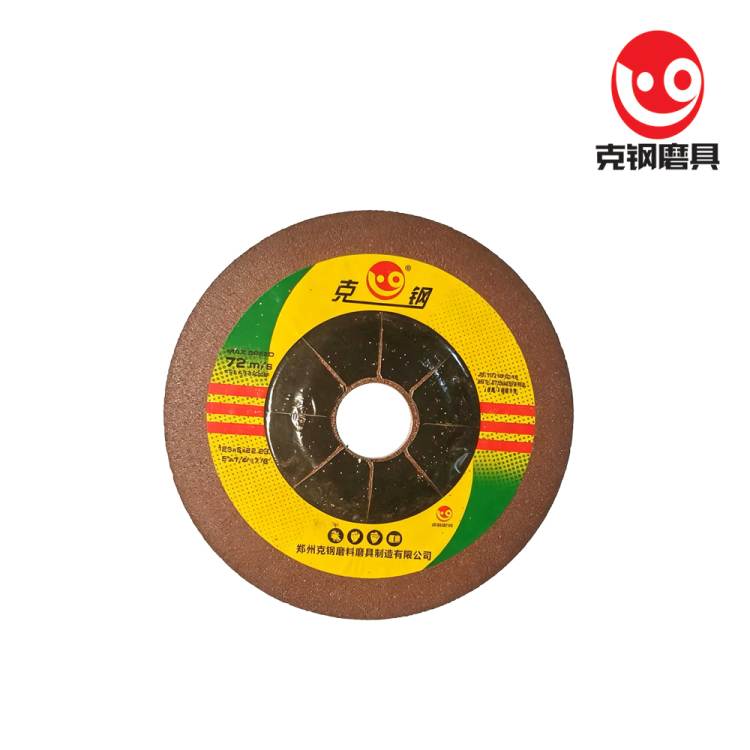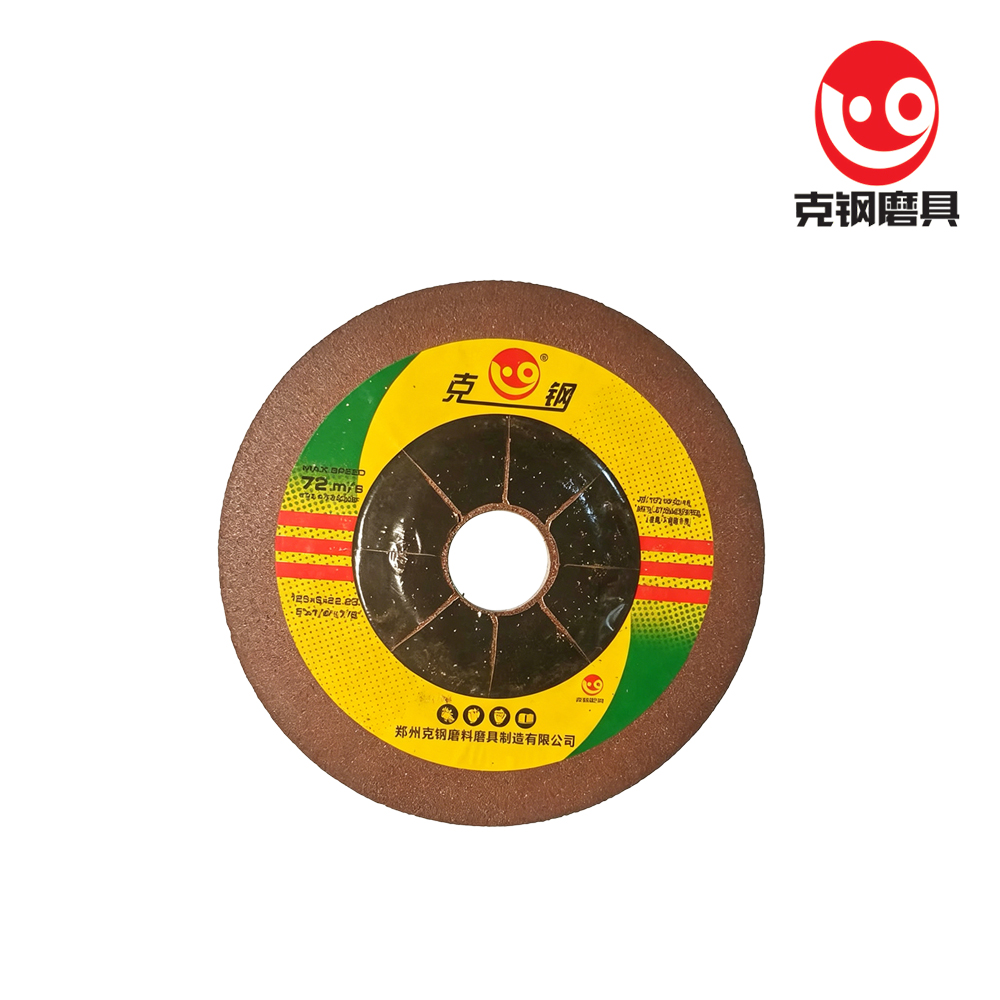
Stainless does not rust because of the grain in the wheel — it rusts because of the fillers the wheel leaves in the cut. A disc rated for stainless holds iron, sulfur and chlorine below 0.1% combined (Fe + S + Cl < 0.1%), which is a chemistry specification the manufacturer sets, not a safety certification anyone audits at the border.
That distinction causes most of the arguments in this category. A buyer orders "INOX" discs, receives a product labelled for stainless, cuts 304 tube, and finds orange freckles along the cut edge three days later in a humid warehouse. Nothing failed mechanically. The disc was simply a carbon-steel formulation wearing a stainless label. The same trap exists on the reinforced side: a Fiber reinforced resin cut-off disc can pass every dimensional and burst check and still be the wrong product for 316.
Here is what actually separates the two, and how to prove which one you were sold.
1. Why Does a General-Purpose Resin abrasive wheel Contaminate Stainless?
Because the fillers that make a general-purpose bond cut well are built from exactly the elements stainless cannot tolerate. Active fillers — the additives that decompose under cutting heat to lubricate the cut and prevent glazing — include pyrite (FeS₂), which releases sulfur as it breaks down, lithopone (ZnS + BaSO₄), which decomposes into sulfur compounds, and lead chloride in some older systems. Iron-bearing fillers appear in the bond and in the grain carrier.
Stainless protects itself with a chromium-oxide passive film a few nanometres thick. That film heals instantly in air — until free iron particles sit on top of it. Then the iron rusts first, the rust holds moisture against the surface, and the pitting starts underneath. Sulfur attacks the film directly and drives pitting; chlorine drives both pitting and stress-corrosion cracking, which is the failure mode that matters on 304 and 316.
| Contaminant | Limit | Failure it causes |
| Iron (Fe) | < 0.1% combined | Free iron embeds in the surface and rusts as orange freckles |
| Sulfur (S) | < 0.1% combined | Attacks the passive film, promotes pitting |
| Chlorine (Cl) | < 0.1% combined | Pitting and stress-corrosion cracking on austenitic grades |
The second path is cross-contamination, and it is entirely an operator problem. A disc that has touched carbon steel carries ferrous particles and presses them into stainless on the next job. The trade rule is one-directional: a stainless disc may be demoted to carbon steel, but a disc that has cut carbon steel never touches stainless again. Colour-coded blotters and a locked cabinet for INOX stock do more for yield than any specification sheet.
A quick field check any buyer can run: hold a magnet to the abrasive face. A genuine INOX disc shows almost no attraction away from the steel ring. Strong attraction means iron in the mix. Kegang runs that check on every stainless batch before packing.
✅ Bottom line: The Fe + S + Cl limit is a formulation decision, not a marketing word — if the technical data sheet has no figure, treat the disc as carbon steel.
2. How Do You Specify and Verify a Stainless Grade?
Specify the grain, the bond grade and the chemistry together, then verify with a cut test — the label alone proves nothing. White aluminium oxide is the default for stainless: it is naturally low in iron, friable, and breaks down fast enough to keep the cut cool. Zirconia alumina is the upgrade for continuous production work where wheel life matters more than the coolest possible cut. Fine grit, 46 to 60, removes smaller chips, generates less friction and leaves a burr that needs little dressing.
Bond hardness runs the opposite way from what buyers expect. A softer bond releases dull grain sooner, exposing fresh cutting edges, which keeps the cut cool on a work-hardening alloy. Hard bonds glaze on stainless and then the operator leans harder, which is where heat tint and warping begin.
- Thickness: 1.0 mm for sheet to 3 mm and thin-wall tube; 1.2 mm for general pipe; 1.6 mm where the operator cannot hold the tool square.
- Profile: T41 flat for straight bench cuts; T42 where guard clearance is tight.
- Chemistry: Fe + S + Cl below 0.1%, stated on the technical data sheet, not just the carton.
- Traceability: batch code on the blotter so a rust complaint can be traced to a resin lot.
- Documentation: grain supplier certificate and a spin-test record at 1.5× rated speed.
Verification is physical. Cut a sample of 304, leave it in a humid chamber or a damp workshop for 72 hours, and look at the cut edge. That test costs almost nothing and settles supplier claims faster than any certificate. Ask for it before a container, not after.
Kegang formulates stainless grades on white aluminium oxide with a documented Fe + S + Cl figure per batch, and supplies a cut sample from the production run so the buyer can run that humidity test independently.
✅ Bottom line: Cool cut, soft bond, fine grit, documented chemistry — and a 72-hour humidity test on a real sample before the order ships.
FAQ
Q: Can I just clean a carbon-steel disc and use it on stainless? No. The contamination is inside the bond, not on the surface, and cleaning removes neither the iron fillers nor the sulfur compounds. A used disc also carries embedded ferrous particles from previous work. Keep separate stock, separate storage and separate colour coding — Kegang prints the grade on the blotter so a shop-floor mix-up is visible at a glance.
Q: Does a Resin cutting disc marked "for metal" work on 304 if the finish does not matter? It will cut, and the part may pass inspection if it is painted, buried or welded over. Anywhere the surface stays visible and wet — handrails, food equipment, architectural panels, marine fittings — after-rust is a rejection. The cost of one rejected assembly exceeds the price difference across a full box of INOX discs.
Q: What grit should I use for stainless tube? A46 to A60 in a soft-to-medium bond covers most tube work. Go finer on thin wall where heat tint is a rejection criterion, and coarser only when the cut edge will be machined anyway. Grit is a heat-control decision on stainless more than a finish decision.
Get the Chemistry, Not the Adjective
Send Kegang your grade, thickness and application, and we will return the Fe + S + Cl figure, the grain specification and a production sample for your own humidity test. For distributors building an INOX line, Zhengzhou Kegang Abrasives Manufacturing Co., Ltd. offers OEM and ODM programmes covering formulation, blotter print, colour coding and export packaging, with wholesale and bulk terms from a plant that has run reinforced press lines since 1991.
Kegang produces more than 10,000 tons a year across 50-plus automated lines and three PLC-controlled tunnel kilns in Zhengzhou, under ISO 9001:2008. Email [email protected] or call +86 13938462431.
Mobile: +86 13938462431
Email: [email protected]
Website: www.kegangabrasive.com