
1. High-Strength Leveling: Why S550GD Is Not S250GD With a Different Label
Leveling overwrites coil curvature by bending past yield, and how far past is set by the grade — a physics the brochure hides. Elastic springback after a bend is proportional to yield strength divided by Young's modulus: S250GD (σy ≥ 250 MPa) recovers roughly half as much as S550GD (σy ≥ 550 MPa) at the same gauge. Practically, that means the high-strength grade needs about double the intermesh depth to force full plastic penetration, and about double the motor torque, because the bending moment at the roll face scales with σy·t²/4.
|
Grade |
Min yield strength |
Relative leveling force (same gauge) |
Penetration window at 3 mm |
Note |
|
S250GD |
250 MPa |
1.0 |
Comfortable margin |
General rails, thin gauge |
|
S350GD |
350 MPa |
≈1.4 |
Moderate |
Standard mounting rail duty |
|
S550GD |
550 MPa |
≈2.2 |
Narrow — set per coil |
Tracker rails, thick gauge; watch springback between passes |
The narrow window on S550GD is where solar lines earn their reputation: too shallow and the coil set reappears downstream as rails that refuse to sit square; too deep and the sheet work-hardens visibly, which matters when the customer bends flanges along the rail. The line answer is a leveler with fine per-pass gap adjustment and a settings table per grade-thickness pair — not one penetration value "for high-strength".
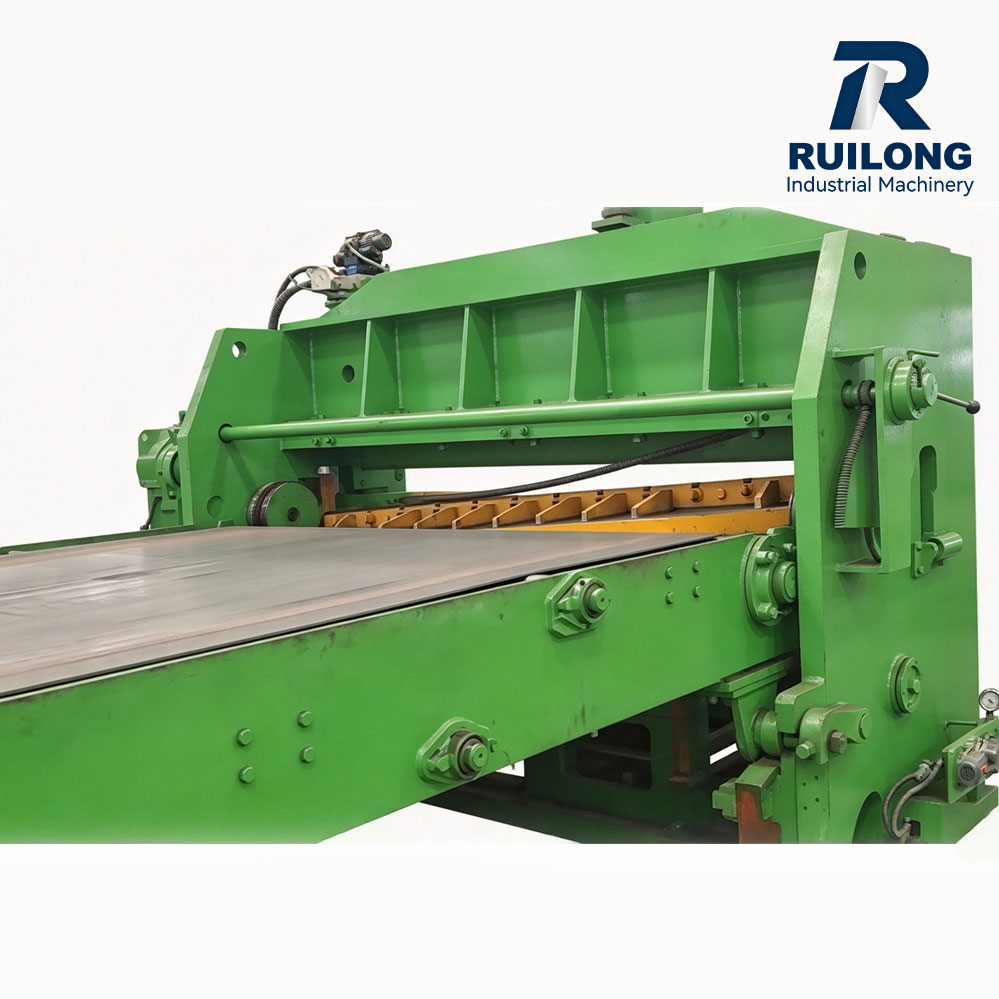
Ruilong publishes the settings table format with its cut to length line for solar mounting structure steel scope and pre-loads it at commissioning with the customer's actual grade list, because the difference between S350GD and S550GD settings is the difference between rails that pass inspection and a batch the installer rejects on site.
✅ Bottom line: Springback scales with yield strength — S550GD needs about twice the intermesh and force of S250GD, with a penetration window set per grade-thickness pair.
2. Surviving the Zinc, and Feeding the Torque Tube Mill
Zinc has its own physics: it is soft, and it is the product — so every contact and every bend either protects it or wears it. Leveling bends that pass cleanly on bare steel can pick up or crack zinc when the roll surface is wrong. The discipline on a galvanized line: smooth PU or chrome-plated contact rolls, no sharp edges at guides, and bend strains per leveling pass kept inside what the coating tolerates — cracking appears first on heavy hot-dip coatings above Z600, which is exactly what tracker specs ask for.
The tracker product adds a length-and-width story. Torque tubes are formed from slit strip — typically 150–300 mm wide, 2.0–3.0 mm thick, ZM or Z275+ — and the forming mill downstream wants it cut to length with tighter discipline than general construction steel:
|
Product |
Gauge range |
Width tolerance |
Length tolerance |
Coating |
Feeds |
|
Mounting rail blanks |
1.5–3.0 mm |
±1.0 mm |
±1.5 mm |
Z275 / ZM310 |
Press or roll-former |
|
Tracker torque tube strip |
2.0–3.0 mm |
±0.3 mm |
±1.0 mm |
ZM / Z600+ |
Tube-forming mill |
|
Fastener and clamp strip |
2.0–4.0 mm |
±0.3 mm |
±1.0 mm |
Z275 / ZM |
Punching line |
The ±0.3 mm width tolerance on cut to length line for tracker torque tube strip output is a tube-mill requirement, not a construction habit: tube forming computes the final tube diameter from strip width, and a drifting width becomes an out-of-round tube or a welding gap at the mill. That tolerance is held the same way the drum-body article describes — guided side-trimmer, measured per bundle — with the coating protection on top, and Ruilong states both disciplines explicitly in the line specification rather than assuming the crew will bridge them.
✅ Bottom line: Protect the zinc with smooth contact and graded bend strain, and hold strip width to ±0.3 mm where a tube mill is downstream — both are line design decisions, not operator diligence.
FAQ
Q: Can one line run S550GD at 3mm and thin CR for clamps? A: Yes, if the leveler is specified for the top grade and the settings table covers both ends — the mistake is sizing the motor for the average grade and discovering at commissioning that S550GD bogs down between passes.
Q: Does leveling crack the zinc coating on high-strength coil? A: Not at correct settings — bend strain per pass stays well inside what zinc tolerates on Z275; cracking risk concentrates on heavy coatings above Z600 run with excessive intermesh, which is why Ruilong grades the penetration table by coating class as well as by gauge and grade.
Q: What makes a genuine galvanized high strength steel coil processing line different from a carbon line? A: Three line-level choices: contact surfaces that will not pick up zinc, a leveler sized for the top grade's springback, and width holding to tube-mill tolerance where tracker strip is in scope — a carbon-steel line relabeled for galvanized fails the second and third quietly.
Get the Grade Table for Your Solar Program
Send Ruilong your grade list, coating classes and product mix, and the engineering team will return the leveling settings table and line sizing in a custom quote from our China factory: as the manufacturer behind Tai'an Ruilong Machinery Co., Ltd., we quote supplier/OEM-direct with the scope itemized, free of charge and without obligation.